
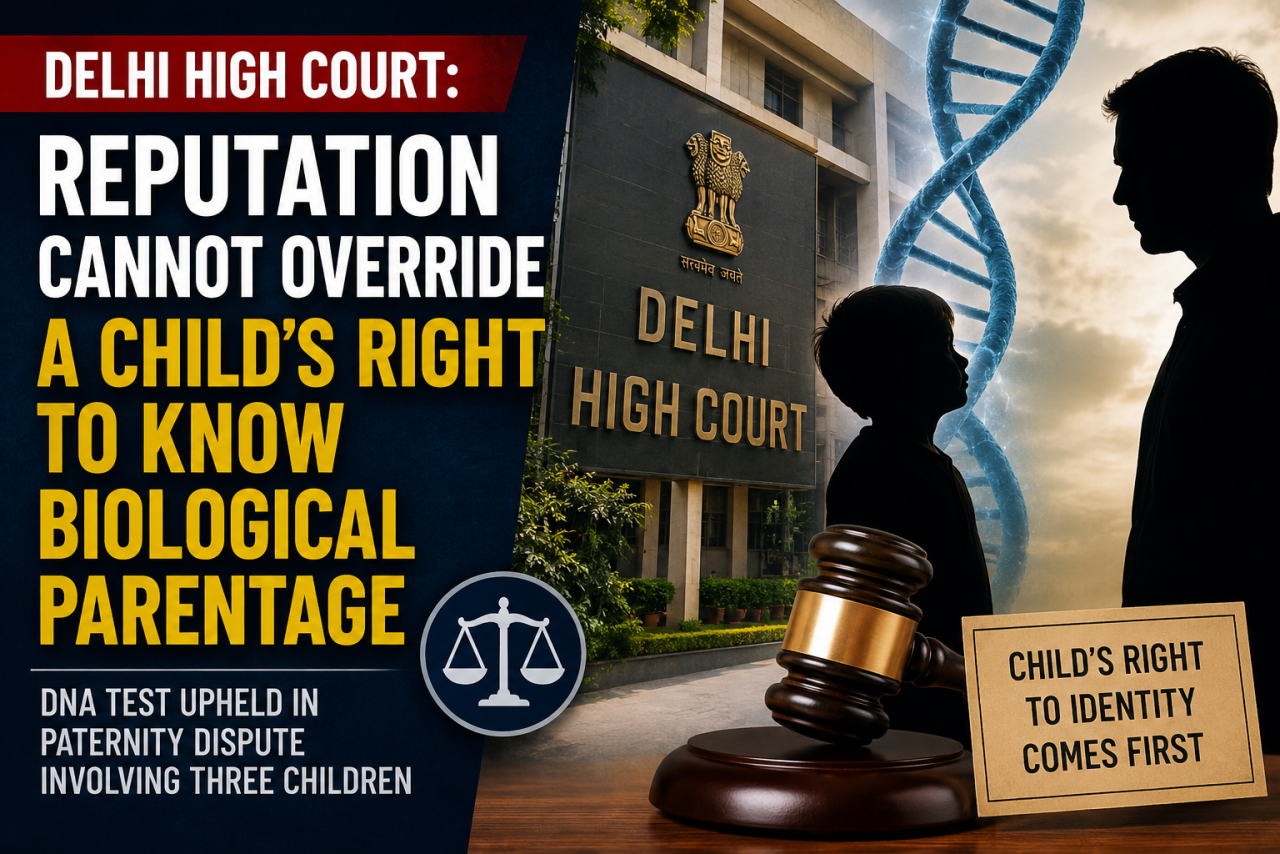
Justice Swarna Kanta Sharma upholds trial court order directing DNA test in a paternity dispute involving three children, holding that a person's present reputation cannot erase the facts of his past.
The Delhi High Court has ruled that a child's right to establish paternity takes precedence over an adult's concern for social standing, upholding a trial court's order directing DNA testing in a long-running paternity dispute. The court held that concerns over reputation or embarrassment cannot outweigh a child's fundamental right to know their biological parentage and secure the legal rights flowing from that identity.
A bench of Justice Swarna Kanta Sharma delivered the judgment on Friday, dismissing a man's challenge to a March 2024 trial court order directing DNA testing of him and three children to determine whether he is their biological father. The petitioner argued that the test would tarnish his reputation and subject him to social embarrassment because he already has a legally wedded wife.
The dispute dates back nearly four decades. According to the case record, the man married his first wife in Bihar in February 1986. He was later alleged to have married another woman in Delhi in May 1991, with whom he lived and had three children. The woman claimed that the man abandoned her and the children in 2005 and stopped providing maintenance. She subsequently approached the family court seeking maintenance for herself and the children, making the issue of paternity central to the proceedings. The man denied both the marriage and the paternity claims, prompting the trial court to order a DNA test.
In its 32-page judgment, the High Court held that the constitutional guarantee of personal liberty cannot be interpreted to permit an individual to erase inconvenient facts from the past. The bench observed that establishing a child's biological parentage is integral to the child's identity and to the legal entitlements that stem from it, including the right to maintenance. It further held that adults cannot evade the consequences of their personal choices by shifting the burden onto children born from those relationships.
Rejecting the petitioner's plea that the DNA test would cause him social embarrassment, the court observed that an adult's discomfort cannot override a child's right to know their biological identity. It emphasised that allowing reputation to prevail over truth would amount to protecting an adult's convenience at the expense of a child's dignity and legal rights.
The bench also found that the trial court had exercised its discretion appropriately in ordering a scientific examination, noting that determining paternity was essential for adjudicating the maintenance claim. It concluded that the DNA test was both necessary and legally justified in the circumstances of the case.
The ruling clears the way for the DNA test ordered in March 2024 to proceed, potentially resolving the question of paternity and determining the maintenance claims linked to it. It also closes the petitioner's attempt to avoid scientific examination by invoking concerns over his existing marriage and social reputation.
Beyond the facts of the present case, the judgment reinforces an important legal principle in Indian family law: when paternity is genuinely in dispute and relevant to determining legal rights such as maintenance, a court-ordered DNA test cannot ordinarily be resisted on grounds of privacy, reputation, or social stigma. It underscores that a child's right to identity enjoys stronger constitutional protection than an adult's interest in concealing past relationships.
For individuals involved in contested paternity or maintenance disputes, the judgment provides greater legal clarity. It signals that courts are likely to prioritise a child's right to identity and legal recognition over an adult's reputational concerns, and that scientifically ordered evidence will generally prevail where it is necessary to establish the truth.
The Delhi High Court has ruled that a child's right to establish paternity takes precedence over an adult's concern for social standing, upholding a trial court's order directing DNA testing in a long-running paternity dispute. The court held that concerns over reputation or embarrassment cannot outweigh a child's fundamental right to know their biological parentage and secure the legal rights flowing from that identity.
A bench of Justice Swarna Kanta Sharma delivered the judgment on Friday, dismissing a man's challenge to a March 2024 trial court order directing DNA testing of him and three children to determine whether he is their biological father. The petitioner argued that the test would tarnish his reputation and subject him to social embarrassment because he already has a legally wedded wife.
The dispute dates back nearly four decades. According to the case record, the man married his first wife in Bihar in February 1986. He was later alleged to have married another woman in Delhi in May 1991, with whom he lived and had three children. The woman claimed that the man abandoned her and the children in 2005 and stopped providing maintenance. She subsequently approached the family court seeking maintenance for herself and the children, making the issue of paternity central to the proceedings. The man denied both the marriage and the paternity claims, prompting the trial court to order a DNA test.
In its 32-page judgment, the High Court held that the constitutional guarantee of personal liberty cannot be interpreted to permit an individual to erase inconvenient facts from the past. The bench observed that establishing a child's biological parentage is integral to the child's identity and to the legal entitlements that stem from it, including the right to maintenance. It further held that adults cannot evade the consequences of their personal choices by shifting the burden onto children born from those relationships.
Rejecting the petitioner's plea that the DNA test would cause him social embarrassment, the court observed that an adult's discomfort cannot override a child's right to know their biological identity. It emphasised that allowing reputation to prevail over truth would amount to protecting an adult's convenience at the expense of a child's dignity and legal rights.
The bench also found that the trial court had exercised its discretion appropriately in ordering a scientific examination, noting that determining paternity was essential for adjudicating the maintenance claim. It concluded that the DNA test was both necessary and legally justified in the circumstances of the case.
The ruling clears the way for the DNA test ordered in March 2024 to proceed, potentially resolving the question of paternity and determining the maintenance claims linked to it. It also closes the petitioner's attempt to avoid scientific examination by invoking concerns over his existing marriage and social reputation.
Beyond the facts of the present case, the judgment reinforces an important legal principle in Indian family law: when paternity is genuinely in dispute and relevant to determining legal rights such as maintenance, a court-ordered DNA test cannot ordinarily be resisted on grounds of privacy, reputation, or social stigma. It underscores that a child's right to identity enjoys stronger constitutional protection than an adult's interest in concealing past relationships.
For individuals involved in contested paternity or maintenance disputes, the judgment provides greater legal clarity. It signals that courts are likely to prioritise a child's right to identity and legal recognition over an adult's reputational concerns, and that scientifically ordered evidence will generally prevail where it is necessary to establish the truth.


























Leave a Comment