
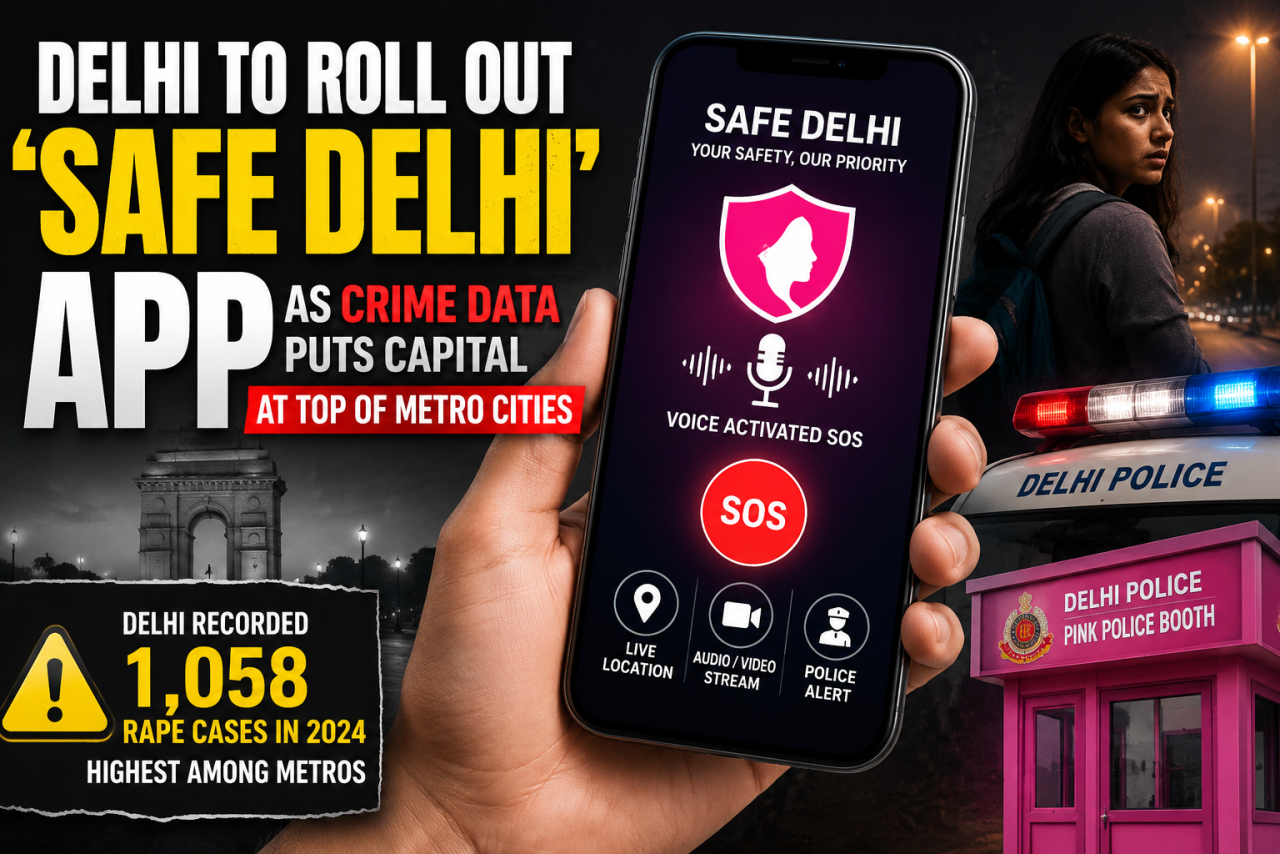
Can technology make Delhi safer for women? The government's upcoming Safe Delhi app promises instant police alerts, but whether it delivers in real emergencies remains the real test.
The Delhi government is preparing to launch a mobile safety application called "Safe Delhi," designed to give women a direct line to police during emergencies. Senior officials confirmed on Friday that a trial version of the app has already been shown to Chief Minister Rekha Gupta, who also oversees the women and child development portfolio in the capital.
The move comes against a backdrop of troubling numbers. The most recent National Crime Records Bureau data places Delhi at the top among India's major metropolitan cities for crimes against women. The city recorded 1,058 rape cases in 2024, the highest figure among metros, with a comparable number of attempted assault cases also reported during the same period.
According to officials familiar with the project, the app will combine GPS tracking with a voice-activated panic trigger, meaning a user under threat will not necessarily need to unlock her phone or type anything to call for help. A spoken cue is expected to be enough to set off an alert. Once triggered, the system is designed to stream live audio and video directly to a monitoring room staffed by the Delhi Police, allowing officers to assess a situation in real time rather than relying solely on a verbal account after the fact.
This is not the city's first attempt at a tech-driven safety initiative. The Delhi Police already operates the Himmat Plus app and a network of pink police booths across the city, both intended to give women faster access to assistance in high-risk areas. Officials say Safe Delhi is meant to complement these existing measures rather than replace them, with an emphasis on improving response times during incidents near construction sites, isolated campus areas, poorly lit roads, and other locations where women have reported feeling unsafe.
A pilot run of the application has already taken place in Delhi's central police district, officials said. Based on the outcome of the trial, a proposal for a citywide rollout is expected to be placed before the cabinet for approval in the coming weeks, although no official launch date has been announced.
One official, speaking on condition of anonymity, said the app's significance lies in improving coordination rather than introducing entirely new technology. "The system's capabilities include voice-enabled activation, real-time audio-video feed, and location streaming directly to the police control room, enabling law enforcement to respond effectively to critical incidents," the official said. The feature is expected to be particularly useful for women commuting through vulnerable areas on foot, by auto-rickshaw, or on public transport during late hours.
Delhi's crime statistics have remained under scrutiny for years, with experts noting that higher reporting figures may reflect both an increase in incidents and improved willingness among survivors to report crimes. Regardless of the reason, the scale of the challenge has prompted successive governments to invest in technology-based interventions while broader structural measures—such as better street lighting, increased police presence, and faster disposal of criminal cases—continue to evolve.
Whether Safe Delhi succeeds in reducing emergency response times will become clear only after its wider rollout. Similar safety applications introduced in other Indian cities have produced mixed results, often facing challenges such as low public awareness, poor mobile connectivity in remote locations, and limited capacity within police control rooms to respond promptly to distress alerts. Experts believe Safe Delhi's effectiveness will depend not only on its technological features but also on sustained public awareness campaigns and adequate police staffing.
For now, the project remains in its pilot phase. Its long-term success is likely to be judged less by the sophistication of its technology and more by whether it enables police to reach women in distress quickly when they need assistance the most.
The Delhi government is preparing to launch a mobile safety application called "Safe Delhi," designed to give women a direct line to police during emergencies. Senior officials confirmed on Friday that a trial version of the app has already been shown to Chief Minister Rekha Gupta, who also oversees the women and child development portfolio in the capital.
The move comes against a backdrop of troubling numbers. The most recent National Crime Records Bureau data places Delhi at the top among India's major metropolitan cities for crimes against women. The city recorded 1,058 rape cases in 2024, the highest figure among metros, with a comparable number of attempted assault cases also reported during the same period.
According to officials familiar with the project, the app will combine GPS tracking with a voice-activated panic trigger, meaning a user under threat will not necessarily need to unlock her phone or type anything to call for help. A spoken cue is expected to be enough to set off an alert. Once triggered, the system is designed to stream live audio and video directly to a monitoring room staffed by the Delhi Police, allowing officers to assess a situation in real time rather than relying solely on a verbal account after the fact.
This is not the city's first attempt at a tech-driven safety initiative. The Delhi Police already operates the Himmat Plus app and a network of pink police booths across the city, both intended to give women faster access to assistance in high-risk areas. Officials say Safe Delhi is meant to complement these existing measures rather than replace them, with an emphasis on improving response times during incidents near construction sites, isolated campus areas, poorly lit roads, and other locations where women have reported feeling unsafe.
A pilot run of the application has already taken place in Delhi's central police district, officials said. Based on the outcome of the trial, a proposal for a citywide rollout is expected to be placed before the cabinet for approval in the coming weeks, although no official launch date has been announced.
One official, speaking on condition of anonymity, said the app's significance lies in improving coordination rather than introducing entirely new technology. "The system's capabilities include voice-enabled activation, real-time audio-video feed, and location streaming directly to the police control room, enabling law enforcement to respond effectively to critical incidents," the official said. The feature is expected to be particularly useful for women commuting through vulnerable areas on foot, by auto-rickshaw, or on public transport during late hours.
Delhi's crime statistics have remained under scrutiny for years, with experts noting that higher reporting figures may reflect both an increase in incidents and improved willingness among survivors to report crimes. Regardless of the reason, the scale of the challenge has prompted successive governments to invest in technology-based interventions while broader structural measures—such as better street lighting, increased police presence, and faster disposal of criminal cases—continue to evolve.
Whether Safe Delhi succeeds in reducing emergency response times will become clear only after its wider rollout. Similar safety applications introduced in other Indian cities have produced mixed results, often facing challenges such as low public awareness, poor mobile connectivity in remote locations, and limited capacity within police control rooms to respond promptly to distress alerts. Experts believe Safe Delhi's effectiveness will depend not only on its technological features but also on sustained public awareness campaigns and adequate police staffing.
For now, the project remains in its pilot phase. Its long-term success is likely to be judged less by the sophistication of its technology and more by whether it enables police to reach women in distress quickly when they need assistance the most.



























Leave a Comment