
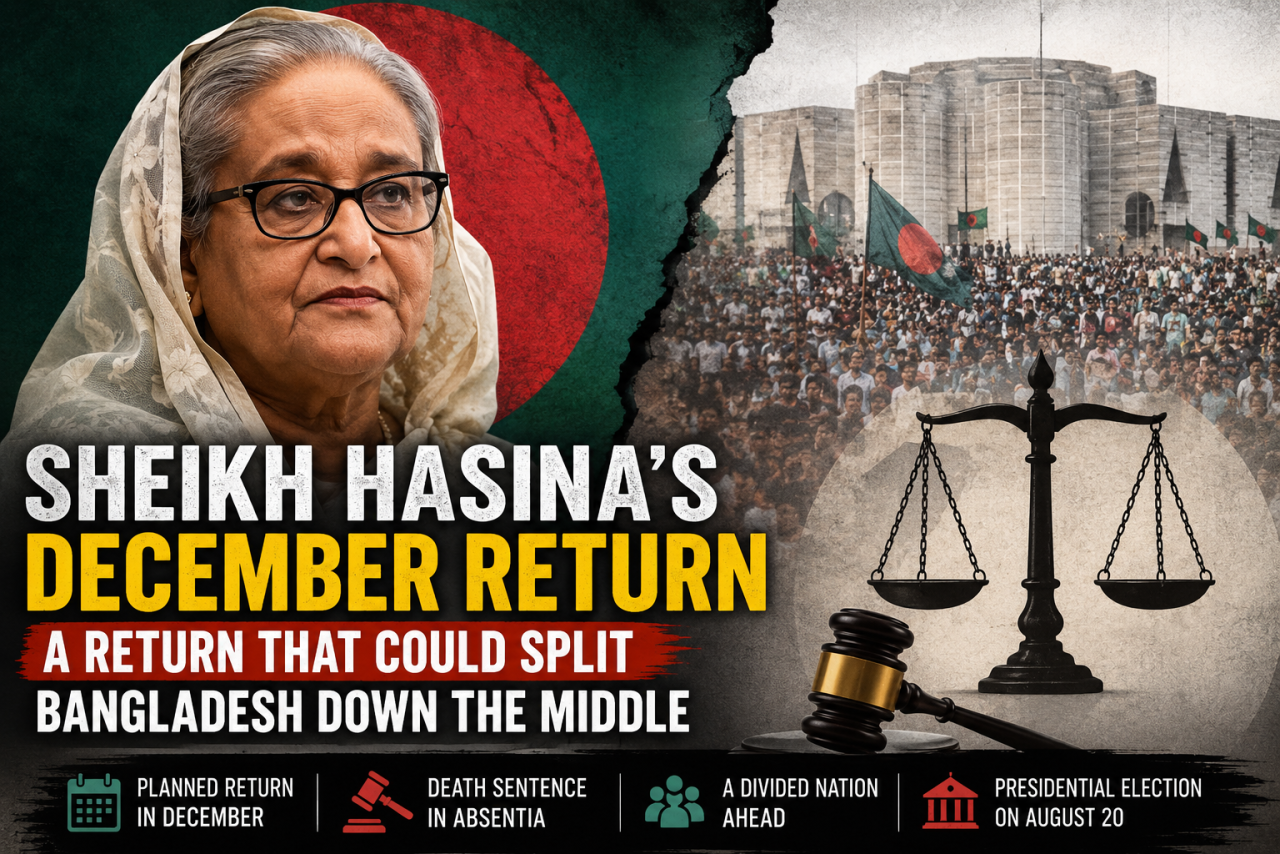
Sheikh Hasina’s planned December return could become Bangladesh’s biggest political test since her ouster, forcing the country to confront accountability, reconciliation and the future of the Awami League.
Sheikh Hasina has finally put a date on her return.
Nearly two years after fleeing Dhaka in the face of a mass uprising, Bangladesh's former prime minister has announced that she plans to return home in December. Speaking virtually from New Delhi in her first major news conference since her ouster, Hasina made it clear that fear of arrest, imprisonment or even death would not stop her from going back to Bangladesh.
Her announcement has reopened one of Bangladesh's deepest political wounds. It has also forced the country to confront a question that has no easy answer: what happens when a former prime minister sentenced to death returns to the country where she once exercised enormous political power?
Hasina has lived in India since August 5, 2024, when student-led protests brought an end to her 15-year rule. In November 2025, Bangladesh's International Crimes Tribunal convicted her in absentia of crimes against humanity linked to the violent suppression of the 2024 uprising and sentenced her to death. Human rights organisations have raised concerns about the fairness of the proceedings, while Hasina has rejected the verdict and described the cases against her as politically motivated.
Her latest message was not simply a declaration of personal courage. It was also political.
Hasina called for reconciliation, constitutional development, secularism and stability. She argued that Bangladesh must return to what she described as the right path of democratic and economic development. She also called for the release of imprisoned Awami League leaders and workers, making it clear that her proposed return is not merely about reclaiming her personal place in Bangladesh. It is also about the political future of the Awami League.
That is precisely what makes her announcement so consequential.
The reaction from Dhaka was immediate and hostile. The Bangladesh government condemned her virtual appearance from India, arguing that it insulted those who died during the 2024 uprising. The response reflects how little political space remains between Hasina's supporters and those who regard her government as responsible for the violence that accompanied its final days.
Syed Moazzem Hossain Alal, an adviser to BNP chairman and Prime Minister Tarique Rahman, questioned why Hasina wanted to wait until December. If she is confident about facing Bangladesh's legal and political system, he argued, she should return immediately.
His challenge captures the political dilemma neatly. If Hasina returns, Bangladesh will have to decide whether it sees her primarily as a former leader returning to her people or as a convicted former ruler who must face the consequences of a judicial verdict.
The divide is likely to be particularly sharp among Hasina's supporters.
The Awami League still has a significant political legacy. During Hasina's long tenure, Bangladesh experienced substantial economic and infrastructure development, while her supporters credit her government with strengthening the country's secular character and maintaining political continuity. For many of them, her removal did not necessarily settle the country's problems. Her return could therefore become a rallying point for a political constituency that has largely been pushed out of the formal political arena.
But for Hasina's opponents, her return would represent something entirely different.
It would bring back a leader who has been convicted over the crackdown on the 2024 uprising. The Awami League's political activities have also been banned, creating a further obstacle to any attempt by Hasina to immediately re-enter mainstream politics. Her return could therefore trigger an intense confrontation between supporters demanding political rehabilitation and opponents demanding accountability.
The timing makes the situation even more complicated.
Bangladesh is scheduled to hold its presidential election on August 20, following the resignation of President Mohammed Shahabuddin on health grounds before the completion of his five-year term. The election will bring a new political figure into the country's constitutional framework just months before Hasina's proposed return.
That means Bangladesh could enter the final months of 2026 with a new president, a government still consolidating its authority and an Awami League leader facing a death sentence preparing to return from India.
For India, Hasina's announcement creates a dilemma of its own.
Her continued presence in India has become a persistent irritant in relations with Dhaka. Her eventual departure could remove one source of bilateral tension, but it could also create a much larger diplomatic question if Bangladesh seeks her extradition or expects India to facilitate her return. New Delhi will have to balance its relationship with Bangladesh with the legal and humanitarian implications of sending a former head of government back to face a death sentence.
Ultimately, Hasina's December announcement is about much more than one politician's homecoming.
It is about whether Bangladesh can reconcile accountability with political reconciliation. It is about whether a party associated with one of the country's most powerful political dynasties can find a legitimate place in its future. And it is about whether Bangladesh's political system can absorb the return of a leader who remains both deeply admired and fiercely rejected.
Hasina says she will return to her people regardless of what awaits her.
Bangladesh now has several months to decide what awaits her when she arrives.
December may therefore become not merely the month of Sheikh Hasina's return, but a defining test of Bangladesh's democracy, judiciary and political maturity.
Sheikh Hasina has finally put a date on her return.
Nearly two years after fleeing Dhaka in the face of a mass uprising, Bangladesh's former prime minister has announced that she plans to return home in December. Speaking virtually from New Delhi in her first major news conference since her ouster, Hasina made it clear that fear of arrest, imprisonment or even death would not stop her from going back to Bangladesh.
Her announcement has reopened one of Bangladesh's deepest political wounds. It has also forced the country to confront a question that has no easy answer: what happens when a former prime minister sentenced to death returns to the country where she once exercised enormous political power?
Hasina has lived in India since August 5, 2024, when student-led protests brought an end to her 15-year rule. In November 2025, Bangladesh's International Crimes Tribunal convicted her in absentia of crimes against humanity linked to the violent suppression of the 2024 uprising and sentenced her to death. Human rights organisations have raised concerns about the fairness of the proceedings, while Hasina has rejected the verdict and described the cases against her as politically motivated.
Her latest message was not simply a declaration of personal courage. It was also political.
Hasina called for reconciliation, constitutional development, secularism and stability. She argued that Bangladesh must return to what she described as the right path of democratic and economic development. She also called for the release of imprisoned Awami League leaders and workers, making it clear that her proposed return is not merely about reclaiming her personal place in Bangladesh. It is also about the political future of the Awami League.
That is precisely what makes her announcement so consequential.
The reaction from Dhaka was immediate and hostile. The Bangladesh government condemned her virtual appearance from India, arguing that it insulted those who died during the 2024 uprising. The response reflects how little political space remains between Hasina's supporters and those who regard her government as responsible for the violence that accompanied its final days.
Syed Moazzem Hossain Alal, an adviser to BNP chairman and Prime Minister Tarique Rahman, questioned why Hasina wanted to wait until December. If she is confident about facing Bangladesh's legal and political system, he argued, she should return immediately.
His challenge captures the political dilemma neatly. If Hasina returns, Bangladesh will have to decide whether it sees her primarily as a former leader returning to her people or as a convicted former ruler who must face the consequences of a judicial verdict.
The divide is likely to be particularly sharp among Hasina's supporters.
The Awami League still has a significant political legacy. During Hasina's long tenure, Bangladesh experienced substantial economic and infrastructure development, while her supporters credit her government with strengthening the country's secular character and maintaining political continuity. For many of them, her removal did not necessarily settle the country's problems. Her return could therefore become a rallying point for a political constituency that has largely been pushed out of the formal political arena.
But for Hasina's opponents, her return would represent something entirely different.
It would bring back a leader who has been convicted over the crackdown on the 2024 uprising. The Awami League's political activities have also been banned, creating a further obstacle to any attempt by Hasina to immediately re-enter mainstream politics. Her return could therefore trigger an intense confrontation between supporters demanding political rehabilitation and opponents demanding accountability.
The timing makes the situation even more complicated.
Bangladesh is scheduled to hold its presidential election on August 20, following the resignation of President Mohammed Shahabuddin on health grounds before the completion of his five-year term. The election will bring a new political figure into the country's constitutional framework just months before Hasina's proposed return.
That means Bangladesh could enter the final months of 2026 with a new president, a government still consolidating its authority and an Awami League leader facing a death sentence preparing to return from India.
For India, Hasina's announcement creates a dilemma of its own.
Her continued presence in India has become a persistent irritant in relations with Dhaka. Her eventual departure could remove one source of bilateral tension, but it could also create a much larger diplomatic question if Bangladesh seeks her extradition or expects India to facilitate her return. New Delhi will have to balance its relationship with Bangladesh with the legal and humanitarian implications of sending a former head of government back to face a death sentence.
Ultimately, Hasina's December announcement is about much more than one politician's homecoming.
It is about whether Bangladesh can reconcile accountability with political reconciliation. It is about whether a party associated with one of the country's most powerful political dynasties can find a legitimate place in its future. And it is about whether Bangladesh's political system can absorb the return of a leader who remains both deeply admired and fiercely rejected.
Hasina says she will return to her people regardless of what awaits her.
Bangladesh now has several months to decide what awaits her when she arrives.
December may therefore become not merely the month of Sheikh Hasina's return, but a defining test of Bangladesh's democracy, judiciary and political maturity.























Leave a Comment