
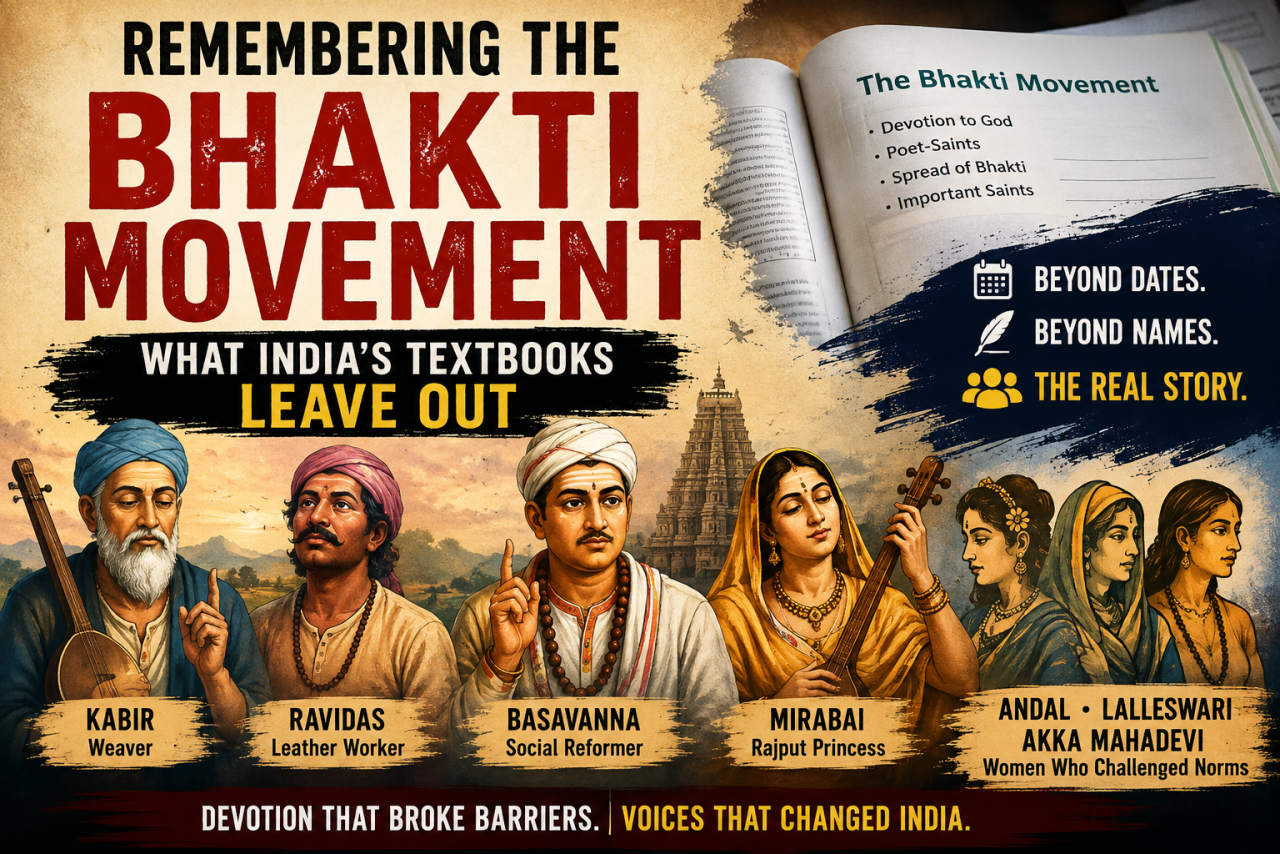
India’s Bhakti movement was far more radical than the textbook version suggests. Its saints questioned caste, ritual and authority while giving ordinary people a voice through their own languages.
For most Indian students, the Bhakti movement appears in textbooks as a short paragraph — a list of poet-saints, a few dates, and a vague mention of "devotion to God." What rarely comes through is how radical this movement actually was, and why revisiting it matters for how young Indians understand their own history today.
A Movement That Crossed Every Line
Stretching from roughly the 7th century in Tamil Nadu to the 17th century in North India, the Bhakti movement was not one event but a centuries-long wave of religious and social reform that swept across the subcontinent in dozens of regional languages. Its saints came from every background imaginable: Kabir was raised by a family of weavers, Ravidas was born into a family of leather workers, Basavanna challenged Karnataka's rigid social order in the 12th century, and Mirabai was a Rajput princess who walked away from palace life to sing of her devotion in the streets. Andal in Tamil Nadu, Lalleshwari in Kashmir, and Akka Mahadevi in Karnataka all pushed against the expectation that women stay confined to private, domestic roles.
What united these figures was not one doctrine but a shared instinct: that devotion did not need a priest, a temple hierarchy, or a Sanskrit text to be legitimate. It could be sung in Kannada, Hindi, Bengali, or Tamil, by anyone, regardless of caste or gender. Basavanna, for instance, built the Anubhava Mantapa — a hall where people from vastly different social positions could gather to debate questions of philosophy and social justice together, at a time when such mixing was almost unthinkable.
Why This History Gets Flattened
There are a few reasons the Bhakti movement often gets reduced to a footnote. First, it doesn't fit neatly into a single narrative. Its figures criticized Brahmanical ritualism as often as they engaged respectfully with Sufi thought — Kabir is a good example, drawing on both Hindu and Islamic spiritual vocabulary while remaining sharply critical of empty ritual in both traditions. That complexity is harder to teach than a simple, one-line story.
Second, the movement's core message — that caste hierarchies and ritual purity were obstacles to genuine spirituality — sits uneasily with more sanitized, uncontroversial versions of religious history that are easier to present in a classroom without inviting debate.
The Present-Day Debate
This is where a live argument is unfolding in Indian education policy. Since the National Education Policy of 2020, there has been a push to revise history and social science curricula to give more prominence to India's indigenous knowledge systems and civilizational heritage, including devotional movements like Bhakti and Sufism.
Supporters of this shift argue that Indian textbooks, shaped heavily by colonial-era and early post-independence historiography, have long underrepresented indigenous reform movements and regional literary traditions, and that restoring this history is a correction, not a distortion. They point out that figures like Kabir and Ravidas are genuinely subversive voices against caste oppression, and that teaching them properly should be uncontroversial.
Critics, however, worry that curriculum revisions in recent years have sometimes selectively emphasized figures and movements in ways that serve a particular ideological narrative about Indian civilization — foregrounding certain saints while downplaying the syncretic, often anti-establishment edge of their teachings, or the extent to which they challenged religious orthodoxy itself, not just foreign rule. Historians on this side argue that turning the Bhakti saints into symbols of a single, unified civilizational story risks sanding down exactly what made them radical: their willingness to criticize entrenched power within their own communities, including religious authorities.
Both camps generally agree on one thing: as currently taught, the Bhakti movement is underexplored in Indian classrooms relative to its historical importance. Where they differ is on what a fuller treatment should emphasize, and who gets to decide that.
Why It's Worth Getting Right
For a 12th-grade student trying to make sense of Indian history, the deeper lesson of the Bhakti movement isn't really about religion at all — it's about how ordinary people, using regional languages and popular songs rather than formal theology, could reshape their society's ideas about equality, dignity, and who gets to speak. Whatever shape the curriculum debate ultimately takes, understanding that history clearly — its complexity included — matters more than reducing it to a slogan.
For most Indian students, the Bhakti movement appears in textbooks as a short paragraph — a list of poet-saints, a few dates, and a vague mention of "devotion to God." What rarely comes through is how radical this movement actually was, and why revisiting it matters for how young Indians understand their own history today.
A Movement That Crossed Every Line
Stretching from roughly the 7th century in Tamil Nadu to the 17th century in North India, the Bhakti movement was not one event but a centuries-long wave of religious and social reform that swept across the subcontinent in dozens of regional languages. Its saints came from every background imaginable: Kabir was raised by a family of weavers, Ravidas was born into a family of leather workers, Basavanna challenged Karnataka's rigid social order in the 12th century, and Mirabai was a Rajput princess who walked away from palace life to sing of her devotion in the streets. Andal in Tamil Nadu, Lalleshwari in Kashmir, and Akka Mahadevi in Karnataka all pushed against the expectation that women stay confined to private, domestic roles.
What united these figures was not one doctrine but a shared instinct: that devotion did not need a priest, a temple hierarchy, or a Sanskrit text to be legitimate. It could be sung in Kannada, Hindi, Bengali, or Tamil, by anyone, regardless of caste or gender. Basavanna, for instance, built the Anubhava Mantapa — a hall where people from vastly different social positions could gather to debate questions of philosophy and social justice together, at a time when such mixing was almost unthinkable.
Why This History Gets Flattened
There are a few reasons the Bhakti movement often gets reduced to a footnote. First, it doesn't fit neatly into a single narrative. Its figures criticized Brahmanical ritualism as often as they engaged respectfully with Sufi thought — Kabir is a good example, drawing on both Hindu and Islamic spiritual vocabulary while remaining sharply critical of empty ritual in both traditions. That complexity is harder to teach than a simple, one-line story.
Second, the movement's core message — that caste hierarchies and ritual purity were obstacles to genuine spirituality — sits uneasily with more sanitized, uncontroversial versions of religious history that are easier to present in a classroom without inviting debate.
The Present-Day Debate
This is where a live argument is unfolding in Indian education policy. Since the National Education Policy of 2020, there has been a push to revise history and social science curricula to give more prominence to India's indigenous knowledge systems and civilizational heritage, including devotional movements like Bhakti and Sufism.
Supporters of this shift argue that Indian textbooks, shaped heavily by colonial-era and early post-independence historiography, have long underrepresented indigenous reform movements and regional literary traditions, and that restoring this history is a correction, not a distortion. They point out that figures like Kabir and Ravidas are genuinely subversive voices against caste oppression, and that teaching them properly should be uncontroversial.
Critics, however, worry that curriculum revisions in recent years have sometimes selectively emphasized figures and movements in ways that serve a particular ideological narrative about Indian civilization — foregrounding certain saints while downplaying the syncretic, often anti-establishment edge of their teachings, or the extent to which they challenged religious orthodoxy itself, not just foreign rule. Historians on this side argue that turning the Bhakti saints into symbols of a single, unified civilizational story risks sanding down exactly what made them radical: their willingness to criticize entrenched power within their own communities, including religious authorities.
Both camps generally agree on one thing: as currently taught, the Bhakti movement is underexplored in Indian classrooms relative to its historical importance. Where they differ is on what a fuller treatment should emphasize, and who gets to decide that.
Why It's Worth Getting Right
For a 12th-grade student trying to make sense of Indian history, the deeper lesson of the Bhakti movement isn't really about religion at all — it's about how ordinary people, using regional languages and popular songs rather than formal theology, could reshape their society's ideas about equality, dignity, and who gets to speak. Whatever shape the curriculum debate ultimately takes, understanding that history clearly — its complexity included — matters more than reducing it to a slogan.




















Leave a Comment