
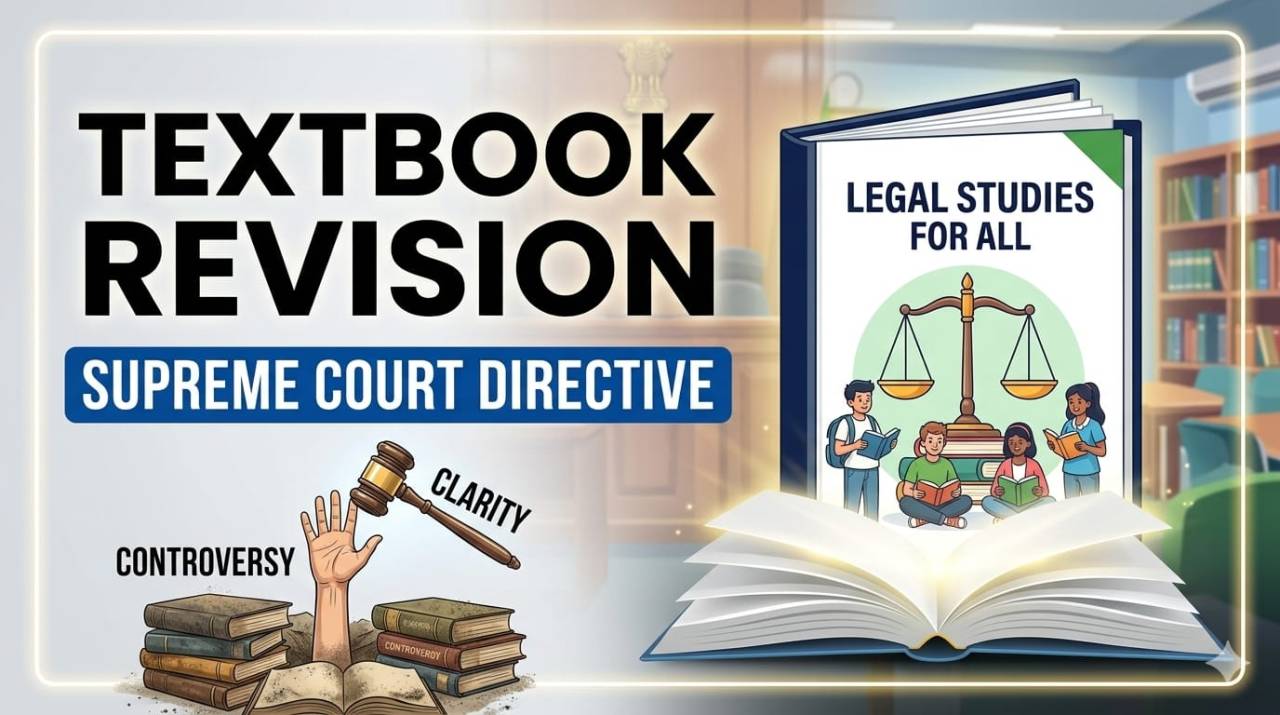
Are India’s textbooks shaping truth or bias? Supreme Court steps in to ensure balance and better legal awareness for students.
Education shapes how young minds see their country, its institutions, and their role in society. Among all learning tools, textbooks play the most important role. They are often treated as the final source of truth by students, especially in their early years. This is why any concern about misleading or unbalanced content in school books becomes a serious national issue.
A recent development involving the Supreme Court of India has brought this issue into focus. The court has stepped in to ensure that school textbooks, particularly those dealing with the judiciary and legal systems, present information that is accurate, balanced, and constructive.
What Triggered the Concern
The issue began with certain remarks found in a Class 8 Social Science textbook published by National Council of Educational Research and Training. The content reportedly included references to “corruption in the judiciary,” which raised concerns within the court.
The problem was not about criticism itself. In a democracy, questioning institutions is both necessary and healthy. However, the court observed that when such sensitive topics are presented without proper context or balance, they can create a distorted perception in the minds of students.
At a young age, children tend to accept textbook content without questioning it. If they are exposed to one-sided narratives, it may lead to confusion or mistrust toward institutions they do not yet fully understand. Recognizing this risk, the court took up the matter on its own through a suo motu proceeding, highlighting the seriousness of the issue.
Court’s Objective: Balance, Not Censorship
There is a common misunderstanding that the court is trying to remove criticism or present a flawless image of itself. However, the intention behind the intervention is different.
The Supreme Court of India has emphasized that educational content must be:
- Factually accurate
- Properly contextualized
- Constructively framed
The key question raised by the court is simple: Does the content help students understand institutions in a fair and meaningful way, or does it create unnecessary cynicism?
The aim is not to silence debate, but to ensure that discussions in textbooks are age-appropriate and balanced.
A Bigger Reform: Beyond Just One Class
Initially, the focus was on revising the Class 8 textbook. However, the court expanded the scope significantly.
A bench led by then Chief Justice Surya Kant and Justice Joymalya Bagchi suggested that the review should not be limited to a single class.
Instead, the court encouraged a broader reform:
- Review legal and judicial content across multiple classes
- Introduce structured legal education gradually
- Build understanding step-by-step as students grow
This approach shifts the focus from a one-time correction to a long-term improvement in how legal awareness is taught in schools.
Oversight Committee: Experts Leading the Change
To ensure that textbook revisions are handled carefully and professionally, a high-level Oversight Committee has been formed.
Key members and collaborators include:
- Justice (Retd.) Indu Malhotra as Chairperson
- National Judicial Academy providing legal expertise
- A reconstituted syllabus panel led by M. C. Pant
- Co-chaired by renowned mathematician Manjul Bhargava
This mix of legal and academic experts ensures that the revised curriculum will be:
- Academically strong
- Legally accurate
- Free from bias
It also reflects a collaborative approach rather than a top-down directive.
Fairness in Addressing Past Actions
The court also showed balance in handling the experts who originally worked on the NCERT textbook.
While concerns were raised about the content and initial action was taken against the authors, the court later agreed to review their case after hearing their arguments. Their counsel stated that they were experienced professionals, not irresponsible contributors.
By agreeing to reconsider their position, the court demonstrated its commitment to due process and fairness, reinforcing that the goal is accountability—not punishment.
Why This Matters for India’s Youth
This development is more than just a textbook revision. It represents a shift in how education can prepare students for real-world understanding.
If implemented effectively, the changes could:
- Improve legal awareness among students
- Build trust in democratic institutions
- Encourage critical thinking with proper context
- Create responsible and informed citizens
Instead of reacting to controversies, the system is moving toward proactive and structured learning.
Final Take
The Supreme Court’s direction marks an important step in improving the quality of education in India. By pushing for balanced and well-designed content across all classes, the focus is now on long-term reform rather than short-term fixes.
The message is clear: education should not just inform—it should guide, clarify, and build understanding.
If textbooks succeed in doing this, they will not only teach facts but also shape a generation that understands its rights, respects institutions, and contributes meaningfully to the country’s democratic framework.
Also Read: Textbooks, Truth and Trust: Why India’s Youth Must Pay Attention to Curriculum Changes























Leave a Comment