
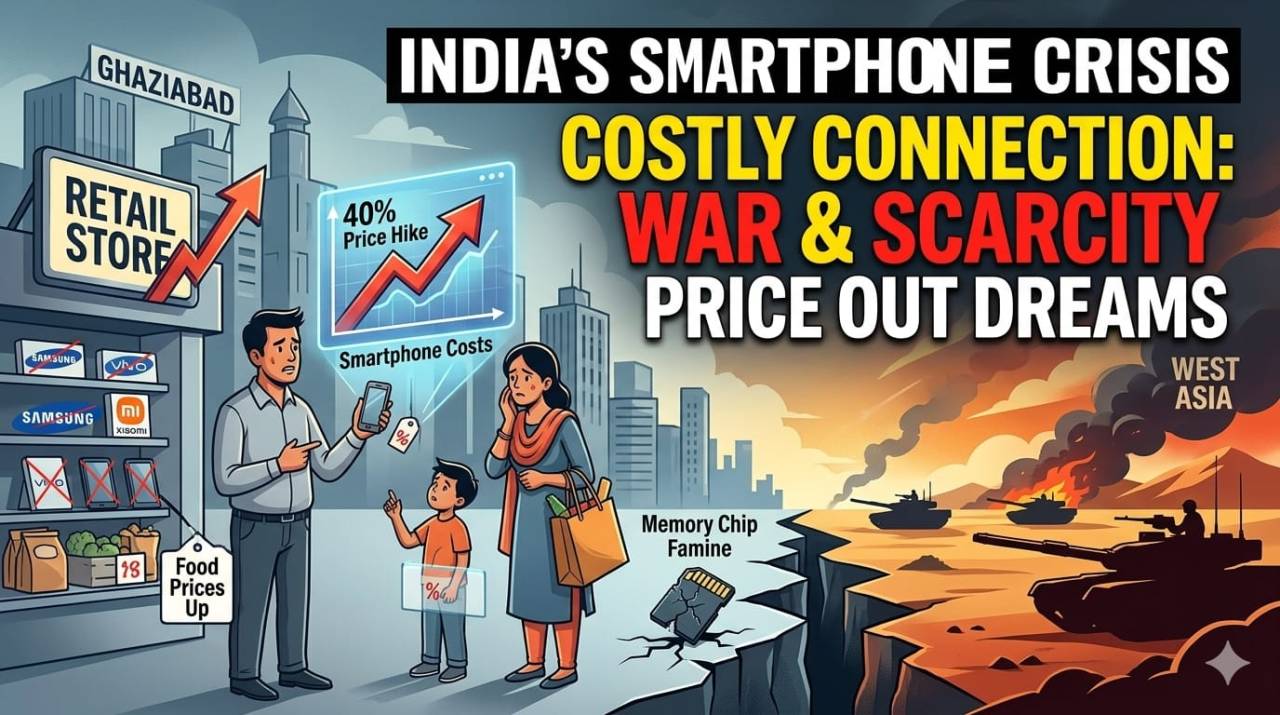
Smartphones are getting expensive in India—and not by a little. A global crisis is quietly pushing prices up by as much as 40%.
For years, India’s bustling mobile markets—from Delhi’s Nehru Place to Mumbai’s Lamington Road—symbolized affordability and access, offering millions a gateway to the digital world. But in early 2026, that promise is under strain. Smartphone prices in India are rising sharply, with some models witnessing hikes of up to 40%, leaving consumers and retailers grappling with an unexpected crisis.
What was once a fiercely competitive, price-driven market is now facing a rare reversal—where staying connected is becoming increasingly expensive.
A Global Crisis Hits Home
The surge in mobile prices in India is not an isolated phenomenon. It is the direct fallout of global disruptions that are reshaping supply chains.
The ongoing geopolitical tensions in West Asia have significantly disrupted key shipping routes. As freight costs and insurance premiums climb, manufacturers are passing these expenses down the chain—ultimately to Indian consumers.
At the same time, the global tech ecosystem is facing a critical shortage of memory components like DRAM and NAND flash chips. These are essential for smartphone performance, yet their supply is tightening.
The reason? Chipmakers are prioritizing high-margin production for artificial intelligence infrastructure over budget smartphone components. As demand from AI data centers surges, the supply available for consumer electronics continues to shrink.
Why Budget Smartphones Are Getting Expensive
The biggest impact is being felt in the budget smartphone segment, once the backbone of India’s digital expansion.
Devices that were earlier priced under ₹10,000 are now becoming increasingly unviable for manufacturers. Entry-level and mid-range smartphones have seen price increases ranging between ₹1,500 and ₹3,000, fundamentally altering buying patterns.
Brands like Samsung, Xiaomi, Vivo, and Oppo have already adjusted pricing across multiple models.
For instance, Vivo’s T-series devices, once aggressively priced for mass adoption, have seen significant upward revisions—highlighting the pressure on cost structures.
The Human Impact
For millions of Indians, a smartphone is more than a gadget—it is essential for education, work, and daily communication.
Ramesh Gupta, a small vendor in Noida, shares a reality many families are facing:
“I had saved for months to buy a phone for my daughter’s college. The price has suddenly jumped. I can’t explain global shortages to her—I just know it’s no longer affordable.”
This shift is forcing households to rethink spending priorities. With inflation already impacting essentials like food and fuel, electronics purchases are increasingly being postponed.
The Two-Sided Crisis Hitting Buyers
Industry experts describe the current situation as a dual shock to consumers, where pressures are building from both ends of the market.
On one side, rising component and logistics costs—driven by global supply disruptions and chip shortages—are pushing smartphone prices higher. On the other, weak consumer sentiment and persistent domestic inflation are tightening household budgets, making discretionary spending increasingly difficult.
The result is a clear shift in consumer behavior. Instead of upgrading to new devices, many buyers are opting to repair and extend the life of their existing smartphones. As a consequence, India’s average smartphone replacement cycle is stretching significantly—from around 18 months to nearly three years.
A Structural Reset in India’s Smartphone Market
According to insights from the International Data Corporation, this is not a temporary fluctuation but a structural reset of the Indian smartphone market.
The sub-₹10,000 category—once the driving force behind mass digital adoption—is becoming increasingly unsustainable for brands.
This marks a significant shift:
- From affordability-driven growth
- To margin-driven survival
The era of ultra-cheap smartphones may be fading, replaced by a more cautious and cost-sensitive ecosystem.
Final Take
While demand for smartphones in India remains strong, the current price surge reflects deeper global imbalances that are unlikely to resolve overnight.
For now, consumers are left navigating a difficult reality—where the dream of affordable connectivity is still alive, but increasingly out of reach.
In mobile stores, the slowdown is palpable. It is not just a dip in sales—it is a pause, as millions wait for stability to return to a world where even the smallest chip can shape the biggest decisions.





















Leave a Comment