
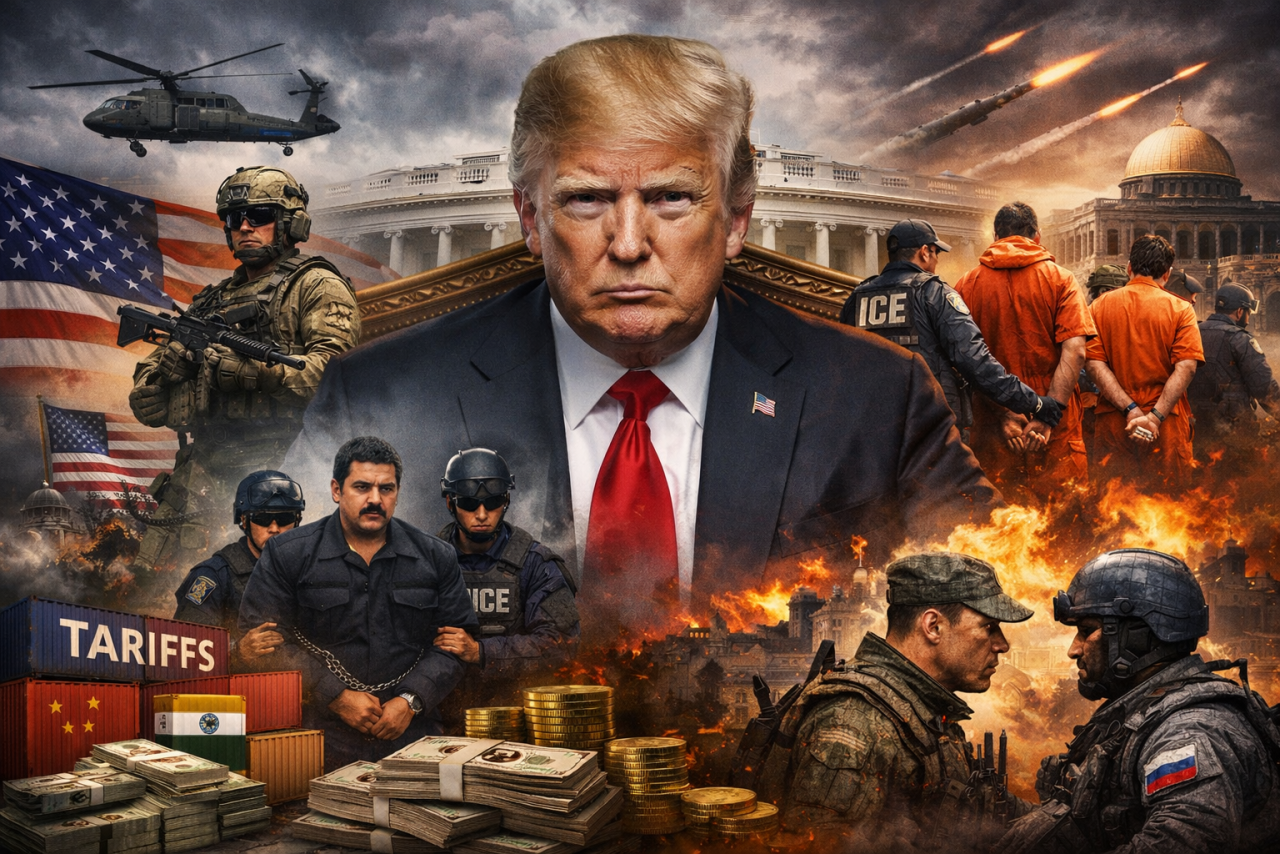
Power doesn’t just corrupt—it evolves. From regime change in Venezuela to tariff wars and global conflicts, Trump’s second term is testing how far presidential authority can go.
When Donald Trump returned to power, the expectation among supporters was decisive leadership. Among critics, the concern was different that a president who had already tested institutional limits would return more willing—and more prepared—to push beyond them.
Sixteen months into his second term, the record suggests something more consequential than continuity. It suggests escalation.
Across military action, economic coercion, diplomacy, and domestic enforcement, Trump’s presidency is increasingly defined not just by the use of power—but by its expansion.
Venezuela: Executive Power and the Normalization of Regime Change
The clearest example came at the very start of 2026.
In a covert operation personally authorized by Trump, U.S. forces captured Venezuelan president Nicolás Maduro in a large-scale military raid involving extensive intelligence coordination and air support. The operation was conducted without prior Congressional authorization, raising immediate constitutional concerns over war powers.
Maduro was transported to the United States to face charges, while Washington moved quickly to reshape Venezuela’s political order—recognizing a new leadership and reopening diplomatic and economic channels within months.
This sequence—capture, transition, recognition—marked a profound shift. Regime change, once the outcome of prolonged conflict or multilateral consensus, was executed as a rapid executive decision.
Legal scholars and international observers warned that such actions blur the line between counterterrorism and sovereignty violation. The precedent is stark: if one state can unilaterally remove another’s leader, the global norm itself begins to erode.
Tariffs as Instruments of Pressure, Not Policy
Trump’s second term has also redefined economic power—not as policy, but as leverage.
The introduction of “secondary tariffs” represents a major shift. These measures penalize not only adversaries but also third countries that engage with them.
India became a central case. In 2025, the U.S. imposed tariffs of up to 50% on Indian goods, explicitly linking them to India’s continued purchase of Russian oil. The pressure worked: by early 2026, a new trade agreement saw tariffs reduced after India committed to cutting those imports and expanding economic ties with the U.S.
Trump himself framed the outcome in personal terms, suggesting that trade behavior shifted because leaders sought to “make [him] happy.”
This is not traditional trade diplomacy. It is personalized economic coercion, where tariffs function as tools of compliance rather than instruments of market balance.
Russia–Ukraine: Negotiation or Realignment?
Trump’s approach to the Russia–Ukraine war further reflects this shift toward unilateral power.
His administration has pushed for negotiated settlements while signaling openness to concessions for Russia and even assigning partial blame to Ukraine—positions that have unsettled long-standing U.S. allies.
This reflects a broader pattern: diplomacy conducted less through alliances and more through direct, leader-driven negotiation. Analysts describe this model as “transactional”—where outcomes depend less on institutional consensus and more on presidential leverage.
The risk is structural. When diplomacy becomes personalized, consistency gives way to improvisation—and global stability becomes tied to individual decision-making.
India–Pakistan: Mediation Without Consent
In South Asia, the pattern repeated.
During the 2025 India–Pakistan tensions, Trump publicly claimed credit for mediating a ceasefire. Pakistan acknowledged the role; India rejected it outright.
The episode exposed a growing gap between declared influence and accepted diplomacy. Mediation, traditionally grounded in mutual consent, was instead asserted unilaterally.
It is a smaller incident than Venezuela or tariffs—but illustrative of a broader trend: power expressed through narrative, not just action.
West Asia: From Alignment to Escalation
Nowhere has the expansion of power been more visible than in West Asia.
In early 2026, the United States, alongside Israel, launched major strikes on Iran with the stated objective of regime change. The conflict quickly escalated into a broader regional crisis.
Simultaneously, Trump proposed an extraordinary plan for Gaza—suggesting U.S. control of the territory and the relocation of its Palestinian population to neighboring countries.
Such proposals, once politically unthinkable, reflect how far the boundaries of executive rhetoric—and ambition—have shifted.
Diplomacy here is no longer about mediation. It is about redesign.
Immigration and the Use of Domestic Power
At home, the same pattern of expansion is visible in immigration policy.
The administration has invoked sweeping legal authorities, including wartime-era provisions, to justify mass deportations and enforcement actions. These policies have been accompanied by controversial claims—such as allegations linking foreign governments to organized migration—that intelligence assessments have not substantiated.
The result is a system where legal authority, political messaging, and enforcement spectacle intersect.
Immigration, in this context, is not just policy. It is demonstration—a visible assertion of state power.
Institutions Under Strain—but Not Collapse
Despite this expansion, institutional resistance remains.
Courts have challenged tariff regimes and immigration measures. The Federal Court has even struck down aspects of Trump’s tariff authority, forcing the administration to pursue alternative legal pathways.
Yet these checks often operate reactively, not preventively. Power is exercised first, contested later.
That sequence matters.
The Pattern: Power Accelerates Itself
Taken together, the second Trump presidency reveals a consistent trajectory:
- Military force deployed with minimal oversight
- Economic tools used as geopolitical pressure
- Diplomacy personalized and often unilateral
- Domestic authority expanded through legal reinterpretation
This is not merely strong governance. It is concentrated governance, where decision-making increasingly resides in the executive alone.
Does Power Corrupt—or Simply Remove Restraint?
The classic warning—“power corrupts”—implies moral decline. But Trump’s second term suggests something more structural.
Power, once regained, does not necessarily change direction. It becomes more confident. Faster. Less constrained.
In Trump’s case, the shift is visible: from testing limits in a first term to redefining them in a second.
The result is a presidency that does not just operate within the system—but increasingly shapes it.
And that may be the more enduring lesson.
Because in modern democracies, the greatest risk is not that power breaks the rules.
It is that, over time, it rewrites them.

















Leave a Comment