
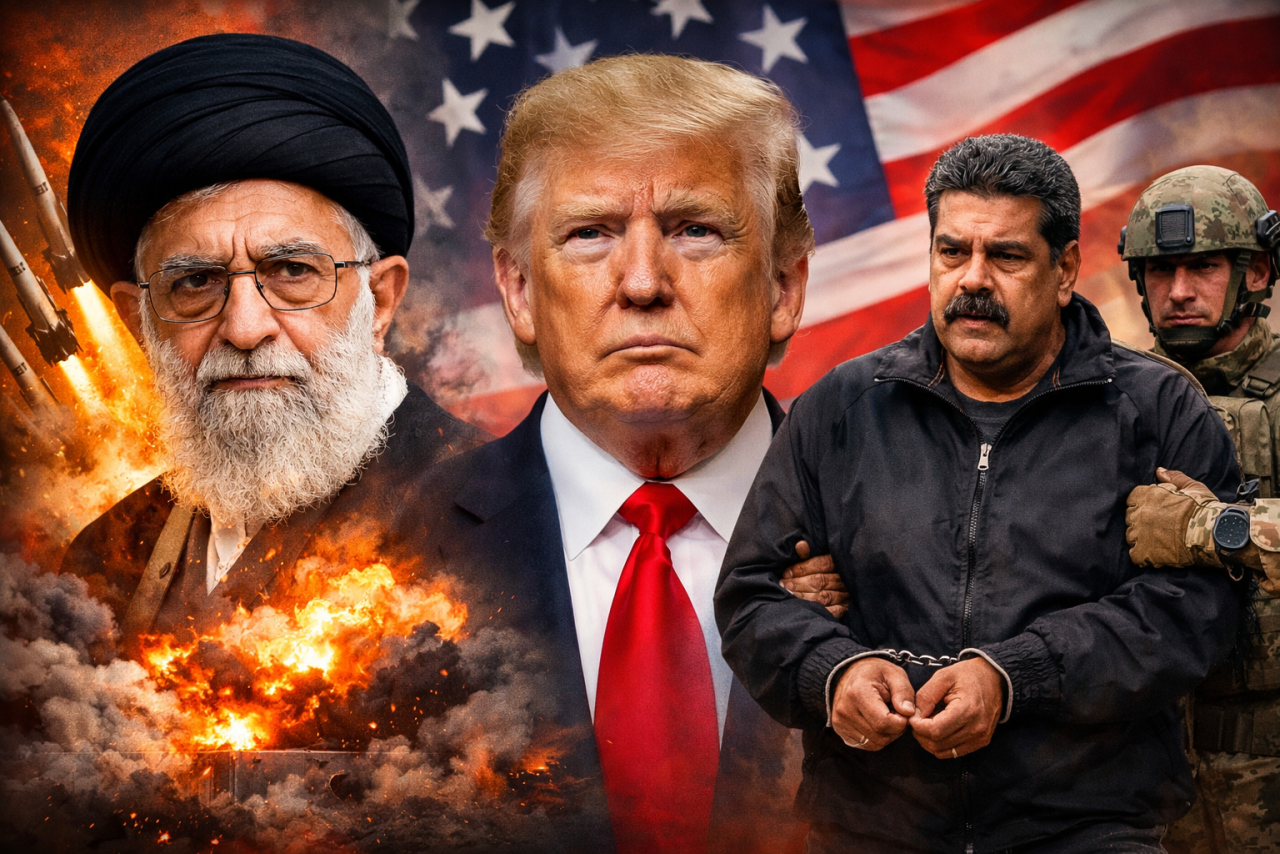
Tehran wakes to the death of its Supreme Leader, Caracas reels from a president in custody, and Washington stands at the center of it all — is this the bold return of American dominance, or the beginning of a far more dangerous global chapter?
March 2026 will be remembered as a defining month in modern geopolitics. Iran has confirmed that its Supreme Leader, Ali Khamenei, was killed in a coordinated U.S.-Israeli strike, marking the most dramatic escalation in Middle East conflict in decades. The announcement has sent shockwaves across global capitals, rattled energy markets, and triggered emergency diplomatic sessions at the United Nations.
The strike, carried out in coordination with Israel, targeted high-level command centers and strategic infrastructure in Tehran and other key locations. Iranian state media reported not only Khamenei’s death but also the killing of senior commanders close to him. Within hours, retaliatory missile launches were reported across parts of the Gulf, and regional airspaces were temporarily restricted.
This is not just another episode in the long-running standoff between Washington and Tehran. It represents a profound rupture in the political architecture of the Islamic Republic — and a bold statement of intent from President Donald Trump in his second term.
A Turning Point in Tehran
For more than three decades, Khamenei stood at the apex of Iran’s political and military hierarchy. His authority shaped Iran’s nuclear posture, its regional alliances, and its confrontation with the West. His sudden death in a foreign military strike marks an extraordinary escalation — one that analysts are already describing as a geopolitical earthquake.
Regional governments are now calculating their next moves carefully. Iran has declared a national mourning period and vowed a response. Armed groups aligned with Tehran across the Middle East are on high alert. Oil prices spiked in early trading, reflecting fears of supply disruptions in one of the world’s most sensitive energy corridors.
Security analyst Dr. Michael Harrington describes the event as “a generational rupture.”
“When the central authority of a state like Iran is removed through direct external force, the consequences extend far beyond one country. This affects alliance systems, proxy networks, and deterrence balances across the region.”
For Washington, the strike signals something equally consequential: a willingness to directly target the highest level of adversarial leadership if strategic calculations demand it.
Trump’s Second-Term Doctrine on Display
Since returning to office, Trump has emphasized strength, speed, and unilateral decisiveness in foreign policy. His administration has framed recent actions not as acts of expansion, but as enforcement — enforcing red lines, enforcing deterrence, enforcing consequences.
The Iran strike appears to fit squarely within that framework.
Supporters argue that overwhelming force restores credibility and prevents prolonged conflict. Critics warn that such actions risk spiraling escalation, particularly in a region already defined by layered tensions.
China and Russia have condemned the strike, calling for urgent diplomatic de-escalation. European leaders have expressed concern about wider regional fallout. Yet for Trump’s base, the operation reinforces an image of American power unrestrained and assertive.
Caracas Came First
Before Tehran dominated headlines, Washington had already reshaped another political landscape — this time in the Western Hemisphere.
On January 3, 2026, U.S. forces conducted a rapid and coordinated operation in Venezuela that resulted in the capture of President Nicolás Maduro. The mission, described by officials as a response to narcoterrorism indictments, involved precision strikes on military facilities in Caracas before Maduro was taken into U.S. custody.
The move stunned Latin America. It was the most direct American military intervention in the region in decades. Maduro was transported to the United States to face criminal charges, while leadership in Caracas shifted abruptly amid political uncertainty.
Strategically, the Venezuela operation sent a message closer to home: the Western Hemisphere remains a core U.S. sphere of influence. The administration signaled that it would not tolerate what it characterizes as criminal or destabilizing regimes operating near American borders.
Professor Elena Vargas, an expert on international sovereignty, sees the two operations as part of a broader shift.
“What we are witnessing is a reassertion of hard power as the primary diplomatic instrument. From Latin America to the Middle East, the United States is demonstrating that it will act directly rather than rely solely on sanctions or negotiations.”
Supremacy or Strain?
Taken together, the death of Khamenei and the capture of Maduro underscore the unmatched global reach of the United States. No other country currently combines military logistics, intelligence capability, and rapid strike capacity at this scale.
Yet power projection does not occur in isolation. Each action produces reactions.
In the Middle East, Iran’s next steps could determine whether the crisis remains contained or expands into broader confrontation. Proxy groups may escalate tensions beyond Iran’s borders. Cyber responses remain a possibility. The Gulf region is bracing for uncertainty.
In Latin America, the Venezuela operation has reopened debates about sovereignty and intervention. Some regional leaders privately acknowledge relief at Maduro’s removal, while publicly criticizing the method. Others see it as a troubling precedent.
Domestically within the United States, debates over executive authority and war powers are intensifying. Lawmakers are examining whether congressional approval should have preceded such significant military actions.
A New Global Phase
The events of early 2026 suggest that global politics is entering a new phase — one in which decisive force is once again central to great-power competition. Trump’s second term has accelerated that shift, replacing incremental diplomacy with bold, high-impact operations.
From Tehran’s leadership vacuum to Caracas’s political reset, Washington has demonstrated that it retains the ability to alter geopolitical landscapes rapidly.
Whether these actions consolidate American supremacy or generate a more volatile multipolar resistance will define the coming years. What is clear today is that March 2026 has already reshaped the global conversation.
The world is watching closely — not just to see what the United States will do next, but to understand how others will respond.













Leave a Comment