
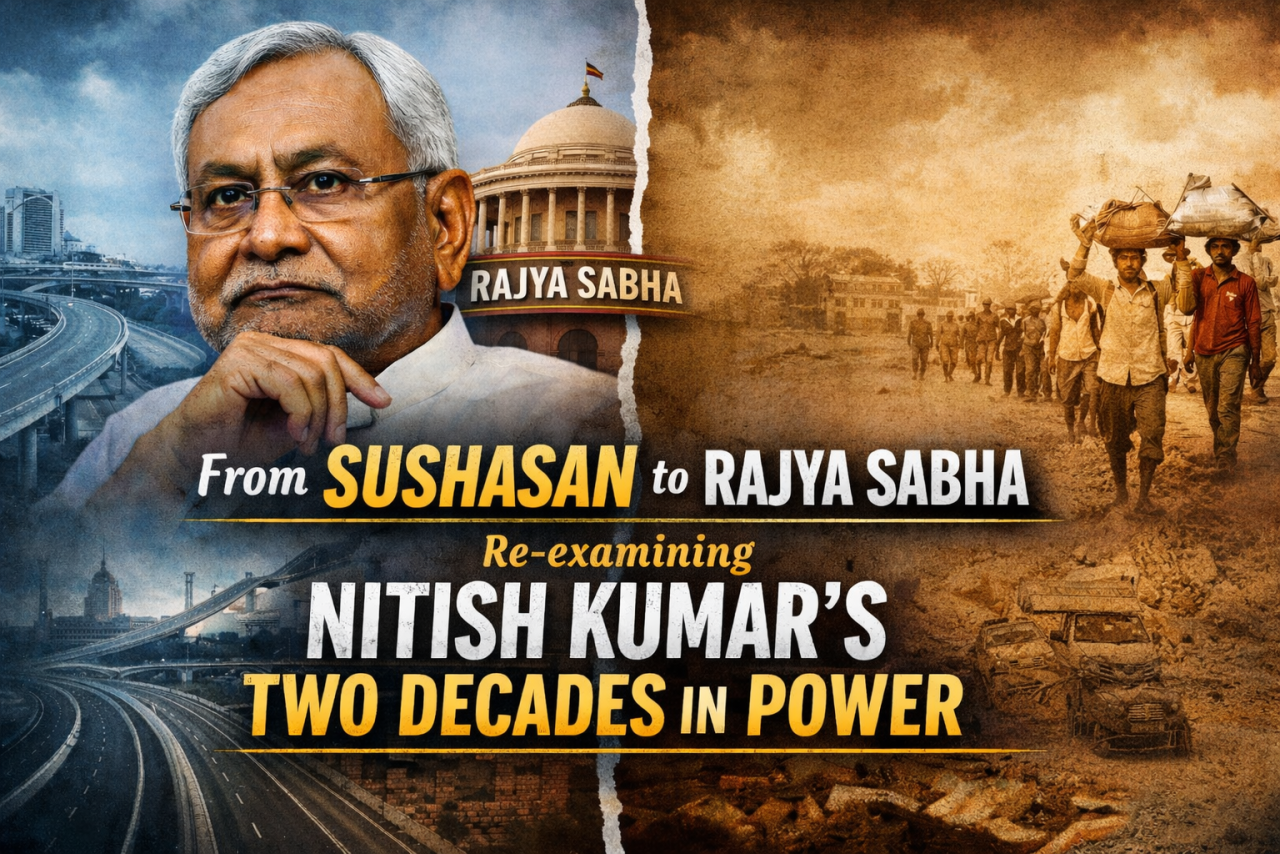
From the promise of sushasan to a seat in the Rajya Sabha, Nitish Kumar’s two decades in power demand a hard reassessment: what actually changed in Bihar?
Politics often reveals its truths not in speeches but in endings. The decision of Nitish Kumar to seek entry into the Rajya Sabha after nearly two decades dominating Bihar’s executive politics is more than a personal career shift. It is a moment that invites reflection on a long political experiment. Nitish Kumar rose to power in 2005 with a powerful promise: to replace the chaos associated with the era of Lalu Prasad Yadav with governance, efficiency and development. The slogan of sushasan—good governance—became both a political brand and a moral claim. Twenty years later, as the architect of that promise prepares to move from Patna to Parliament, the question before Bihar is simple but uncomfortable: how much of that promise translated into lasting transformation?
The contrast between the two eras is central to this question. Lalu Prasad Yadav’s politics was unapologetically ideological. His narrative revolved around social justice and empowerment of historically marginalised communities. Critics accused him of administrative neglect and economic stagnation, but his politics never pretended to be technocratic governance. Nitish Kumar, by contrast, defined his leadership almost entirely through the language of development and administrative reform. Expectations were therefore higher, and the yardstick inevitably stricter.
In the early years of his tenure, the difference appeared visible. Roads improved across the state, connecting districts that had long remained physically isolated. Law and order stabilised compared with the turbulence of the 1990s. Administrative systems became more predictable. Bihar even recorded impressive growth rates in several years during the late 2000s and early 2010s.
But numbers in politics, like promises, require interpretation. Bihar’s growth figures appeared dramatic partly because the state began from one of the lowest economic bases in the country. High percentage growth from a low starting point can create the appearance of rapid progress without necessarily altering the structural realities of an economy. The deeper test of governance is not growth alone but transformation: whether the economic structure changes in a way that expands opportunity and reduces dependence on migration.
On that test, Bihar’s progress has been far less convincing.
Despite two decades of governance centred on development, Bihar continues to record the lowest per-capita income among Indian states. Industrial investment remains thin. The state’s economic structure still depends heavily on agriculture and public sector employment, while manufacturing contributes only a small share of the workforce. Private sector job creation—the engine that powers transformation in most successful economies—remains limited.
The consequences are visible in the annual migration of millions of workers from Bihar to other parts of India. From construction sites in Mumbai to factories in Gujarat and service jobs in Delhi, the labour of Bihar fuels economic growth elsewhere. Migration itself is not a failure; many economies rely on mobile labour. But when migration becomes the dominant economic pathway for a state’s youth, it signals a deeper absence of opportunity at home.
Education presents another paradox. Nitish Kumar’s governments expanded school enrolment and introduced welfare schemes aimed at improving attendance, particularly among girls. These initiatives increased access and were widely welcomed. Yet access is only the first step. Learning outcomes remain uneven, and the state continues to struggle with shortages of quality higher-education institutions. Thousands of students still leave Bihar each year to pursue university education elsewhere, turning education itself into another form of migration.
Employment statistics reflect the same imbalance. A growing number of educated young people find themselves competing for a very limited pool of formal jobs, particularly in the public sector. Government recruitment examinations routinely attract hundreds of thousands of applicants for a few thousand posts, a phenomenon that illustrates both the aspirations of Bihar’s youth and the scarcity of opportunities.
Politics, however, often operates through narrative rather than data. Nitish Kumar mastered the art of political reinvention, shifting alliances and recalibrating strategies whenever the landscape demanded it. His partnerships with the Bharatiya Janata Party and the Rashtriya Janata Dal changed repeatedly over the years, each shift justified in the language of stability or principle. These manoeuvres demonstrated remarkable political skill and ensured his continued relevance in Bihar’s complex coalition politics.
Yet frequent realignments also blurred accountability. When governments change alliances, responsibility for outcomes becomes diffuse. Success is shared; failure becomes difficult to assign. Over time, the narrative of governance can move faster than the reality of development.
By the time of the most recent elections, the political message had subtly changed. Instead of celebrating completed transformation, the campaign appealed for “one more chance.” It was a modest phrase, but it carried a revealing implication: the work of transformation remained unfinished after nearly two decades.
Longevity in power offers a rare opportunity in democratic politics. Few leaders are granted the time required to reshape institutions, attract sustained investment, and build a durable economic ecosystem. Nitish Kumar enjoyed that opportunity more than most chief ministers in India. His tenure brought improvements in infrastructure, administrative stability and welfare delivery. These achievements should not be dismissed.
But expectations were never limited to better roads and smoother administration. The promise of sushasan implied something larger: a Bihar capable of offering its citizens the same economic horizons available in more prosperous states.
That transformation remains incomplete.
As Nitish Kumar prepares to move from the chief minister’s office to the Rajya Sabha, his legacy will inevitably invite reassessment. Political survival, after all, is not the same as historical success. History asks a different question: whether a leader changed the trajectory of the society he governed.
Bihar today is calmer, somewhat better connected and administratively more stable than it was two decades ago. Yet it still stands at the bottom of India’s economic ladder, sending its youth across the country in search of opportunity.
The story of the Nitish Kumar era, therefore, is not one of simple failure or triumph. It is the story of a promise that raised expectations of transformation but delivered only partial change. And as Bihar turns the page on this long chapter of its politics, the distance between promise and outcome may become the most important measure of all.



























Leave a Comment