
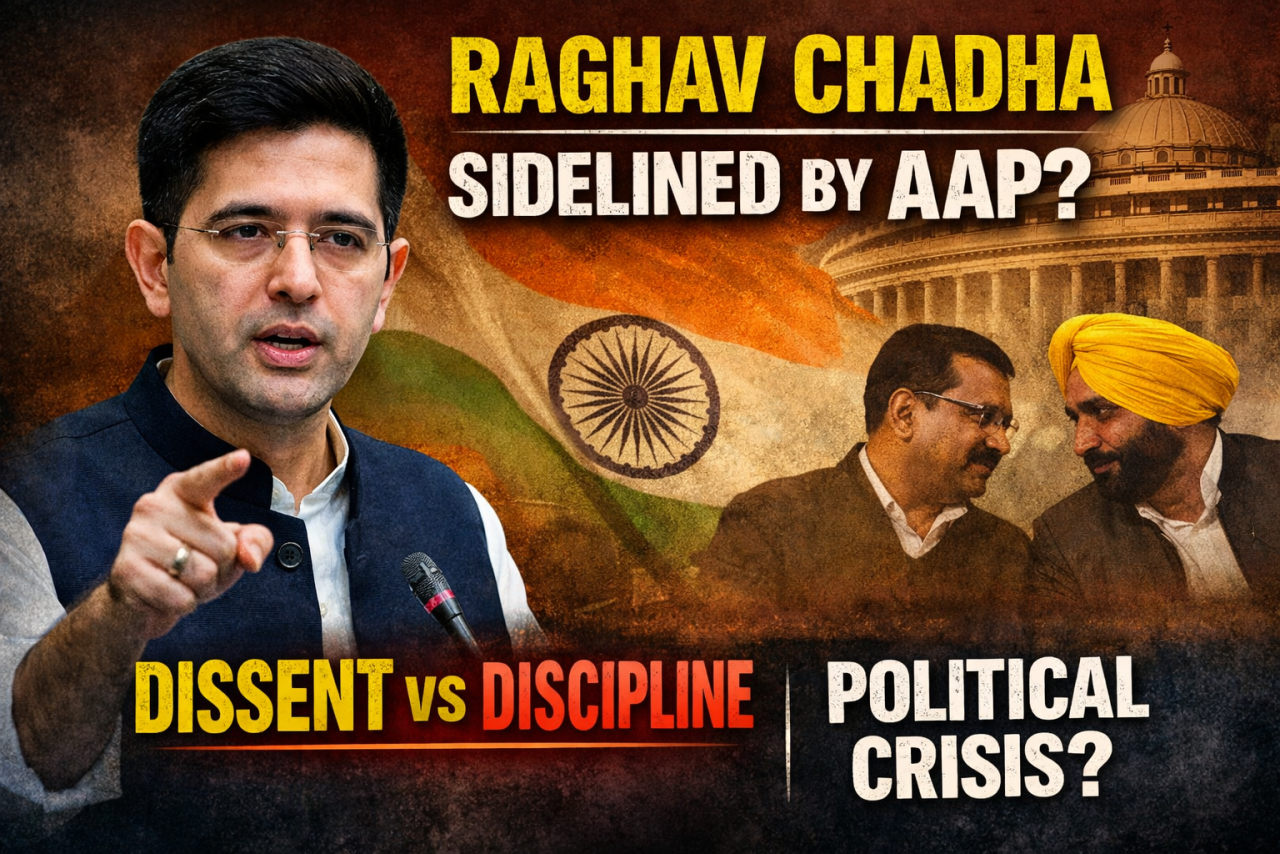
When a party born to amplify the common voice begins to quiet one of its sharpest speakers, the real story isn’t just about Raghav Chadha—it’s about the changing character of politics within the Aam Aadmi Party and what it means for democratic debate in India.
The latest developments surrounding Raghav Chadha have triggered a fresh political debate, not just about parliamentary procedure, but about internal dynamics within the Aam Aadmi Party (AAP) and the evolving nature of political expression in India. What makes this episode particularly significant is that, unlike his 2023 suspension from the Rajya Sabha, the current controversy is not about formal disciplinary action by the House, but about his reduced role, limited speaking opportunities, and apparent marginalisation within his own party.
Recent Developments: From Key Voice to Limited Role
Over the past few days, Chadha’s presence in the Rajya Sabha has been notably subdued. Despite being one of AAP’s most prominent national faces, he has reportedly not been given adequate opportunities to speak during key debates. This has coincided with a major internal shift—his removal as AAP’s Deputy Leader in the Rajya Sabha, a position that once placed him at the center of the party’s parliamentary strategy.
Party insiders have downplayed the move as part of routine restructuring. However, the timing—coming immediately after his recent speeches and public interventions—has fueled speculation of a deeper internal disagreement. Chadha himself has hinted at this tension, stating publicly that he feels “silenced, not defeated,” a remark that has since gained traction in political circles.
What Did Chadha Raise in Parliament?
At the heart of the issue lies the content of Chadha’s recent parliamentary interventions. Unlike traditional high-pitched political speeches, his focus has been on everyday governance concerns—issues that directly affect citizens but often receive limited attention in national political discourse.
Among the key issues he raised:
- Cost of Living Pressures: Chadha questioned pricing practices in sectors like telecom and aviation, highlighting how consumers are burdened by 28-day mobile recharge cycles and inflated food prices at airports.
- Banking and Financial Policies: He criticized penalties imposed on maintaining minimum bank balances, arguing that such practices disproportionately affect lower-income groups.
- Taxation Reforms: He proposed the idea of joint income tax filing for married couples, presenting it as a way to ease financial stress on households.
- Gig Economy Concerns: Chadha emphasized the need for social security frameworks for gig workers, a rapidly growing segment of India’s workforce.
- Social Policy Issues: From advocating paternity leave to addressing menstrual hygiene, his speeches reflected a focus on social inclusivity.
- Governance Innovations: He proposed ideas like “One Nation, One Healthcare”, aiming to improve accessibility and efficiency in public health systems.
These interventions positioned Chadha as a leader focusing on micro-level governance issues—practical concerns that resonate with urban middle classes, youth, and working professionals.
The Party’s Response: Strategic Silence or Discomfort?
While AAP has not openly criticized Chadha’s speeches, its actions suggest a degree of discomfort. His removal from a key parliamentary role and reduced visibility in debates indicate a shift in how the party is managing its internal voices.
Some leaders within the party have informally questioned whether such issues—often perceived as “small” or “everyday”—align with the party’s broader political messaging at the national level. This reflects a possible divergence in political strategy:
- Chadha’s approach: Issue-based, detail-oriented politics
- Party leadership’s approach: Macro-level, narrative-driven politics
This divergence is not unusual in growing political parties. As parties expand their footprint, they often move from grassroots activism to a more centralized and controlled communication strategy. However, in AAP’s case, this transition is particularly sensitive given its origins.
AAP’s Founding Ideals vs Current Reality
AAP was born out of an anti-corruption movement that emphasized transparency, decentralization, and fearless questioning of authority. Leaders were encouraged to speak directly, challenge policies, and bring citizen concerns to the forefront.
In this context, Chadha’s recent interventions appear consistent with the party’s founding philosophy. However, the current developments raise an important question:
Is AAP moving away from its original model toward a more conventional, centralized political structure?
Political analysts note that such a shift is often inevitable as parties gain power and administrative responsibility. Governance requires discipline, coordination, and strategic messaging. But the risk lies in over-centralization, where individual voices are constrained in favor of uniformity.
Parliamentary Implications: Voice vs Procedure
Unlike the 2023 episode—where Chadha’s suspension was linked to a procedural violation—today’s situation revolves around access to voice. Technically, decisions about who speaks in Parliament are influenced by party leadership and floor management strategies. However, when a prominent MP is repeatedly sidelined, it raises broader concerns about representation.
Parliament is designed to be a space for diverse viewpoints. When internal party dynamics limit participation, the impact extends beyond individual careers—it affects the quality of democratic debate.
Chadha’s Counter-Strategy: Taking the Message Public
In response to his reduced role in Parliament, Chadha has turned to public platforms. He has released videos highlighting his speeches and policy proposals, positioning himself as a leader committed to raising “real issues” faced by citizens.
This strategy serves two purposes:
- It reinforces his political identity as a grassroots-focused reformist.
- It subtly challenges the party’s internal decisions without direct confrontation.
His messaging suggests that the conflict is not about personal ambition, but about the type of politics that should define AAP’s future.
Broader Political Context
The Chadha episode reflects wider trends in Indian politics:
- Centralization of Leadership: Across parties, decision-making is increasingly concentrated at the top.
- Controlled Messaging: Political communication is becoming more strategic, leaving less room for spontaneous or individual expression.
- Shift in Issue Prioritization: Everyday governance issues often take a backseat to larger ideological or electoral narratives.
In this environment, leaders who focus on granular policy concerns may find themselves at odds with broader party strategies.
What Lies Ahead?
For Raghav Chadha, the coming months will be crucial. Whether he regains a central role within AAP or continues on the margins will depend on how the party balances internal discipline with space for individual expression.
For AAP, this is a defining moment. The party must decide whether to:
- Reinforce centralized control and strategic messaging, or
- Reaffirm its commitment to open debate and diverse viewpoints
Final Take
The unfolding situation around Raghav Chadha is more than an internal party issue—it is a reflection of the changing nature of Indian politics. It highlights the tension between discipline and dissent, strategy and spontaneity, control and expression.
As the story develops, one question remains central:
Can a party built on the promise of giving voice to the common citizen afford to limit the voices within its own ranks?
The answer will not only shape AAP’s political future but also influence how democratic debate evolves in India’s parliamentary system.















Leave a Comment