
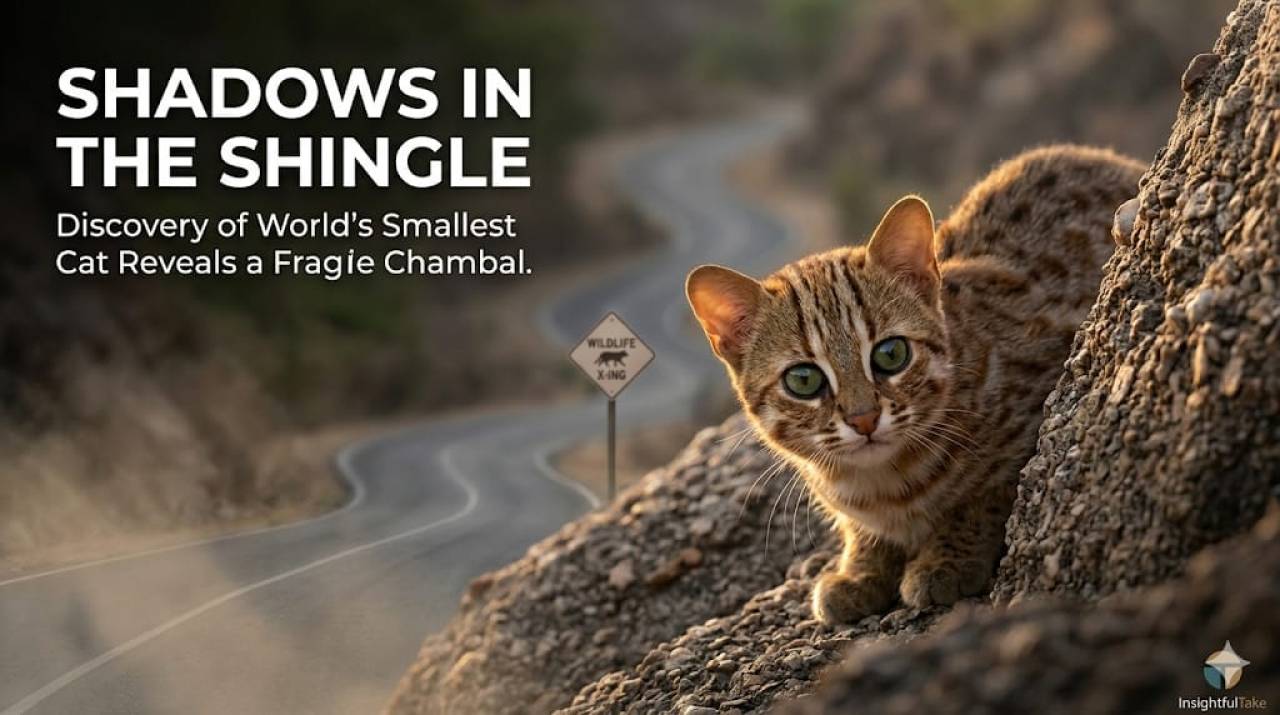
A rare wild cat thought to inhabit only southern India has now been confirmed in Uttar Pradesh’s Chambal region—but its first evidence comes from tragic roadkill, exposing both hidden biodiversity and growing ecological threats.
In the hyper-fragmented landscapes of modern conservation, a monumental discovery can sometimes arrive in the most tragic of vessels. For the Rusty-spotted cat (Prionailurus rubiginosus)—lauded globally as the world’s smallest feline—its official introduction to the rugged terrains of Uttar Pradesh did not occur via a camera-trap flash or a researcher’s binoculars, but rather on the asphalt of the Bharthana-Sindaus road in the Etawah district.
According to a seminal paper published in the Journal of Threatened Taxa, researchers from the Wildlife Institute of India (WII) documented the first confirmed records of this elusive predator within the National Chambal Sanctuary. The evidence, unfortunately, comprised two separate roadkill incidents: a male carcass discovered near the Yamuna river on March 14, 2025, and a female recorded shortly thereafter on April 24, 2025, along a stretch of road near Chakar Nagar. While these deaths represent an irreplaceable loss to an already threatened species, they concurrently unlock a vital, unprecedented chapter in Indian wildlife geography.
A Miniature Predator in a Mighty Wilderness
Weighing a mere two to three pounds at adulthood, the Rusty-spotted cat (Prionailurus rubiginosus) is an evolutionary masterpiece of stealth and adaptation. Historically associated with the moist deciduous forests and scrublands of southern India and Sri Lanka, its presence in the brutal, hyper-arid ravine systems of the Chambal-Yamuna interfluve caught the scientific community entirely off guard.
The landscape here is notoriously harsh. Yet, as WII scientists VishnuPriya Kolipakam and Qamar Qureshi highlight, this specific network of rugged gullies, interlinked patches of dry forest, and deep ravines forms a highly unique, interconnected macro-habitat. This complex topography offers crucial cover and a steady abundance of small rodents, making it an ideal, albeit unsuspected, haven for small carnivores. The fact that the two specimens were found in areas structurally linked to the broader Chambal river landscape strongly suggests that a resident, breeding population has been quietly navigating these ravines for generations.
“The Chambal ravines have long been romanticized as a landscape of outlaws and untamed wilderness. Today, they reveal themselves as a vital ecological sanctuary for a species trembling on the edge of vulnerability.”
The Modern Ecological Crisis: Linear Infrastructure
The discovery of the Rusty-spotted cat in southern Uttar Pradesh serves as a double-edged sword for conservationists. While the expansion of its known geographic range offers hope and allows for more localized, targeted conservation measures, the manner of its discovery highlights an escalating crisis: the lethal intersection of wildlife corridors and modern linear infrastructure.
Roads cutting through highly sensitive ecosystems act as invisible, deadly barriers. For a nocturnal, ground-dwelling creature no larger than a domestic kitten, crossing a high-speed asphalt corridor intersecting a ravine ecosystem is a near-impossible gamble. The roadkills near Chakar Nagar and Bharthana underscore how unchecked infrastructural development can quietly decapitate local biodiversity before scientists even realize a species is present. It stresses the immediate, non-negotiable need for mitigation strategies—such as dedicated eco-ducts, wildlife underpasses, and strictly enforced seasonal speed limits—integrated directly into rural road planning.
Final Take
The Rusty-spotted cat is currently listed as “Near Threatened” on the IUCN Red List, a status that could rapidly deteriorate without active intervention. WII team members have already initiated intensive, systematic camera-trapping surveys across the National Chambal Sanctuary to accurately map population densities and identify critical crossing hotspots.
Protecting the world’s smallest cat requires looking past charismatic megafauna like tigers and rhinos, and recognizing that micro-predators play an equally indispensable role in regulating the health of our ecosystems. If we fail to safeguard these fragmented ravine networks, we risk losing these enigmatic shadows of the Chambal before we ever truly get to understand them.
In the hyper-fragmented landscapes of modern conservation, a monumental discovery can sometimes arrive in the most tragic of vessels. For the Rusty-spotted cat (Prionailurus rubiginosus)—lauded globally as the world’s smallest feline—its official introduction to the rugged terrains of Uttar Pradesh did not occur via a camera-trap flash or a researcher’s binoculars, but rather on the asphalt of the Bharthana-Sindaus road in the Etawah district.
According to a seminal paper published in the Journal of Threatened Taxa, researchers from the Wildlife Institute of India (WII) documented the first confirmed records of this elusive predator within the National Chambal Sanctuary. The evidence, unfortunately, comprised two separate roadkill incidents: a male carcass discovered near the Yamuna river on March 14, 2025, and a female recorded shortly thereafter on April 24, 2025, along a stretch of road near Chakar Nagar. While these deaths represent an irreplaceable loss to an already threatened species, they concurrently unlock a vital, unprecedented chapter in Indian wildlife geography.
A Miniature Predator in a Mighty Wilderness
Weighing a mere two to three pounds at adulthood, the Rusty-spotted cat (Prionailurus rubiginosus) is an evolutionary masterpiece of stealth and adaptation. Historically associated with the moist deciduous forests and scrublands of southern India and Sri Lanka, its presence in the brutal, hyper-arid ravine systems of the Chambal-Yamuna interfluve caught the scientific community entirely off guard.
The landscape here is notoriously harsh. Yet, as WII scientists VishnuPriya Kolipakam and Qamar Qureshi highlight, this specific network of rugged gullies, interlinked patches of dry forest, and deep ravines forms a highly unique, interconnected macro-habitat. This complex topography offers crucial cover and a steady abundance of small rodents, making it an ideal, albeit unsuspected, haven for small carnivores. The fact that the two specimens were found in areas structurally linked to the broader Chambal river landscape strongly suggests that a resident, breeding population has been quietly navigating these ravines for generations.
“The Chambal ravines have long been romanticized as a landscape of outlaws and untamed wilderness. Today, they reveal themselves as a vital ecological sanctuary for a species trembling on the edge of vulnerability.”
The Modern Ecological Crisis: Linear Infrastructure
The discovery of the Rusty-spotted cat in southern Uttar Pradesh serves as a double-edged sword for conservationists. While the expansion of its known geographic range offers hope and allows for more localized, targeted conservation measures, the manner of its discovery highlights an escalating crisis: the lethal intersection of wildlife corridors and modern linear infrastructure.
Roads cutting through highly sensitive ecosystems act as invisible, deadly barriers. For a nocturnal, ground-dwelling creature no larger than a domestic kitten, crossing a high-speed asphalt corridor intersecting a ravine ecosystem is a near-impossible gamble. The roadkills near Chakar Nagar and Bharthana underscore how unchecked infrastructural development can quietly decapitate local biodiversity before scientists even realize a species is present. It stresses the immediate, non-negotiable need for mitigation strategies—such as dedicated eco-ducts, wildlife underpasses, and strictly enforced seasonal speed limits—integrated directly into rural road planning.
Final Take
The Rusty-spotted cat is currently listed as “Near Threatened” on the IUCN Red List, a status that could rapidly deteriorate without active intervention. WII team members have already initiated intensive, systematic camera-trapping surveys across the National Chambal Sanctuary to accurately map population densities and identify critical crossing hotspots.
Protecting the world’s smallest cat requires looking past charismatic megafauna like tigers and rhinos, and recognizing that micro-predators play an equally indispensable role in regulating the health of our ecosystems. If we fail to safeguard these fragmented ravine networks, we risk losing these enigmatic shadows of the Chambal before we ever truly get to understand them.
























Leave a Comment