
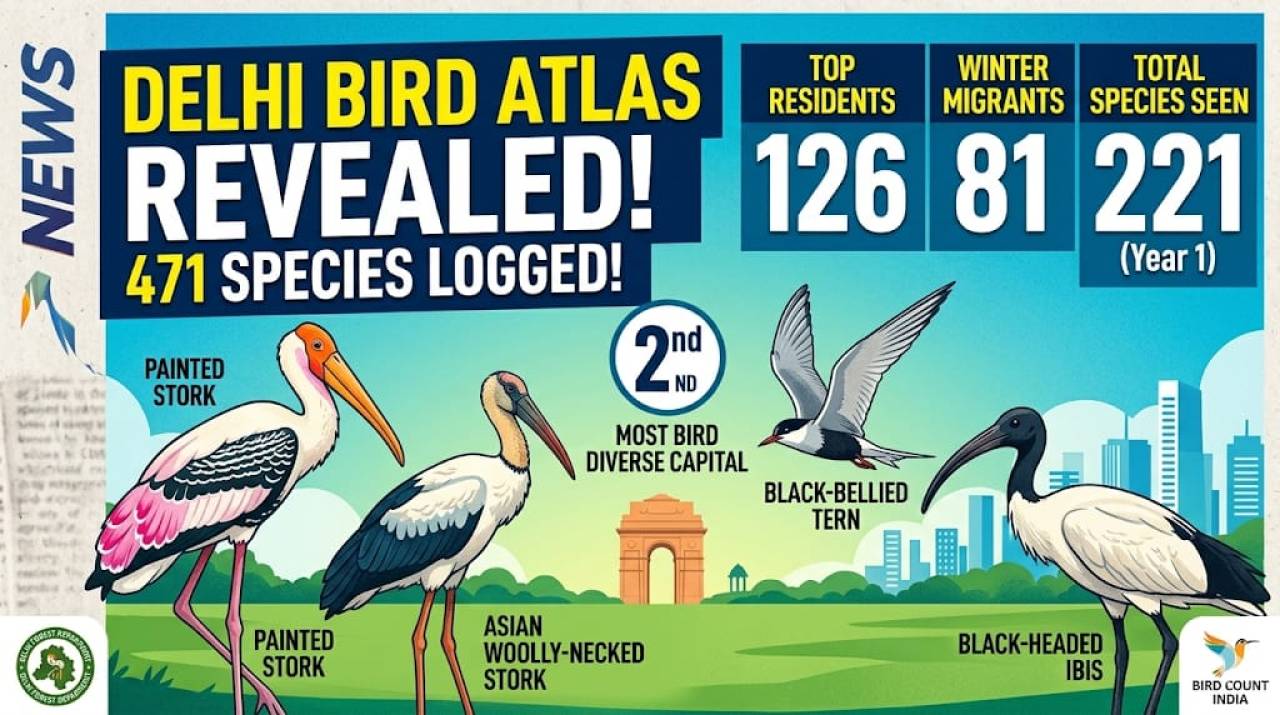
Delhi is more than a megacity. Its first Bird Atlas reveals 471 species, proving that extraordinary biodiversity continues to thrive amid urban growth.
A bustling metropolis known for its traffic, expanding infrastructure, and dense population may not seem like an ideal haven for wildlife. Yet Delhi has proven otherwise. The launch of the capital’s first comprehensive bird atlas has revealed an astonishing level of biodiversity, documenting 471 bird species and placing Delhi among the most bird-diverse national capitals in the world.
Released on the occasion of World Environment Day by Union Minister of State for External Affairs Kirti Vardhan Singh, the Delhi Bird Atlas highlights a side of the city that often goes unnoticed. The landmark publication not only showcases the richness of Delhi’s avian life but also provides a scientific foundation for future conservation efforts, urban planning, and environmental education.
Mapping Delhi’s Birds with Scientific Precision
Creating a detailed picture of bird diversity across a city as large and complex as Delhi required a carefully designed scientific approach. The two-year project, launched in January 2025, was led by the Delhi Forest Department in collaboration with Bird Count India.
Researchers divided Delhi into grids measuring 6.6 kilometres by 6.6 kilometres. Each grid was further broken into smaller sections, ensuring systematic coverage of the city’s varied landscapes. From these, 145 sub-cells representing around 11 percent of Delhi’s total area were randomly selected for intensive surveys.
Nearly 200 participants, including experienced birdwatchers and citizen scientists, worked in teams to conduct standardized 15-minute bird counts across different seasons. This method helped researchers capture both resident and migratory species while reducing observational bias.
The result is the most comprehensive record of bird life ever assembled for India’s capital.
What the First-Year Survey Revealed
During the first year alone, survey teams documented 221 bird species. Researchers categorized these species according to their feeding habits, providing valuable insights into the health of Delhi’s ecosystems.
Almost half of the recorded species were invertebrate feeders, relying on insects and other small invertebrates for survival. Their abundance suggests that despite rapid urbanization, Delhi still supports healthy insect populations in its parks, wetlands, forests, and green corridors.
Plant and seed feeders formed another significant group, while omnivores demonstrated the adaptability of many urban bird species. Birds of prey and scavengers also maintained a strong presence, highlighting the continued ecological importance of Delhi’s natural habitats.
By contrast, fruit and nectar feeders represented only a small proportion of the total. This finding may indicate the need for more flowering and fruit-bearing trees within the city’s urban landscape.
Why Delhi Attracts So Many Birds
Delhi’s extraordinary bird diversity is no accident. The city sits at a unique ecological crossroads where several habitats converge.
The Aravalli Ridge brings rocky terrain, scrub forests, and woodland habitats into the heart of the capital. At the same time, the Yamuna River and its floodplains provide critical wetland ecosystems that support waterbirds and other wildlife.
Delhi also occupies a strategic position along the Central Asian Flyway, one of the world’s major migratory bird routes. Every year, birds travel thousands of kilometres from Siberia, Central Asia, and the Arctic to escape harsh winters, with many using Delhi as a seasonal refuge.
Of the 221 species documented during the first year of surveys, 126 were resident species, 81 were winter migrants, and 14 were summer migrants that arrived to breed.
This combination of diverse habitats and global migration pathways makes Delhi an exceptionally important destination for birds.
A Warning Amid the Success Story
While the atlas paints an encouraging picture of urban biodiversity, it also highlights significant conservation challenges.
Researchers recorded several threatened and near-threatened species, including the Black-bellied Tern, Oriental Darter, Asian Woolly-necked Stork, Black-headed Ibis, and Painted Stork. Their continued presence demonstrates the ecological value of Delhi’s remaining natural habitats.
However, the report also notes that 22 bird species historically recorded in the capital have not been observed since 1975. Their disappearance serves as a reminder of the pressures created by habitat loss, pollution, and unchecked urban expansion.
The findings underscore the need for stronger conservation measures to ensure that future generations continue to witness Delhi’s remarkable avian diversity.
A Blueprint for Conservation and Citizen Science
The Delhi Bird Atlas is more than a checklist of species. It establishes a baseline against which future environmental changes can be measured.
According to Delhi Environment Minister Manjinder Singh Sirsa, the atlas will help guide habitat restoration efforts, sustainable urban development, and the protection of ecologically sensitive areas such as the Yamuna floodplains.
The project also demonstrates the power of citizen science. By involving volunteers alongside experts, it transformed ordinary residents into contributors to scientific research and conservation.
Perhaps the atlas’s most important message is that biodiversity is not confined to remote forests or national parks. It exists in city parks, neighbourhood gardens, school grounds, and wetlands woven into urban life.
As Delhi continues to grow, the atlas serves as both a celebration and a call to action—showing that a modern megacity can remain a thriving home for wildlife when nature is valued, protected, and allowed to flourish.
A bustling metropolis known for its traffic, expanding infrastructure, and dense population may not seem like an ideal haven for wildlife. Yet Delhi has proven otherwise. The launch of the capital’s first comprehensive bird atlas has revealed an astonishing level of biodiversity, documenting 471 bird species and placing Delhi among the most bird-diverse national capitals in the world.
Released on the occasion of World Environment Day by Union Minister of State for External Affairs Kirti Vardhan Singh, the Delhi Bird Atlas highlights a side of the city that often goes unnoticed. The landmark publication not only showcases the richness of Delhi’s avian life but also provides a scientific foundation for future conservation efforts, urban planning, and environmental education.
Mapping Delhi’s Birds with Scientific Precision
Creating a detailed picture of bird diversity across a city as large and complex as Delhi required a carefully designed scientific approach. The two-year project, launched in January 2025, was led by the Delhi Forest Department in collaboration with Bird Count India.
Researchers divided Delhi into grids measuring 6.6 kilometres by 6.6 kilometres. Each grid was further broken into smaller sections, ensuring systematic coverage of the city’s varied landscapes. From these, 145 sub-cells representing around 11 percent of Delhi’s total area were randomly selected for intensive surveys.
Nearly 200 participants, including experienced birdwatchers and citizen scientists, worked in teams to conduct standardized 15-minute bird counts across different seasons. This method helped researchers capture both resident and migratory species while reducing observational bias.
The result is the most comprehensive record of bird life ever assembled for India’s capital.
What the First-Year Survey Revealed
During the first year alone, survey teams documented 221 bird species. Researchers categorized these species according to their feeding habits, providing valuable insights into the health of Delhi’s ecosystems.
Almost half of the recorded species were invertebrate feeders, relying on insects and other small invertebrates for survival. Their abundance suggests that despite rapid urbanization, Delhi still supports healthy insect populations in its parks, wetlands, forests, and green corridors.
Plant and seed feeders formed another significant group, while omnivores demonstrated the adaptability of many urban bird species. Birds of prey and scavengers also maintained a strong presence, highlighting the continued ecological importance of Delhi’s natural habitats.
By contrast, fruit and nectar feeders represented only a small proportion of the total. This finding may indicate the need for more flowering and fruit-bearing trees within the city’s urban landscape.
Why Delhi Attracts So Many Birds
Delhi’s extraordinary bird diversity is no accident. The city sits at a unique ecological crossroads where several habitats converge.
The Aravalli Ridge brings rocky terrain, scrub forests, and woodland habitats into the heart of the capital. At the same time, the Yamuna River and its floodplains provide critical wetland ecosystems that support waterbirds and other wildlife.
Delhi also occupies a strategic position along the Central Asian Flyway, one of the world’s major migratory bird routes. Every year, birds travel thousands of kilometres from Siberia, Central Asia, and the Arctic to escape harsh winters, with many using Delhi as a seasonal refuge.
Of the 221 species documented during the first year of surveys, 126 were resident species, 81 were winter migrants, and 14 were summer migrants that arrived to breed.
This combination of diverse habitats and global migration pathways makes Delhi an exceptionally important destination for birds.
A Warning Amid the Success Story
While the atlas paints an encouraging picture of urban biodiversity, it also highlights significant conservation challenges.
Researchers recorded several threatened and near-threatened species, including the Black-bellied Tern, Oriental Darter, Asian Woolly-necked Stork, Black-headed Ibis, and Painted Stork. Their continued presence demonstrates the ecological value of Delhi’s remaining natural habitats.
However, the report also notes that 22 bird species historically recorded in the capital have not been observed since 1975. Their disappearance serves as a reminder of the pressures created by habitat loss, pollution, and unchecked urban expansion.
The findings underscore the need for stronger conservation measures to ensure that future generations continue to witness Delhi’s remarkable avian diversity.
A Blueprint for Conservation and Citizen Science
The Delhi Bird Atlas is more than a checklist of species. It establishes a baseline against which future environmental changes can be measured.
According to Delhi Environment Minister Manjinder Singh Sirsa, the atlas will help guide habitat restoration efforts, sustainable urban development, and the protection of ecologically sensitive areas such as the Yamuna floodplains.
The project also demonstrates the power of citizen science. By involving volunteers alongside experts, it transformed ordinary residents into contributors to scientific research and conservation.
Perhaps the atlas’s most important message is that biodiversity is not confined to remote forests or national parks. It exists in city parks, neighbourhood gardens, school grounds, and wetlands woven into urban life.
As Delhi continues to grow, the atlas serves as both a celebration and a call to action—showing that a modern megacity can remain a thriving home for wildlife when nature is valued, protected, and allowed to flourish.




























Leave a Comment