
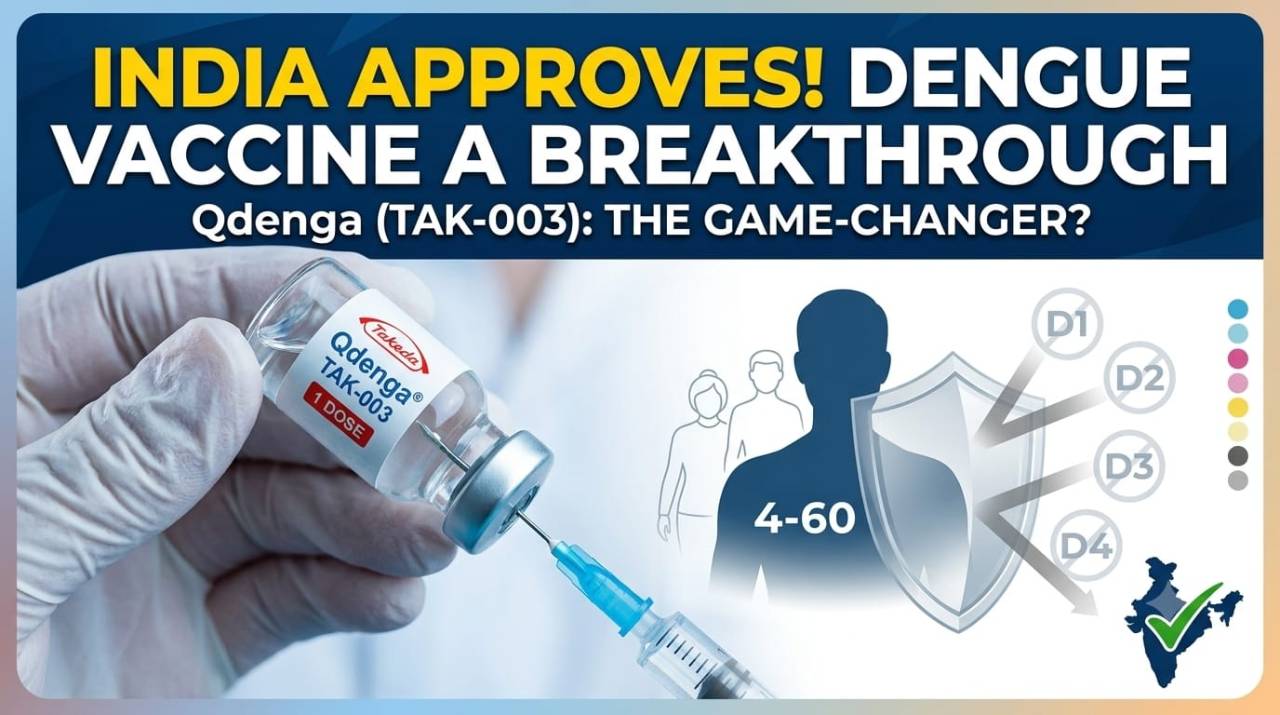
India has taken a historic step in the fight against dengue. With the approval of Qdenga, the country's first dengue vaccine, millions could soon have access to stronger protection against one of India's fastest-growing mosquito-borne diseases.
In a long-awaited regulatory milestone, India has approved its first-ever vaccine against dengue, opening a powerful new front in the country’s ongoing battle against mosquito-borne diseases. The Drug Controller General of India (DCGI) granted market authorization to Qdenga (TAK-003), a live-attenuated dengue vaccine developed by the Japanese pharmaceutical company Takeda.
Approved for individuals aged 4 to 60, this landmark authorization comes at a critical time as seasonal dengue outbreaks continue to strain healthcare infrastructure across Indian states.
Key Features of Qdenga
Qdenga represents a major technological step forward in vector-borne disease prevention:
- Broad Protection Across Serotypes: As a tetravalent vaccine, it is formulated to protect against all four dengue virus serotypes (DENV-1, DENV-2, DENV-3, and DENV-4).
- No Pre-Vaccination Screening Required: Unlike Sanofi’s earlier vaccine (Dengvaxia), which was limited strictly to individuals with laboratory-confirmed prior infection, Qdenga can be administered regardless of whether a person has previously had dengue.
- Simple Dosing Schedule: The vaccine is delivered subcutaneously in a standard two-dose regimen, administered three months apart.
Addressing India’s Escalating Dengue Challenge
Dengue has long remained one of India’s most persistent vector-borne threats. Rapid urbanization, changing weather patterns, and expanding mosquito habitats have caused reported cases to surge nearly 11-fold over the past two decades.
┌─────────────────────────────────────────────────────────────┐
│ INDIA'S DENGUE PROFILE
├─────────────────────────────────────────────────────────────┤
│ • Global Share : 33% of world's dengue burden
│ • Transmission : Endemic year-round with seasonal spikes
│ • Co-Circulation: All 4 virus serotypes present nationally
└─────────────────────────────────────────────────────────────┘
India accounts for nearly one-third of the total global dengue burden. Official data reported over 2.32 lakh cases and hundreds of deaths annually, though health experts note the actual number of infections is significantly higher due to widespread underreporting. Because all four virus serotypes circulate simultaneously across several regions, individuals remain at continuous risk for secondary infections, which carry a much higher likelihood of progressing to severe dengue or hospitalisation.
Clinical Evidence and Safety Profile
The DCGI’s approval was backed by rigorous data from Takeda's global clinical development program involving over 28,000 participants across 19 trials. This included the pivotal Phase III TIDES trial as well as dedicated Phase III clinical studies (DEN-302) conducted directly among Indian participants aged 4 to 60 years, which confirmed that the vaccine is safe, well-tolerated, and immunogenic across age groups.
Clinical Findings: Long-term follow-up data spanning seven years demonstrated sustained protection against symptomatic dengue and severe disease, showing over 80% efficacy in preventing hospitalisations.
The vaccine has already received prequalification from the World Health Organization (WHO) and is approved in over 40 countries, including Brazil, Argentina, Indonesia, and members of the European Union.
What Lies Ahead: Rollout and Policy Decisions
While the regulatory approval is a cause for celebration, public health experts emphasize that the vaccine's actual impact will depend heavily on execution:
- Commercial Availability: Takeda plans to launch the vaccine in the Indian market, working alongside regulatory and healthcare partners to finalize logistics.
- Affordability & Pricing: Pricing strategies will determine how quickly the vaccine becomes accessible to the broader public.
- Government Integration: Incorporating Qdenga into national immunization initiatives could transform equitable access for vulnerable populations.
Medical experts caution that while vaccines are a vital weapon, they do not eliminate the need for primary prevention. Integrated vector management, such as mosquito breeding control, public sanitation, and community awareness, must remain central to India’s disease control strategy alongside immunization. Nevertheless, Qdenga offers India a vital defense mechanism against a disease that has plagued millions for decades.
In a long-awaited regulatory milestone, India has approved its first-ever vaccine against dengue, opening a powerful new front in the country’s ongoing battle against mosquito-borne diseases. The Drug Controller General of India (DCGI) granted market authorization to Qdenga (TAK-003), a live-attenuated dengue vaccine developed by the Japanese pharmaceutical company Takeda.
Approved for individuals aged 4 to 60, this landmark authorization comes at a critical time as seasonal dengue outbreaks continue to strain healthcare infrastructure across Indian states.
Key Features of Qdenga
Qdenga represents a major technological step forward in vector-borne disease prevention:
- Broad Protection Across Serotypes: As a tetravalent vaccine, it is formulated to protect against all four dengue virus serotypes (DENV-1, DENV-2, DENV-3, and DENV-4).
- No Pre-Vaccination Screening Required: Unlike Sanofi’s earlier vaccine (Dengvaxia), which was limited strictly to individuals with laboratory-confirmed prior infection, Qdenga can be administered regardless of whether a person has previously had dengue.
- Simple Dosing Schedule: The vaccine is delivered subcutaneously in a standard two-dose regimen, administered three months apart.
Addressing India’s Escalating Dengue Challenge
Dengue has long remained one of India’s most persistent vector-borne threats. Rapid urbanization, changing weather patterns, and expanding mosquito habitats have caused reported cases to surge nearly 11-fold over the past two decades.
┌─────────────────────────────────────────────────────────────┐
│ INDIA'S DENGUE PROFILE
├─────────────────────────────────────────────────────────────┤
│ • Global Share : 33% of world's dengue burden
│ • Transmission : Endemic year-round with seasonal spikes
│ • Co-Circulation: All 4 virus serotypes present nationally
└─────────────────────────────────────────────────────────────┘
India accounts for nearly one-third of the total global dengue burden. Official data reported over 2.32 lakh cases and hundreds of deaths annually, though health experts note the actual number of infections is significantly higher due to widespread underreporting. Because all four virus serotypes circulate simultaneously across several regions, individuals remain at continuous risk for secondary infections, which carry a much higher likelihood of progressing to severe dengue or hospitalisation.
Clinical Evidence and Safety Profile
The DCGI’s approval was backed by rigorous data from Takeda's global clinical development program involving over 28,000 participants across 19 trials. This included the pivotal Phase III TIDES trial as well as dedicated Phase III clinical studies (DEN-302) conducted directly among Indian participants aged 4 to 60 years, which confirmed that the vaccine is safe, well-tolerated, and immunogenic across age groups.
Clinical Findings: Long-term follow-up data spanning seven years demonstrated sustained protection against symptomatic dengue and severe disease, showing over 80% efficacy in preventing hospitalisations.
The vaccine has already received prequalification from the World Health Organization (WHO) and is approved in over 40 countries, including Brazil, Argentina, Indonesia, and members of the European Union.
What Lies Ahead: Rollout and Policy Decisions
While the regulatory approval is a cause for celebration, public health experts emphasize that the vaccine's actual impact will depend heavily on execution:
- Commercial Availability: Takeda plans to launch the vaccine in the Indian market, working alongside regulatory and healthcare partners to finalize logistics.
- Affordability & Pricing: Pricing strategies will determine how quickly the vaccine becomes accessible to the broader public.
- Government Integration: Incorporating Qdenga into national immunization initiatives could transform equitable access for vulnerable populations.
Medical experts caution that while vaccines are a vital weapon, they do not eliminate the need for primary prevention. Integrated vector management, such as mosquito breeding control, public sanitation, and community awareness, must remain central to India’s disease control strategy alongside immunization. Nevertheless, Qdenga offers India a vital defense mechanism against a disease that has plagued millions for decades.

















Leave a Comment