
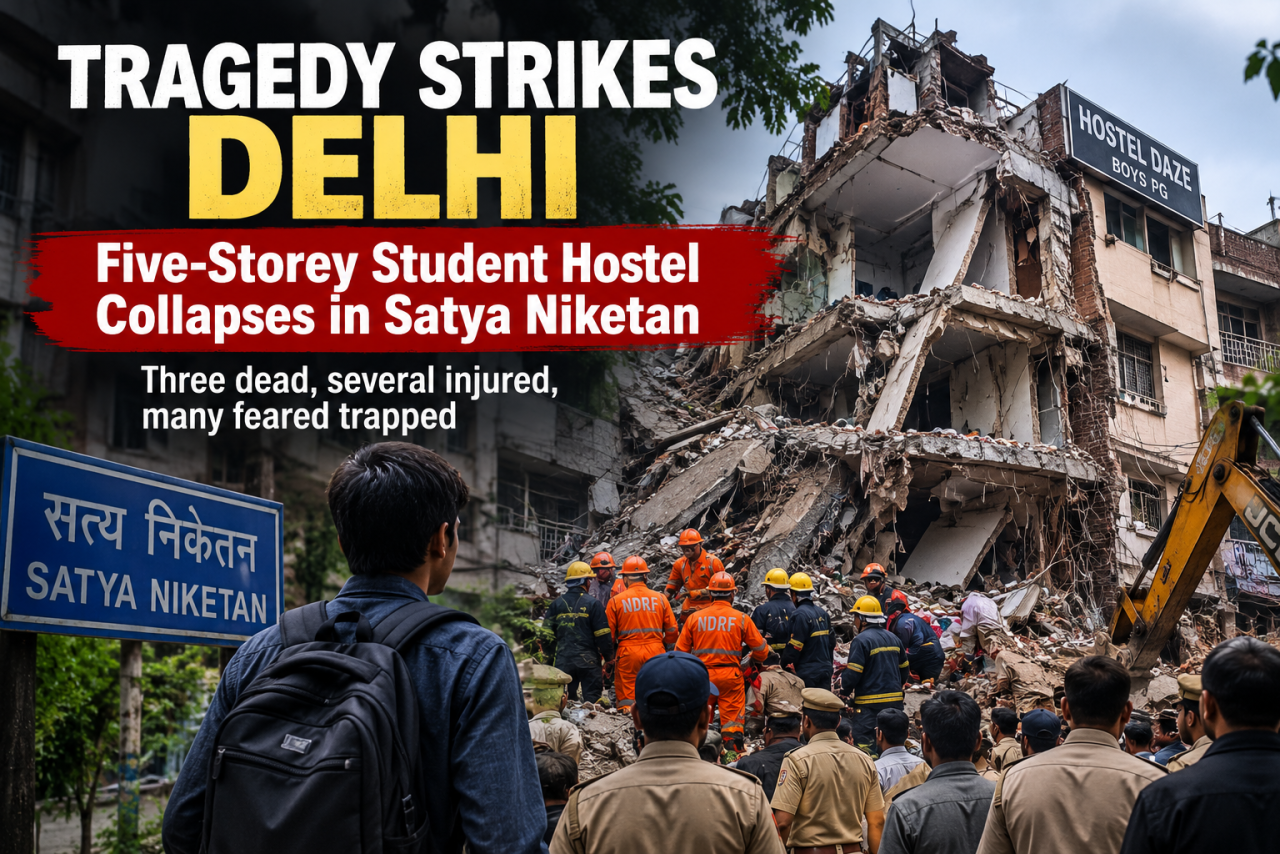
A student hostel collapsed in Delhi’s Satya Niketan, killing at least three people. The rubble now raises a larger question about how unsafe student housing is allowed to operate until disaster strikes.
A five-storey building housing a boys’ paying guest accommodation collapsed in Delhi’s Satya Niketan area around 1:30 pm on Sunday, September 6, killing at least three people and leaving several others injured or feared trapped beneath the rubble.
The collapse occurred near Nanakpura Gurdwara, close to Delhi University’s South Campus, turning a busy student neighbourhood into a rescue zone within minutes.
The incident has once again raised serious questions about the safety of ageing private student accommodations in the national capital, particularly buildings that undergo structural alterations without adequate oversight.
An Ageing Building Filled With Students
Locally known as Hostel Daze, the building was reportedly around 40 to 50 years old and consisted of a basement and five upper floors.
It was being used as a private PG accommodation for students, many of whom attended colleges in the South Campus area, including Motilal Nehru College, Atma Ram Sanatan Dharma College and Sri Venkateswara College.
Locals estimated that the building contained around 15 rooms, with two or three students sharing each room. With it being a rainy Sunday, a large number of residents were reportedly inside when the structure collapsed.
Eyewitnesses described a sudden tremor before the building came down.
Some residents said the sensation was “like an earthquake”. Others reported hearing cries for help from beneath the rubble.
According to local accounts, some trapped students managed to make phone and video calls seeking assistance.
One resident who has lived in the area for around two decades claimed that repair and construction work was underway in the basement. Water had reportedly accumulated there following recent rains.
The resident alleged that the foundation was already extremely weak.
These accounts will have to be established through an official investigation. But the possibility that structural work was being carried out in an ageing building has immediately become a central focus of the probe.
Rescue Operation Begins
Delhi Police received a PCR call at 1:34 pm, following which emergency teams were rushed to the site.
Fire tenders, teams from the National Disaster Response Force, Delhi Fire Service, Delhi Disaster Management Authority, Municipal Corporation of Delhi and Centralised Accident and Trauma Services were deployed.
Local residents also joined the rescue effort, attempting to clear debris with their hands and whatever tools were available.
By evening, authorities had confirmed at least three deaths.
Between six and nine people were reportedly rescued alive, with several in critical condition. The injured were taken to AIIMS Trauma Centre and other hospitals.
The exact number of people who may have been inside the building remained unclear in the initial hours. Local estimates varied considerably, with some residents suggesting that as many as 30 to 50 people could have been inside.
The final casualty and missing-person figures are expected to become clearer as rescue teams complete the debris-clearing operation.
Basement Work Under Scanner
Delhi Police have registered an FIR against the building’s owner, identified by officials as Anand Bansal, although some reports have referred to him as Hari Ram Bansal. He is reportedly a resident of Gurugram.
Officials said repair work was underway in the basement when the structure collapsed.
Preliminary accounts have raised the possibility that excavation or structural modification in the basement may have weakened pillars or compromised the foundation of the already ageing building.
An adjoining building was also reportedly found leaning and was considered at risk.
The investigation will need to establish a basic but crucial question. Was structural work being carried out legally and with the necessary safety precautions, and if not, why was it allowed to continue?
Political Reactions and Demands for a Probe
Delhi Chief Minister Rekha Gupta visited the site and reviewed the rescue operation. She said that “no one will be spared”.
Prime Minister Narendra Modi expressed distress over the incident, offered condolences to the families of those who died and prayed for the recovery of those injured.
Union Education Minister Prahlad Joshi also spoke to the Chief Minister and called for effective relief measures.
Student organisations including ABVP, NSUI and SFI, along with teachers’ groups, have demanded a detailed investigation and a city-wide structural safety audit of private PG accommodations.
The demand is significant because Satya Niketan is not an isolated student neighbourhood. It is part of a much larger ecosystem of privately operated accommodation serving thousands of students who cannot find places in university hostels.
Satya Niketan Has Seen a Similar Collapse Before
The latest tragedy has an uncomfortable precedent.
In April 2022, an old three-storey building in Satya Niketan collapsed during alleged illegal renovation work, killing two workers.
The Municipal Corporation of Delhi had reportedly issued a stop-work notice at the time. Yet construction allegedly continued.
That episode raised questions about whether regulatory orders on paper translate into enforcement on the ground.
Four years later, another building has collapsed in the same locality.
Residents have long complained about waterlogging, open drains and the conversion of old residential properties into overcrowded student accommodations.
The proximity of an MCD office to the latest collapse has further intensified questions about inspection and enforcement.
Residents allege that regular structural inspections are rare despite the rapid conversion of buildings into commercial PG accommodation.
How Did an Ageing Building Escape Scrutiny?
The tragedy also puts the spotlight on Delhi’s monsoon preparedness.
The MCD had reportedly surveyed nearly 28 lakh properties ahead of the monsoon and identified only a limited number as dangerous.
That raises an obvious question.
If an ageing five-storey building was being used as a densely occupied student hostel and structural work was taking place in its basement, why was its safety not flagged before disaster struck?
The question becomes even more serious in light of concerns raised in a recent magisterial inquiry into another South Delhi building collapse in Saidulajab.
That inquiry reportedly criticised the civic authorities for prolonged inaction against unauthorised construction and raised allegations concerning the handling of official records.
Taken together, such incidents suggest a problem that goes beyond one building or one locality. They point towards a recurring failure to detect, stop and penalise dangerous construction before lives are lost.
Students Are Paying for a Housing Shortage
Satya Niketan is one of Delhi’s major student hubs.
Thousands of young people from different parts of India live in private PGs because university accommodation remains limited.
Many reportedly pay around ₹12,000 per bed for accommodation.
For students and their families, a PG is not simply a commercial property. It is home.
Yet the rapid expansion of private student housing can create strong commercial incentives to maximise the number of occupants while minimising maintenance and structural expenditure.
That is where regulation becomes critical.
Basement excavation or modification beneath an existing structure can pose serious structural risks and is subject to building regulations. If unauthorised work was carried out in this case, the issue is not merely whether the owner made a mistake. It is also whether the authorities responsible for preventing such work failed to act.
A Preventable Disaster?
As rescue teams worked late into the evening under floodlights, families waited anxiously for news of their children.
The final scale of the tragedy will become clear only after the rubble has been completely cleared and authorities establish exactly how and why the building collapsed.
But the central issue is already clear.
Building collapses in Delhi are rarely just about concrete, pillars and foundations. They are often about what happens when ageing structures, commercial pressure, unauthorised construction and weak enforcement intersect.
If basement work weakened an already vulnerable building, responsibility cannot end with the person who carried out the work. The investigation must also examine who approved it, who inspected the property, who was responsible for enforcing the rules and why potential dangers were not identified earlier.
A student hostel should never become a gamble with young lives.
The Satya Niketan collapse demands more than condolences and rescue operations. It demands accountability, transparent investigation and meaningful structural audits of private student housing across Delhi.
Because when an unsafe building collapses, the disaster may happen in seconds.
Regulatory failure takes much longer.
A five-storey building housing a boys’ paying guest accommodation collapsed in Delhi’s Satya Niketan area around 1:30 pm on Sunday, September 6, killing at least three people and leaving several others injured or feared trapped beneath the rubble.
The collapse occurred near Nanakpura Gurdwara, close to Delhi University’s South Campus, turning a busy student neighbourhood into a rescue zone within minutes.
The incident has once again raised serious questions about the safety of ageing private student accommodations in the national capital, particularly buildings that undergo structural alterations without adequate oversight.
An Ageing Building Filled With Students
Locally known as Hostel Daze, the building was reportedly around 40 to 50 years old and consisted of a basement and five upper floors.
It was being used as a private PG accommodation for students, many of whom attended colleges in the South Campus area, including Motilal Nehru College, Atma Ram Sanatan Dharma College and Sri Venkateswara College.
Locals estimated that the building contained around 15 rooms, with two or three students sharing each room. With it being a rainy Sunday, a large number of residents were reportedly inside when the structure collapsed.
Eyewitnesses described a sudden tremor before the building came down.
Some residents said the sensation was “like an earthquake”. Others reported hearing cries for help from beneath the rubble.
According to local accounts, some trapped students managed to make phone and video calls seeking assistance.
One resident who has lived in the area for around two decades claimed that repair and construction work was underway in the basement. Water had reportedly accumulated there following recent rains.
The resident alleged that the foundation was already extremely weak.
These accounts will have to be established through an official investigation. But the possibility that structural work was being carried out in an ageing building has immediately become a central focus of the probe.
Rescue Operation Begins
Delhi Police received a PCR call at 1:34 pm, following which emergency teams were rushed to the site.
Fire tenders, teams from the National Disaster Response Force, Delhi Fire Service, Delhi Disaster Management Authority, Municipal Corporation of Delhi and Centralised Accident and Trauma Services were deployed.
Local residents also joined the rescue effort, attempting to clear debris with their hands and whatever tools were available.
By evening, authorities had confirmed at least three deaths.
Between six and nine people were reportedly rescued alive, with several in critical condition. The injured were taken to AIIMS Trauma Centre and other hospitals.
The exact number of people who may have been inside the building remained unclear in the initial hours. Local estimates varied considerably, with some residents suggesting that as many as 30 to 50 people could have been inside.
The final casualty and missing-person figures are expected to become clearer as rescue teams complete the debris-clearing operation.
Basement Work Under Scanner
Delhi Police have registered an FIR against the building’s owner, identified by officials as Anand Bansal, although some reports have referred to him as Hari Ram Bansal. He is reportedly a resident of Gurugram.
Officials said repair work was underway in the basement when the structure collapsed.
Preliminary accounts have raised the possibility that excavation or structural modification in the basement may have weakened pillars or compromised the foundation of the already ageing building.
An adjoining building was also reportedly found leaning and was considered at risk.
The investigation will need to establish a basic but crucial question. Was structural work being carried out legally and with the necessary safety precautions, and if not, why was it allowed to continue?
Political Reactions and Demands for a Probe
Delhi Chief Minister Rekha Gupta visited the site and reviewed the rescue operation. She said that “no one will be spared”.
Prime Minister Narendra Modi expressed distress over the incident, offered condolences to the families of those who died and prayed for the recovery of those injured.
Union Education Minister Prahlad Joshi also spoke to the Chief Minister and called for effective relief measures.
Student organisations including ABVP, NSUI and SFI, along with teachers’ groups, have demanded a detailed investigation and a city-wide structural safety audit of private PG accommodations.
The demand is significant because Satya Niketan is not an isolated student neighbourhood. It is part of a much larger ecosystem of privately operated accommodation serving thousands of students who cannot find places in university hostels.
Satya Niketan Has Seen a Similar Collapse Before
The latest tragedy has an uncomfortable precedent.
In April 2022, an old three-storey building in Satya Niketan collapsed during alleged illegal renovation work, killing two workers.
The Municipal Corporation of Delhi had reportedly issued a stop-work notice at the time. Yet construction allegedly continued.
That episode raised questions about whether regulatory orders on paper translate into enforcement on the ground.
Four years later, another building has collapsed in the same locality.
Residents have long complained about waterlogging, open drains and the conversion of old residential properties into overcrowded student accommodations.
The proximity of an MCD office to the latest collapse has further intensified questions about inspection and enforcement.
Residents allege that regular structural inspections are rare despite the rapid conversion of buildings into commercial PG accommodation.
How Did an Ageing Building Escape Scrutiny?
The tragedy also puts the spotlight on Delhi’s monsoon preparedness.
The MCD had reportedly surveyed nearly 28 lakh properties ahead of the monsoon and identified only a limited number as dangerous.
That raises an obvious question.
If an ageing five-storey building was being used as a densely occupied student hostel and structural work was taking place in its basement, why was its safety not flagged before disaster struck?
The question becomes even more serious in light of concerns raised in a recent magisterial inquiry into another South Delhi building collapse in Saidulajab.
That inquiry reportedly criticised the civic authorities for prolonged inaction against unauthorised construction and raised allegations concerning the handling of official records.
Taken together, such incidents suggest a problem that goes beyond one building or one locality. They point towards a recurring failure to detect, stop and penalise dangerous construction before lives are lost.
Students Are Paying for a Housing Shortage
Satya Niketan is one of Delhi’s major student hubs.
Thousands of young people from different parts of India live in private PGs because university accommodation remains limited.
Many reportedly pay around ₹12,000 per bed for accommodation.
For students and their families, a PG is not simply a commercial property. It is home.
Yet the rapid expansion of private student housing can create strong commercial incentives to maximise the number of occupants while minimising maintenance and structural expenditure.
That is where regulation becomes critical.
Basement excavation or modification beneath an existing structure can pose serious structural risks and is subject to building regulations. If unauthorised work was carried out in this case, the issue is not merely whether the owner made a mistake. It is also whether the authorities responsible for preventing such work failed to act.
A Preventable Disaster?
As rescue teams worked late into the evening under floodlights, families waited anxiously for news of their children.
The final scale of the tragedy will become clear only after the rubble has been completely cleared and authorities establish exactly how and why the building collapsed.
But the central issue is already clear.
Building collapses in Delhi are rarely just about concrete, pillars and foundations. They are often about what happens when ageing structures, commercial pressure, unauthorised construction and weak enforcement intersect.
If basement work weakened an already vulnerable building, responsibility cannot end with the person who carried out the work. The investigation must also examine who approved it, who inspected the property, who was responsible for enforcing the rules and why potential dangers were not identified earlier.
A student hostel should never become a gamble with young lives.
The Satya Niketan collapse demands more than condolences and rescue operations. It demands accountability, transparent investigation and meaningful structural audits of private student housing across Delhi.
Because when an unsafe building collapses, the disaster may happen in seconds.
Regulatory failure takes much longer.





















Leave a Comment