
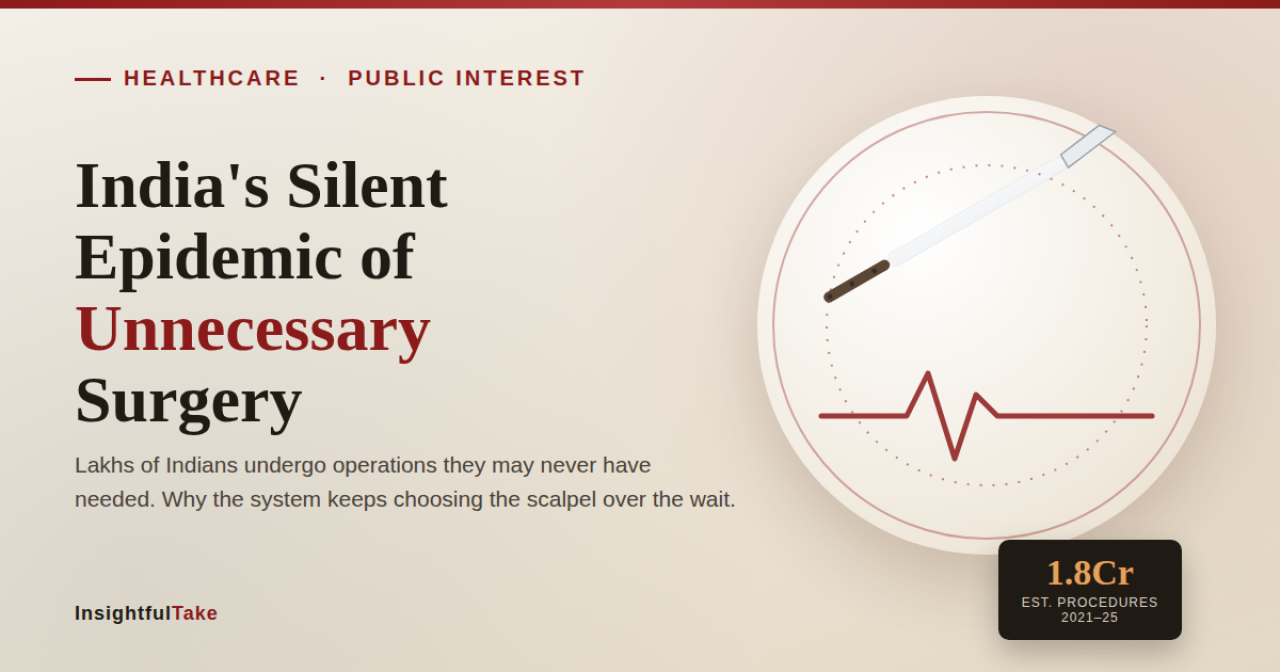
When medical intervention becomes easier than medical restraint, the question is no longer what can be treated, but what actually needs treatment.
Every year, lakhs of Indians walk into hospitals for operations they may never have needed. Gallbladder removal, one of the most common surgeries performed in the country, is now at the India’s Silent Epidemic: When Surgery Becomes the First Answer Instead of the Last
When medical intervention becomes easier than medical restraint, the question is no longer what can be treated, but what actually needs treatment.
Every year, lakhs of Indians walk into hospitals for operations they may never have needed. Gallbladder removal, one of the most common surgeries performed in the country, is now at the centre of a growing debate among doctors about whether India’s healthcare system has quietly shifted from treating disease to intervening where intervention may not always be necessary.
A 2026 review published in BMJ Public Health estimated that around 32 lakh cholecystectomies, the medical term for gallbladder removal, were carried out in India in 2022 alone. Extrapolated over five years, that figure suggests that nearly 1.8 crore people may have undergone the procedure between 2021 and 2025.
India, however, has no national registry tracking how many of these surgeries were medically necessary. That gap in data is one reason doctors increasingly view the rising number of cholecystectomies as a possible warning sign of a much broader problem: the growing risk of overtreatment.
When a Gallstone Becomes a Diagnosis
Gallstones themselves are common and, for most people, harmless. They form from hardened deposits of cholesterol or bile pigments, with the risk increasing with age, obesity, pregnancy, hormonal changes and rapid weight loss.
Crucially, most gallstones cause no symptoms.
They are often discovered incidentally during an ultrasound performed for an unrelated complaint such as acidity, abdominal discomfort or even as part of a routine health check-up.
International medical guidelines generally distinguish between an incidental gallstone and a symptomatic disease requiring intervention. When the gallbladder and bile ducts are otherwise normal and the patient has no symptoms, surgery is usually not required. Observation is often the appropriate course.
Surgery becomes necessary when gallstones cause recurrent pain, inflammation, bile-duct obstruction or complications such as pancreatitis.
For someone with an incidental, symptom-free gallstone, therefore, watching and waiting can be medically sound.
The Pressure to Operate
Practice on the ground can sometimes tell a different story.
Once an ultrasound report mentions “multiple gallstones,” some patients say they are quickly advised to undergo surgery. Laparoscopic cholecystectomy is now a routine and widely available procedure. It usually involves a relatively short hospital stay and is often covered by health insurance.
All of this can make surgery appear to be the safer and more convenient option, even when immediate intervention may not be medically necessary.
This does not automatically mean that doctors or hospitals are acting with bad intentions. The more complicated issue is the structure of healthcare itself.
Much of India’s private and corporate healthcare operates through a fee-for-service model. Hospitals generate revenue from consultations, investigations, admissions and procedures. Counselling a patient to observe a condition, return for follow-up or simply do nothing may require medical time without generating comparable revenue.
Insurance systems can create another distortion. Reimbursement for a defined surgical procedure may be more straightforward than payment for prolonged counselling, monitoring or watchful waiting.
When institutional and financial incentives reward intervention more visibly than restraint, overtreatment can emerge without anyone explicitly deciding to overtreat.
No Surgery Is Truly Risk-Free
The perception that routine surgery is automatically safe can also be misleading.
Even laparoscopic gallbladder removal can involve complications, including bleeding, infection, anaesthetic problems and, in rare cases, injury to the bile duct. Some patients may also experience persistent or altered digestive symptoms after the gallbladder is removed.
These risks are generally considered acceptable when surgery is clearly indicated, particularly when it relieves recurrent symptoms or prevents serious complications.
The ethical question becomes more difficult when the procedure itself was never medically necessary.
The issue, therefore, is not whether surgery is good or bad. It is whether the benefit of surgery outweighs its risks for a particular patient.
Gallbladder Surgery May Be Only the Beginning
Gallbladder removal is merely one entry point into a much wider conversation about medical overtreatment in India.
Caesarean-section rates, particularly in some private healthcare settings, have prompted repeated debate. Hysterectomies among low-income and rural women have attracted government scrutiny and public concern.
Similar questions arise around angioplasty for stable heart disease, spinal procedures for uncomplicated back pain, knee replacement before adequate conservative treatment has been attempted, and certain appendix or tonsil removals.
Each of these procedures can be appropriate in the right circumstances. The concern is not that these interventions exist, but that the threshold for intervention may sometimes become too low.
When Healthcare Starts With a Test
Underlying the problem is a deeper change in how healthcare begins.
Traditionally, the sequence was relatively straightforward. A person developed symptoms, consulted a doctor, underwent appropriate evaluation and received treatment based on the findings.
Modern healthcare has added another pathway.
Healthy people increasingly undergo extensive screening packages. Minor risk factors can be presented as potential diseases. An abnormal number on a report can trigger anxiety, followed by specialist consultations, additional tests and, eventually, procedures.
Technology has made it possible to detect more abnormalities than ever before.
But detecting something does not automatically mean that it needs to be treated.
The central question should always remain: Will treating this finding improve the patient’s health or quality of life?
The Case for “Slow Medicine”
India undoubtedly needs advanced diagnostic facilities, highly trained specialists and capable surgeons. But it may also need something less glamorous: restraint.
Some doctors and healthcare thinkers describe this approach as “slow medicine”. The term does not mean delaying necessary treatment. It means moving quickly when evidence clearly supports intervention while proceeding more carefully when the benefits are uncertain.
It means valuing clinical judgement, second opinions and genuinely informed consent.
Most importantly, it means asking a question that modern healthcare can sometimes overlook:
What is likely to happen if nothing is done?
That question can be particularly important when the proposed treatment is invasive, expensive or irreversible.
India Needs Better Data and Better Incentives
Reports of potentially unnecessary procedures regularly surface in India. Yet the country still lacks a comprehensive national system that records elective surgeries, the reasons behind them and whether they were ultimately considered medically necessary.
Better data could make the scale of the problem measurable.
Insurance reform could also help. Payment systems should not inadvertently encourage procedures simply because procedures are easier to reimburse than counselling or observation.
Stronger primary healthcare would provide another layer of protection by giving patients access to trusted medical advice before they reach a high-cost specialist or hospital setting.
Second-opinion systems could further help patients make informed choices about elective procedures.
The Patient’s Right to Ask “Why?”
Patients, too, have an important role.
Before agreeing to an elective procedure, they have every right to ask:
Do I really need this now?
They can also ask whether there are non-surgical alternatives, what happens if they wait, what the risks of the procedure are, and whether another qualified doctor would recommend the same course of action.
These questions are not challenges to medical authority. They are part of informed consent.
Medicine has achieved extraordinary things because science has expanded the boundaries of what doctors can do.
But the maturity of a healthcare system is measured not only by its ability to intervene. It is also measured by its ability to recognise when intervention is unnecessary.
In the end, progress in medicine is not simply about doing more.
It is about doing what is necessary, for the right patient, at the right time, for the right reason.
Sometimes the best treatment is surgery.
Sometimes it is a second opinion.
And sometimes, quite simply, it is doing nothing at all.
centre of a growing debate among doctors about whether India’s healthcare system has quietly shifted from treating disease to intervening where intervention may not always be necessary.
A 2026 review published in BMJ Public Health estimated that around 32 lakh cholecystectomies, the medical term for gallbladder removal, were carried out in India in 2022 alone. Extrapolated over five years, that figure suggests that nearly 1.8 crore people may have undergone the procedure between 2021 and 2025.
India, however, has no national registry tracking how many of these surgeries were medically necessary. That gap in data is one reason doctors increasingly view the rising number of cholecystectomies as a possible warning sign of a much broader problem: the growing risk of overtreatment.
When a Gallstone Becomes a Diagnosis
Gallstones themselves are common and, for most people, harmless. They form from hardened deposits of cholesterol or bile pigments, with the risk increasing with age, obesity, pregnancy, hormonal changes and rapid weight loss.
Crucially, most gallstones cause no symptoms.
They are often discovered incidentally during an ultrasound performed for an unrelated complaint such as acidity, abdominal discomfort or even as part of a routine health check-up.
International medical guidelines generally distinguish between an incidental gallstone and a symptomatic disease requiring intervention. When the gallbladder and bile ducts are otherwise normal and the patient has no symptoms, surgery is usually not required. Observation is often the appropriate course.
Surgery becomes necessary when gallstones cause recurrent pain, inflammation, bile-duct obstruction or complications such as pancreatitis.
For someone with an incidental, symptom-free gallstone, therefore, watching and waiting can be medically sound.
The Pressure to Operate
Practice on the ground can sometimes tell a different story.
Once an ultrasound report mentions “multiple gallstones,” some patients say they are quickly advised to undergo surgery. Laparoscopic cholecystectomy is now a routine and widely available procedure. It usually involves a relatively short hospital stay and is often covered by health insurance.
All of this can make surgery appear to be the safer and more convenient option, even when immediate intervention may not be medically necessary.
This does not automatically mean that doctors or hospitals are acting with bad intentions. The more complicated issue is the structure of healthcare itself.
Much of India’s private and corporate healthcare operates through a fee-for-service model. Hospitals generate revenue from consultations, investigations, admissions and procedures. Counselling a patient to observe a condition, return for follow-up or simply do nothing may require medical time without generating comparable revenue.
Insurance systems can create another distortion. Reimbursement for a defined surgical procedure may be more straightforward than payment for prolonged counselling, monitoring or watchful waiting.
When institutional and financial incentives reward intervention more visibly than restraint, overtreatment can emerge without anyone explicitly deciding to overtreat.
No Surgery Is Truly Risk-Free
The perception that routine surgery is automatically safe can also be misleading.
Even laparoscopic gallbladder removal can involve complications, including bleeding, infection, anaesthetic problems and, in rare cases, injury to the bile duct. Some patients may also experience persistent or altered digestive symptoms after the gallbladder is removed.
These risks are generally considered acceptable when surgery is clearly indicated, particularly when it relieves recurrent symptoms or prevents serious complications.
The ethical question becomes more difficult when the procedure itself was never medically necessary.
The issue, therefore, is not whether surgery is good or bad. It is whether the benefit of surgery outweighs its risks for a particular patient.
Gallbladder Surgery May Be Only the Beginning
Gallbladder removal is merely one entry point into a much wider conversation about medical overtreatment in India.
Caesarean-section rates, particularly in some private healthcare settings, have prompted repeated debate. Hysterectomies among low-income and rural women have attracted government scrutiny and public concern.
Similar questions arise around angioplasty for stable heart disease, spinal procedures for uncomplicated back pain, knee replacement before adequate conservative treatment has been attempted, and certain appendix or tonsil removals.
Each of these procedures can be appropriate in the right circumstances. The concern is not that these interventions exist, but that the threshold for intervention may sometimes become too low.
When Healthcare Starts With a Test
Underlying the problem is a deeper change in how healthcare begins.
Traditionally, the sequence was relatively straightforward. A person developed symptoms, consulted a doctor, underwent appropriate evaluation and received treatment based on the findings.
Modern healthcare has added another pathway.
Healthy people increasingly undergo extensive screening packages. Minor risk factors can be presented as potential diseases. An abnormal number on a report can trigger anxiety, followed by specialist consultations, additional tests and, eventually, procedures.
Technology has made it possible to detect more abnormalities than ever before.
But detecting something does not automatically mean that it needs to be treated.
The central question should always remain: Will treating this finding improve the patient’s health or quality of life?
The Case for “Slow Medicine”
India undoubtedly needs advanced diagnostic facilities, highly trained specialists and capable surgeons. But it may also need something less glamorous: restraint.
Some doctors and healthcare thinkers describe this approach as “slow medicine”. The term does not mean delaying necessary treatment. It means moving quickly when evidence clearly supports intervention while proceeding more carefully when the benefits are uncertain.
It means valuing clinical judgement, second opinions and genuinely informed consent.
Most importantly, it means asking a question that modern healthcare can sometimes overlook:
What is likely to happen if nothing is done?
That question can be particularly important when the proposed treatment is invasive, expensive or irreversible.
India Needs Better Data and Better Incentives
Reports of potentially unnecessary procedures regularly surface in India. Yet the country still lacks a comprehensive national system that records elective surgeries, the reasons behind them and whether they were ultimately considered medically necessary.
Better data could make the scale of the problem measurable.
Insurance reform could also help. Payment systems should not inadvertently encourage procedures simply because procedures are easier to reimburse than counselling or observation.
Stronger primary healthcare would provide another layer of protection by giving patients access to trusted medical advice before they reach a high-cost specialist or hospital setting.
Second-opinion systems could further help patients make informed choices about elective procedures.
The Patient’s Right to Ask “Why?”
Patients, too, have an important role.
Before agreeing to an elective procedure, they have every right to ask:
Do I really need this now?
They can also ask whether there are non-surgical alternatives, what happens if they wait, what the risks of the procedure are, and whether another qualified doctor would recommend the same course of action.
These questions are not challenges to medical authority. They are part of informed consent.
Medicine has achieved extraordinary things because science has expanded the boundaries of what doctors can do.
But the maturity of a healthcare system is measured not only by its ability to intervene. It is also measured by its ability to recognise when intervention is unnecessary.
In the end, progress in medicine is not simply about doing more.
It is about doing what is necessary, for the right patient, at the right time, for the right reason.
Sometimes the best treatment is surgery.
Sometimes it is a second opinion.
And sometimes, quite simply, it is doing nothing at all.
Every year, lakhs of Indians walk into hospitals for operations they may never have needed. Gallbladder removal, one of the most common surgeries performed in the country, is now at the India’s Silent Epidemic: When Surgery Becomes the First Answer Instead of the Last
When medical intervention becomes easier than medical restraint, the question is no longer what can be treated, but what actually needs treatment.
Every year, lakhs of Indians walk into hospitals for operations they may never have needed. Gallbladder removal, one of the most common surgeries performed in the country, is now at the centre of a growing debate among doctors about whether India’s healthcare system has quietly shifted from treating disease to intervening where intervention may not always be necessary.
A 2026 review published in BMJ Public Health estimated that around 32 lakh cholecystectomies, the medical term for gallbladder removal, were carried out in India in 2022 alone. Extrapolated over five years, that figure suggests that nearly 1.8 crore people may have undergone the procedure between 2021 and 2025.
India, however, has no national registry tracking how many of these surgeries were medically necessary. That gap in data is one reason doctors increasingly view the rising number of cholecystectomies as a possible warning sign of a much broader problem: the growing risk of overtreatment.
When a Gallstone Becomes a Diagnosis
Gallstones themselves are common and, for most people, harmless. They form from hardened deposits of cholesterol or bile pigments, with the risk increasing with age, obesity, pregnancy, hormonal changes and rapid weight loss.
Crucially, most gallstones cause no symptoms.
They are often discovered incidentally during an ultrasound performed for an unrelated complaint such as acidity, abdominal discomfort or even as part of a routine health check-up.
International medical guidelines generally distinguish between an incidental gallstone and a symptomatic disease requiring intervention. When the gallbladder and bile ducts are otherwise normal and the patient has no symptoms, surgery is usually not required. Observation is often the appropriate course.
Surgery becomes necessary when gallstones cause recurrent pain, inflammation, bile-duct obstruction or complications such as pancreatitis.
For someone with an incidental, symptom-free gallstone, therefore, watching and waiting can be medically sound.
The Pressure to Operate
Practice on the ground can sometimes tell a different story.
Once an ultrasound report mentions “multiple gallstones,” some patients say they are quickly advised to undergo surgery. Laparoscopic cholecystectomy is now a routine and widely available procedure. It usually involves a relatively short hospital stay and is often covered by health insurance.
All of this can make surgery appear to be the safer and more convenient option, even when immediate intervention may not be medically necessary.
This does not automatically mean that doctors or hospitals are acting with bad intentions. The more complicated issue is the structure of healthcare itself.
Much of India’s private and corporate healthcare operates through a fee-for-service model. Hospitals generate revenue from consultations, investigations, admissions and procedures. Counselling a patient to observe a condition, return for follow-up or simply do nothing may require medical time without generating comparable revenue.
Insurance systems can create another distortion. Reimbursement for a defined surgical procedure may be more straightforward than payment for prolonged counselling, monitoring or watchful waiting.
When institutional and financial incentives reward intervention more visibly than restraint, overtreatment can emerge without anyone explicitly deciding to overtreat.
No Surgery Is Truly Risk-Free
The perception that routine surgery is automatically safe can also be misleading.
Even laparoscopic gallbladder removal can involve complications, including bleeding, infection, anaesthetic problems and, in rare cases, injury to the bile duct. Some patients may also experience persistent or altered digestive symptoms after the gallbladder is removed.
These risks are generally considered acceptable when surgery is clearly indicated, particularly when it relieves recurrent symptoms or prevents serious complications.
The ethical question becomes more difficult when the procedure itself was never medically necessary.
The issue, therefore, is not whether surgery is good or bad. It is whether the benefit of surgery outweighs its risks for a particular patient.
Gallbladder Surgery May Be Only the Beginning
Gallbladder removal is merely one entry point into a much wider conversation about medical overtreatment in India.
Caesarean-section rates, particularly in some private healthcare settings, have prompted repeated debate. Hysterectomies among low-income and rural women have attracted government scrutiny and public concern.
Similar questions arise around angioplasty for stable heart disease, spinal procedures for uncomplicated back pain, knee replacement before adequate conservative treatment has been attempted, and certain appendix or tonsil removals.
Each of these procedures can be appropriate in the right circumstances. The concern is not that these interventions exist, but that the threshold for intervention may sometimes become too low.
When Healthcare Starts With a Test
Underlying the problem is a deeper change in how healthcare begins.
Traditionally, the sequence was relatively straightforward. A person developed symptoms, consulted a doctor, underwent appropriate evaluation and received treatment based on the findings.
Modern healthcare has added another pathway.
Healthy people increasingly undergo extensive screening packages. Minor risk factors can be presented as potential diseases. An abnormal number on a report can trigger anxiety, followed by specialist consultations, additional tests and, eventually, procedures.
Technology has made it possible to detect more abnormalities than ever before.
But detecting something does not automatically mean that it needs to be treated.
The central question should always remain: Will treating this finding improve the patient’s health or quality of life?
The Case for “Slow Medicine”
India undoubtedly needs advanced diagnostic facilities, highly trained specialists and capable surgeons. But it may also need something less glamorous: restraint.
Some doctors and healthcare thinkers describe this approach as “slow medicine”. The term does not mean delaying necessary treatment. It means moving quickly when evidence clearly supports intervention while proceeding more carefully when the benefits are uncertain.
It means valuing clinical judgement, second opinions and genuinely informed consent.
Most importantly, it means asking a question that modern healthcare can sometimes overlook:
What is likely to happen if nothing is done?
That question can be particularly important when the proposed treatment is invasive, expensive or irreversible.
India Needs Better Data and Better Incentives
Reports of potentially unnecessary procedures regularly surface in India. Yet the country still lacks a comprehensive national system that records elective surgeries, the reasons behind them and whether they were ultimately considered medically necessary.
Better data could make the scale of the problem measurable.
Insurance reform could also help. Payment systems should not inadvertently encourage procedures simply because procedures are easier to reimburse than counselling or observation.
Stronger primary healthcare would provide another layer of protection by giving patients access to trusted medical advice before they reach a high-cost specialist or hospital setting.
Second-opinion systems could further help patients make informed choices about elective procedures.
The Patient’s Right to Ask “Why?”
Patients, too, have an important role.
Before agreeing to an elective procedure, they have every right to ask:
Do I really need this now?
They can also ask whether there are non-surgical alternatives, what happens if they wait, what the risks of the procedure are, and whether another qualified doctor would recommend the same course of action.
These questions are not challenges to medical authority. They are part of informed consent.
Medicine has achieved extraordinary things because science has expanded the boundaries of what doctors can do.
But the maturity of a healthcare system is measured not only by its ability to intervene. It is also measured by its ability to recognise when intervention is unnecessary.
In the end, progress in medicine is not simply about doing more.
It is about doing what is necessary, for the right patient, at the right time, for the right reason.
Sometimes the best treatment is surgery.
Sometimes it is a second opinion.
And sometimes, quite simply, it is doing nothing at all.
centre of a growing debate among doctors about whether India’s healthcare system has quietly shifted from treating disease to intervening where intervention may not always be necessary.
A 2026 review published in BMJ Public Health estimated that around 32 lakh cholecystectomies, the medical term for gallbladder removal, were carried out in India in 2022 alone. Extrapolated over five years, that figure suggests that nearly 1.8 crore people may have undergone the procedure between 2021 and 2025.
India, however, has no national registry tracking how many of these surgeries were medically necessary. That gap in data is one reason doctors increasingly view the rising number of cholecystectomies as a possible warning sign of a much broader problem: the growing risk of overtreatment.
When a Gallstone Becomes a Diagnosis
Gallstones themselves are common and, for most people, harmless. They form from hardened deposits of cholesterol or bile pigments, with the risk increasing with age, obesity, pregnancy, hormonal changes and rapid weight loss.
Crucially, most gallstones cause no symptoms.
They are often discovered incidentally during an ultrasound performed for an unrelated complaint such as acidity, abdominal discomfort or even as part of a routine health check-up.
International medical guidelines generally distinguish between an incidental gallstone and a symptomatic disease requiring intervention. When the gallbladder and bile ducts are otherwise normal and the patient has no symptoms, surgery is usually not required. Observation is often the appropriate course.
Surgery becomes necessary when gallstones cause recurrent pain, inflammation, bile-duct obstruction or complications such as pancreatitis.
For someone with an incidental, symptom-free gallstone, therefore, watching and waiting can be medically sound.
The Pressure to Operate
Practice on the ground can sometimes tell a different story.
Once an ultrasound report mentions “multiple gallstones,” some patients say they are quickly advised to undergo surgery. Laparoscopic cholecystectomy is now a routine and widely available procedure. It usually involves a relatively short hospital stay and is often covered by health insurance.
All of this can make surgery appear to be the safer and more convenient option, even when immediate intervention may not be medically necessary.
This does not automatically mean that doctors or hospitals are acting with bad intentions. The more complicated issue is the structure of healthcare itself.
Much of India’s private and corporate healthcare operates through a fee-for-service model. Hospitals generate revenue from consultations, investigations, admissions and procedures. Counselling a patient to observe a condition, return for follow-up or simply do nothing may require medical time without generating comparable revenue.
Insurance systems can create another distortion. Reimbursement for a defined surgical procedure may be more straightforward than payment for prolonged counselling, monitoring or watchful waiting.
When institutional and financial incentives reward intervention more visibly than restraint, overtreatment can emerge without anyone explicitly deciding to overtreat.
No Surgery Is Truly Risk-Free
The perception that routine surgery is automatically safe can also be misleading.
Even laparoscopic gallbladder removal can involve complications, including bleeding, infection, anaesthetic problems and, in rare cases, injury to the bile duct. Some patients may also experience persistent or altered digestive symptoms after the gallbladder is removed.
These risks are generally considered acceptable when surgery is clearly indicated, particularly when it relieves recurrent symptoms or prevents serious complications.
The ethical question becomes more difficult when the procedure itself was never medically necessary.
The issue, therefore, is not whether surgery is good or bad. It is whether the benefit of surgery outweighs its risks for a particular patient.
Gallbladder Surgery May Be Only the Beginning
Gallbladder removal is merely one entry point into a much wider conversation about medical overtreatment in India.
Caesarean-section rates, particularly in some private healthcare settings, have prompted repeated debate. Hysterectomies among low-income and rural women have attracted government scrutiny and public concern.
Similar questions arise around angioplasty for stable heart disease, spinal procedures for uncomplicated back pain, knee replacement before adequate conservative treatment has been attempted, and certain appendix or tonsil removals.
Each of these procedures can be appropriate in the right circumstances. The concern is not that these interventions exist, but that the threshold for intervention may sometimes become too low.
When Healthcare Starts With a Test
Underlying the problem is a deeper change in how healthcare begins.
Traditionally, the sequence was relatively straightforward. A person developed symptoms, consulted a doctor, underwent appropriate evaluation and received treatment based on the findings.
Modern healthcare has added another pathway.
Healthy people increasingly undergo extensive screening packages. Minor risk factors can be presented as potential diseases. An abnormal number on a report can trigger anxiety, followed by specialist consultations, additional tests and, eventually, procedures.
Technology has made it possible to detect more abnormalities than ever before.
But detecting something does not automatically mean that it needs to be treated.
The central question should always remain: Will treating this finding improve the patient’s health or quality of life?
The Case for “Slow Medicine”
India undoubtedly needs advanced diagnostic facilities, highly trained specialists and capable surgeons. But it may also need something less glamorous: restraint.
Some doctors and healthcare thinkers describe this approach as “slow medicine”. The term does not mean delaying necessary treatment. It means moving quickly when evidence clearly supports intervention while proceeding more carefully when the benefits are uncertain.
It means valuing clinical judgement, second opinions and genuinely informed consent.
Most importantly, it means asking a question that modern healthcare can sometimes overlook:
What is likely to happen if nothing is done?
That question can be particularly important when the proposed treatment is invasive, expensive or irreversible.
India Needs Better Data and Better Incentives
Reports of potentially unnecessary procedures regularly surface in India. Yet the country still lacks a comprehensive national system that records elective surgeries, the reasons behind them and whether they were ultimately considered medically necessary.
Better data could make the scale of the problem measurable.
Insurance reform could also help. Payment systems should not inadvertently encourage procedures simply because procedures are easier to reimburse than counselling or observation.
Stronger primary healthcare would provide another layer of protection by giving patients access to trusted medical advice before they reach a high-cost specialist or hospital setting.
Second-opinion systems could further help patients make informed choices about elective procedures.
The Patient’s Right to Ask “Why?”
Patients, too, have an important role.
Before agreeing to an elective procedure, they have every right to ask:
Do I really need this now?
They can also ask whether there are non-surgical alternatives, what happens if they wait, what the risks of the procedure are, and whether another qualified doctor would recommend the same course of action.
These questions are not challenges to medical authority. They are part of informed consent.
Medicine has achieved extraordinary things because science has expanded the boundaries of what doctors can do.
But the maturity of a healthcare system is measured not only by its ability to intervene. It is also measured by its ability to recognise when intervention is unnecessary.
In the end, progress in medicine is not simply about doing more.
It is about doing what is necessary, for the right patient, at the right time, for the right reason.
Sometimes the best treatment is surgery.
Sometimes it is a second opinion.
And sometimes, quite simply, it is doing nothing at all.




















Leave a Comment