
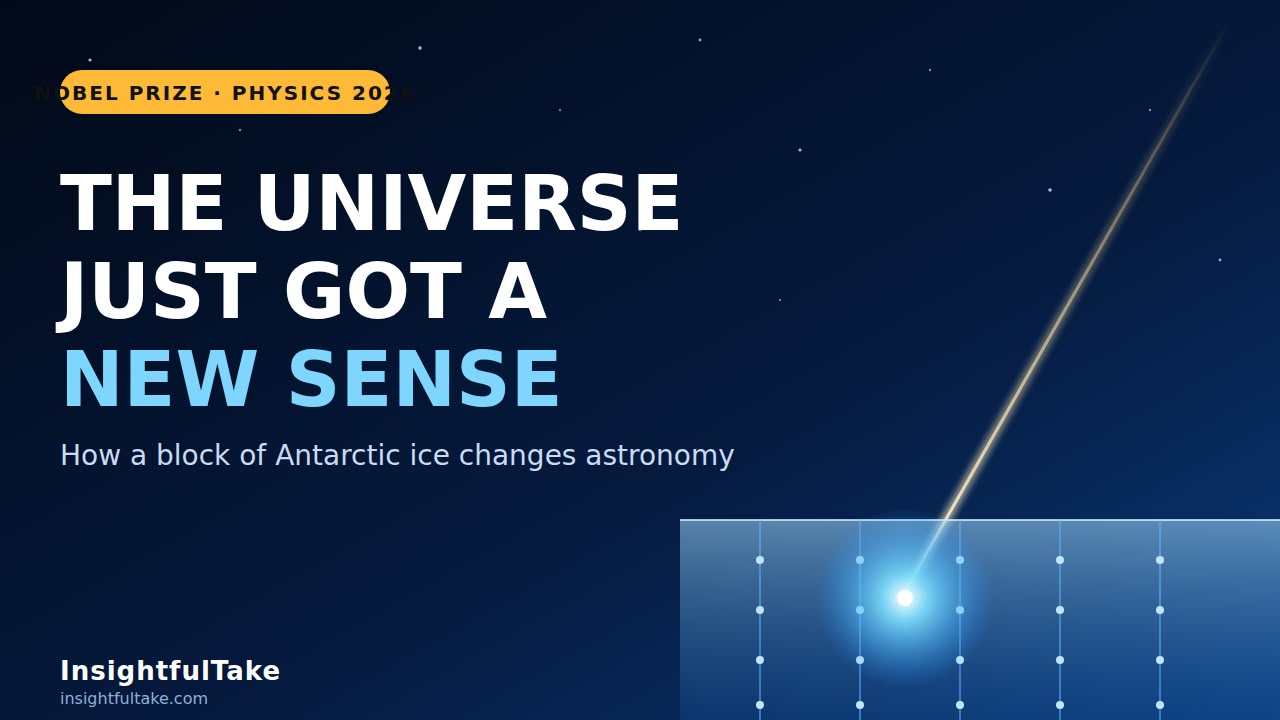
A cubic kilometre of Antarctic ice is helping scientists detect elusive cosmic particles. The 2026 Physics Nobel highlights how neutrinos could reveal what light cannot about the universe.
The 2026 Nobel Prize in Physics honours Francis Halzen for his decisive contributions to the IceCube Neutrino Observatory and the discovery of high-energy neutrinos from cosmic sources. His work has opened a new way to investigate the universe, allowing scientists to trace elusive particles back to distant black holes and some of the most powerful events in space. The prize is a fitting honour for a physicist who spent decades pursuing an idea many colleagues once considered impractical, with the potential to reveal cosmic mysteries that light alone cannot uncover.
A Ghost, Caught in Ice
Neutrinos are among the most abundant particles in the universe. Trillions pass through your body every second without interacting with a single atom. This ability to pass through matter almost undisturbed makes them valuable messengers from distant parts of the cosmos.
Light can be blocked by dust, while cosmic rays are bent by magnetic fields, making it difficult to trace them back to their sources. Neutrinos face neither problem to the same extent. They can travel across enormous distances in straight lines, carrying information about the places where they were produced.
The challenge is detecting them.
Halzen's answer was to use a cubic kilometre of Antarctic ice as a detector. Thousands of light sensors were installed deep beneath the ice at the South Pole. When a high-energy neutrino interacts with an atom, the collision can produce a faint flash of blue light. The sensors capture this signal, helping scientists work out the particle's direction and energy.
The IceCube Neutrino Observatory is, in effect, a telescope built inside a vast mass of frozen water. Instead of collecting light from stars, it searches for particles that can pass through planets and travel across the universe without being stopped.
What Actually Changes
First, neutrinos could help solve a century-old puzzle about cosmic rays.
In 1912, physicist Victor Hess discovered that energetic particles were arriving at Earth from space. These became known as cosmic rays. More than a century later, scientists still face questions about the origins of the most energetic among them.
Where are these particles produced? What forces accelerate them to such extraordinary energies? And what kinds of objects can generate them?
Neutrinos may help answer these questions because they can be produced alongside cosmic rays in extreme astrophysical environments. Unlike electrically charged cosmic rays, they are not deflected by magnetic fields. Scientists can therefore use their direction to identify possible sources.
IceCube has helped connect high-energy neutrinos with a distant blazar, a galaxy powered by a supermassive black hole that sends a jet of material towards Earth. The observatory has also contributed to mapping our own Milky Way through neutrino observations.
These findings give researchers a new way to investigate the powerful processes taking place in distant galaxies and other cosmic environments.
Second, neutrinos are changing how we observe the universe.
For most of human history, astronomy depended on light. Telescopes allowed scientists to study stars, galaxies and other objects by examining the radiation they emitted.
The detection of gravitational waves added another way to explore the cosmos. The 2017 Nobel Prize in Physics recognised the work that helped make gravitational-wave detection possible. These waves carry information about violent events, including collisions between black holes.
Neutrinos provide another source of information. When scientists combine observations from light, gravitational waves and particles, the approach is known as multi-messenger astronomy.
Think of it as watching a film with sound for the first time. Each signal reveals something different. Light may show the visible aftermath of an event, gravitational waves can reveal the movement of massive objects, and neutrinos can provide clues about the particle interactions taking place within them.
Together, these signals can help scientists build a fuller picture of events that no single instrument could explain on its own.
Third, neutrinos may point towards physics that scientists do not yet understand.
The Standard Model is the leading theory describing fundamental particles and three of the four known fundamental forces. Yet it does not explain everything. Neutrinos have tiny masses, but the full explanation for their properties remains an important question in particle physics.
Studying neutrinos could help scientists test existing theories and identify where they are incomplete. High-energy neutrinos are particularly useful because they come from environments with energies far beyond those produced in many terrestrial experiments.
The discoveries will not necessarily arrive with every new observation. But each detection can provide evidence that helps physicists distinguish between competing explanations and investigate questions that remain unanswered.
The Fresh Perspective: Patience Is a Scientific Instrument
The story of IceCube is also a lesson in how major scientific discoveries happen.
The observatory took years to plan and build, and its scientific value has developed through sustained observation and analysis. The original idea required researchers to invest in an instrument whose success was far from guaranteed.
Much of today's research takes place under pressure to publish quickly and demonstrate immediate results. Long-term scientific projects can struggle in such an environment because their value may not become clear for many years.
IceCube shows why some questions require a different approach. Scientists sometimes need to build large instruments, collect rare signals and continue their work even when discoveries are slow to emerge.
The observatory is also the product of international cooperation. Halzen has played a leading role in its development, but the work depends on physicists, engineers, technicians, software developers and data analysts from institutions around the world. The achievement reflects the combined effort required to operate a scientific instrument beneath Antarctic ice and make sense of the signals it records.
What It Means for India
For India, the story has a direct connection with the proposed India-based Neutrino Observatory in Tamil Nadu.
The project has faced years of delay and debate. Its aim is to establish an underground laboratory for neutrino research and contribute to the study of fundamental particles. The proposed facility would offer Indian scientists opportunities to investigate important questions in particle physics.
IceCube provides a useful example of what sustained investment in fundamental science can achieve. Such projects need long-term planning, stable funding, technical expertise and public understanding. Their results rarely arrive on the timetable of an election or a short-term government programme.
Basic research may not produce an immediate commercial product. Its value lies in expanding knowledge, testing scientific theories and creating opportunities for discoveries whose practical uses may not be apparent at the beginning.
India's scientific ambitions will depend not only on announcing major projects but also on building the institutions and public support needed to carry them through.
Final Take
The significance of neutrino astronomy is not that it will deliver a new gadget next year. It is that it could change what humanity knows about the universe.
Neutrinos may help scientists trace the origins of cosmic rays, investigate distant black holes and test the limits of established physics. They could also reveal evidence of processes that existing theories cannot fully explain.
The answers will require patience, careful observation and a willingness to investigate questions without knowing in advance where they will lead.
For centuries, we have studied the universe by looking at the light that reaches Earth. With IceCube, scientists have developed another way to explore the cosmos.
We have spent millennia looking up. Now, we are learning to listen.
The 2026 Nobel Prize in Physics honours Francis Halzen for his decisive contributions to the IceCube Neutrino Observatory and the discovery of high-energy neutrinos from cosmic sources. His work has opened a new way to investigate the universe, allowing scientists to trace elusive particles back to distant black holes and some of the most powerful events in space. The prize is a fitting honour for a physicist who spent decades pursuing an idea many colleagues once considered impractical, with the potential to reveal cosmic mysteries that light alone cannot uncover.
A Ghost, Caught in Ice
Neutrinos are among the most abundant particles in the universe. Trillions pass through your body every second without interacting with a single atom. This ability to pass through matter almost undisturbed makes them valuable messengers from distant parts of the cosmos.
Light can be blocked by dust, while cosmic rays are bent by magnetic fields, making it difficult to trace them back to their sources. Neutrinos face neither problem to the same extent. They can travel across enormous distances in straight lines, carrying information about the places where they were produced.
The challenge is detecting them.
Halzen's answer was to use a cubic kilometre of Antarctic ice as a detector. Thousands of light sensors were installed deep beneath the ice at the South Pole. When a high-energy neutrino interacts with an atom, the collision can produce a faint flash of blue light. The sensors capture this signal, helping scientists work out the particle's direction and energy.
The IceCube Neutrino Observatory is, in effect, a telescope built inside a vast mass of frozen water. Instead of collecting light from stars, it searches for particles that can pass through planets and travel across the universe without being stopped.
What Actually Changes
First, neutrinos could help solve a century-old puzzle about cosmic rays.
In 1912, physicist Victor Hess discovered that energetic particles were arriving at Earth from space. These became known as cosmic rays. More than a century later, scientists still face questions about the origins of the most energetic among them.
Where are these particles produced? What forces accelerate them to such extraordinary energies? And what kinds of objects can generate them?
Neutrinos may help answer these questions because they can be produced alongside cosmic rays in extreme astrophysical environments. Unlike electrically charged cosmic rays, they are not deflected by magnetic fields. Scientists can therefore use their direction to identify possible sources.
IceCube has helped connect high-energy neutrinos with a distant blazar, a galaxy powered by a supermassive black hole that sends a jet of material towards Earth. The observatory has also contributed to mapping our own Milky Way through neutrino observations.
These findings give researchers a new way to investigate the powerful processes taking place in distant galaxies and other cosmic environments.
Second, neutrinos are changing how we observe the universe.
For most of human history, astronomy depended on light. Telescopes allowed scientists to study stars, galaxies and other objects by examining the radiation they emitted.
The detection of gravitational waves added another way to explore the cosmos. The 2017 Nobel Prize in Physics recognised the work that helped make gravitational-wave detection possible. These waves carry information about violent events, including collisions between black holes.
Neutrinos provide another source of information. When scientists combine observations from light, gravitational waves and particles, the approach is known as multi-messenger astronomy.
Think of it as watching a film with sound for the first time. Each signal reveals something different. Light may show the visible aftermath of an event, gravitational waves can reveal the movement of massive objects, and neutrinos can provide clues about the particle interactions taking place within them.
Together, these signals can help scientists build a fuller picture of events that no single instrument could explain on its own.
Third, neutrinos may point towards physics that scientists do not yet understand.
The Standard Model is the leading theory describing fundamental particles and three of the four known fundamental forces. Yet it does not explain everything. Neutrinos have tiny masses, but the full explanation for their properties remains an important question in particle physics.
Studying neutrinos could help scientists test existing theories and identify where they are incomplete. High-energy neutrinos are particularly useful because they come from environments with energies far beyond those produced in many terrestrial experiments.
The discoveries will not necessarily arrive with every new observation. But each detection can provide evidence that helps physicists distinguish between competing explanations and investigate questions that remain unanswered.
The Fresh Perspective: Patience Is a Scientific Instrument
The story of IceCube is also a lesson in how major scientific discoveries happen.
The observatory took years to plan and build, and its scientific value has developed through sustained observation and analysis. The original idea required researchers to invest in an instrument whose success was far from guaranteed.
Much of today's research takes place under pressure to publish quickly and demonstrate immediate results. Long-term scientific projects can struggle in such an environment because their value may not become clear for many years.
IceCube shows why some questions require a different approach. Scientists sometimes need to build large instruments, collect rare signals and continue their work even when discoveries are slow to emerge.
The observatory is also the product of international cooperation. Halzen has played a leading role in its development, but the work depends on physicists, engineers, technicians, software developers and data analysts from institutions around the world. The achievement reflects the combined effort required to operate a scientific instrument beneath Antarctic ice and make sense of the signals it records.
What It Means for India
For India, the story has a direct connection with the proposed India-based Neutrino Observatory in Tamil Nadu.
The project has faced years of delay and debate. Its aim is to establish an underground laboratory for neutrino research and contribute to the study of fundamental particles. The proposed facility would offer Indian scientists opportunities to investigate important questions in particle physics.
IceCube provides a useful example of what sustained investment in fundamental science can achieve. Such projects need long-term planning, stable funding, technical expertise and public understanding. Their results rarely arrive on the timetable of an election or a short-term government programme.
Basic research may not produce an immediate commercial product. Its value lies in expanding knowledge, testing scientific theories and creating opportunities for discoveries whose practical uses may not be apparent at the beginning.
India's scientific ambitions will depend not only on announcing major projects but also on building the institutions and public support needed to carry them through.
Final Take
The significance of neutrino astronomy is not that it will deliver a new gadget next year. It is that it could change what humanity knows about the universe.
Neutrinos may help scientists trace the origins of cosmic rays, investigate distant black holes and test the limits of established physics. They could also reveal evidence of processes that existing theories cannot fully explain.
The answers will require patience, careful observation and a willingness to investigate questions without knowing in advance where they will lead.
For centuries, we have studied the universe by looking at the light that reaches Earth. With IceCube, scientists have developed another way to explore the cosmos.
We have spent millennia looking up. Now, we are learning to listen.


























Leave a Comment