
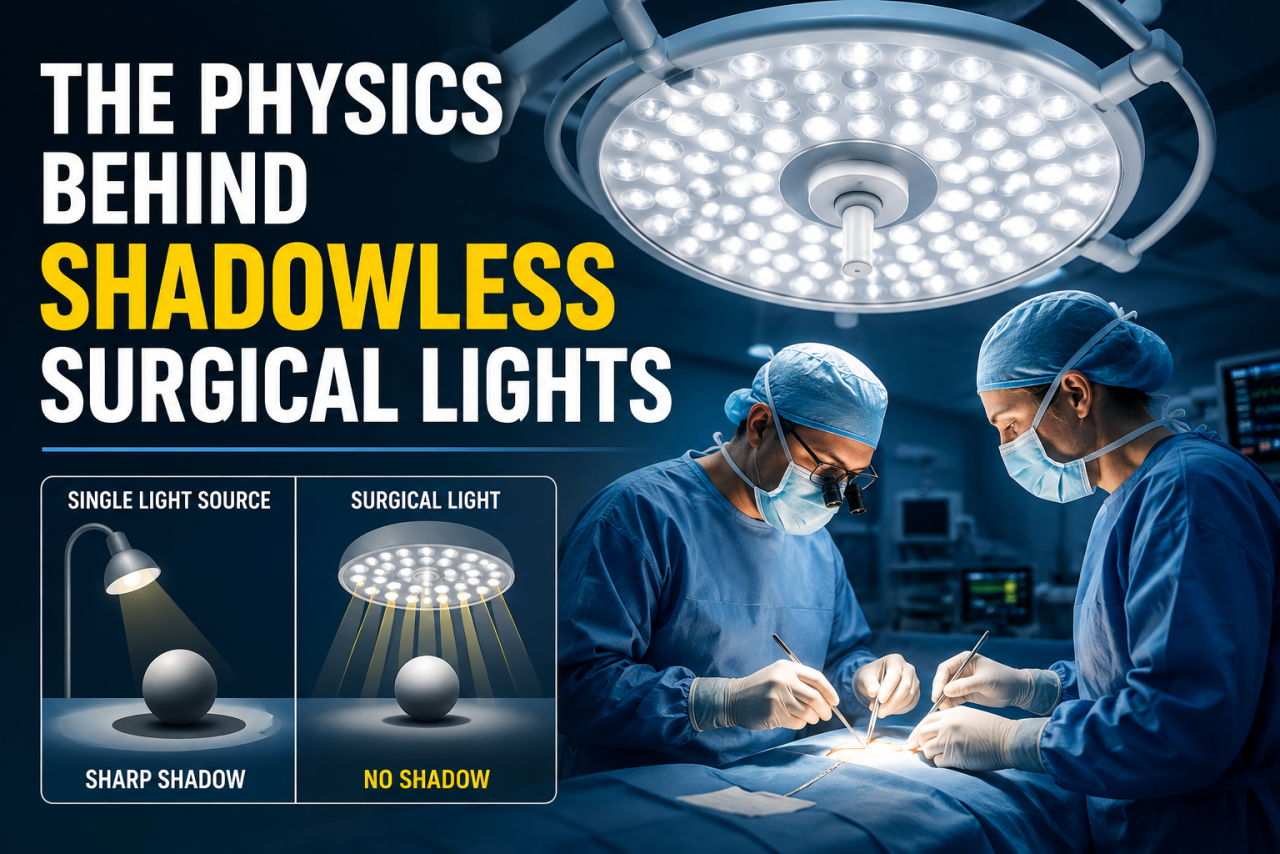
Ever wondered why surgeons can work without their own hands casting shadows over the operating site? The answer lies in a brilliant application of physics, optics, and engineering that keeps every critical detail clearly visible during surgery.
Walk into any operating theatre and the first thing you notice, after the antiseptic smell and the cold air, is the light. It is bright, white, and relentless. It pours over the operating table from every direction at once. And unlike the lamp on your desk, the sun outside, or the bulb above your kitchen counter, it appears almost shadowless. Even when a surgeon's hands move across the operating field, dark patches barely appear.
That is not an accident. It is one of the most elegant applications of physics in modern medicine.
Light From All Directions at Once
To understand why surgical lights appear shadowless, you first need to understand why shadows exist.
A shadow forms when an object blocks light travelling from a single source. Hold your hand beneath a desk lamp and it throws a sharp shadow because nearly all the light is coming from one direction. Block that path, and darkness follows.
Now imagine holding that same hand beneath a large, evenly illuminated ceiling, such as one in a shopping mall. The shadow becomes softer, almost disappearing. That is because light is arriving from hundreds of slightly different angles at the same time. Even if your hand blocks light from one part of the ceiling, light from countless other directions still reaches the surface beneath. The overlapping beams effectively fill in one another's shadows.
This is exactly the principle behind a surgical light. Rather than relying on a single bulb, modern surgical lights use dozens of LEDs arranged in a large circular dome. Each LED illuminates the surgical field from a slightly different angle. The small shadows created by individual light sources overlap and are filled in by neighbouring beams, producing a nearly shadow-free field of view.
The Role of Precision Optics
The dome shape serves a precise optical purpose.
In older halogen surgical lights, specially designed reflectors directed light towards the surgical field. Modern LED systems achieve the same goal primarily through precision lenses mounted over each LED. These optics carefully shape and direct every beam so that dozens of overlapping light paths converge on the operative site from multiple directions.
The result is what engineers call diffuse illumination. Because no single light source dominates, strong shadows are largely eliminated, even when surgeons, assistants, or instruments move between the light and the patient.
Why It Matters
This is far more than a matter of convenience. In surgery, even a momentary shadow can obscure critical anatomy.
A surgeon's hands and instruments are constantly moving within narrow and often deep incisions. Under conventional lighting, every movement would cast shifting shadows across the operating field, making blood vessels, nerves, and delicate tissues more difficult to distinguish. Shadowless illumination ensures that the area of interest remains evenly lit regardless of how the surgical team moves.
Depth of illumination is equally important. Most modern surgical lighting systems are designed to maintain consistent brightness through several tens of centimetres of depth, allowing surgeons to see clearly inside deep abdominal or thoracic cavities without creating excessive glare at the surface.
Colour Accuracy and Heat
Modern surgical lights offer two additional advantages over earlier generations.
First, they reproduce colour with exceptional accuracy. Human tissue often differs only by subtle variations in colour, making faithful illumination essential. Surgical lights typically have a Colour Rendering Index (CRI) above 90, meaning colours appear very close to their appearance under natural daylight. A lower-CRI light can reduce subtle colour differences between tissues, making delicate structures such as nerves, blood vessels, and connective tissue more difficult to distinguish.
Second, they generate very little heat. Older halogen surgical lights produced considerable radiant warmth, which could become uncomfortable during lengthy procedures and even contribute to drying exposed tissue. Modern LEDs convert electrical energy into light far more efficiently, producing significantly less heat while lasting much longer and requiring less maintenance.
An Ordinary Idea, Brilliantly Applied
The underlying science is surprisingly familiar. Photographers have long used large soft boxes to eliminate harsh shadows. Artists have favoured north-facing windows for centuries because indirect daylight produces soft, even illumination.
Modern surgical lights apply exactly the same principle—with remarkable engineering precision—to one of the most demanding environments imaginable.
It is a reminder that some of the most important innovations in medicine are not molecules or algorithms. Sometimes they are simply elegant applications of fundamental physics, solving life-and-death problems with extraordinary effectiveness.
Walk into any operating theatre and the first thing you notice, after the antiseptic smell and the cold air, is the light. It is bright, white, and relentless. It pours over the operating table from every direction at once. And unlike the lamp on your desk, the sun outside, or the bulb above your kitchen counter, it appears almost shadowless. Even when a surgeon's hands move across the operating field, dark patches barely appear.
That is not an accident. It is one of the most elegant applications of physics in modern medicine.
Light From All Directions at Once
To understand why surgical lights appear shadowless, you first need to understand why shadows exist.
A shadow forms when an object blocks light travelling from a single source. Hold your hand beneath a desk lamp and it throws a sharp shadow because nearly all the light is coming from one direction. Block that path, and darkness follows.
Now imagine holding that same hand beneath a large, evenly illuminated ceiling, such as one in a shopping mall. The shadow becomes softer, almost disappearing. That is because light is arriving from hundreds of slightly different angles at the same time. Even if your hand blocks light from one part of the ceiling, light from countless other directions still reaches the surface beneath. The overlapping beams effectively fill in one another's shadows.
This is exactly the principle behind a surgical light. Rather than relying on a single bulb, modern surgical lights use dozens of LEDs arranged in a large circular dome. Each LED illuminates the surgical field from a slightly different angle. The small shadows created by individual light sources overlap and are filled in by neighbouring beams, producing a nearly shadow-free field of view.
The Role of Precision Optics
The dome shape serves a precise optical purpose.
In older halogen surgical lights, specially designed reflectors directed light towards the surgical field. Modern LED systems achieve the same goal primarily through precision lenses mounted over each LED. These optics carefully shape and direct every beam so that dozens of overlapping light paths converge on the operative site from multiple directions.
The result is what engineers call diffuse illumination. Because no single light source dominates, strong shadows are largely eliminated, even when surgeons, assistants, or instruments move between the light and the patient.
Why It Matters
This is far more than a matter of convenience. In surgery, even a momentary shadow can obscure critical anatomy.
A surgeon's hands and instruments are constantly moving within narrow and often deep incisions. Under conventional lighting, every movement would cast shifting shadows across the operating field, making blood vessels, nerves, and delicate tissues more difficult to distinguish. Shadowless illumination ensures that the area of interest remains evenly lit regardless of how the surgical team moves.
Depth of illumination is equally important. Most modern surgical lighting systems are designed to maintain consistent brightness through several tens of centimetres of depth, allowing surgeons to see clearly inside deep abdominal or thoracic cavities without creating excessive glare at the surface.
Colour Accuracy and Heat
Modern surgical lights offer two additional advantages over earlier generations.
First, they reproduce colour with exceptional accuracy. Human tissue often differs only by subtle variations in colour, making faithful illumination essential. Surgical lights typically have a Colour Rendering Index (CRI) above 90, meaning colours appear very close to their appearance under natural daylight. A lower-CRI light can reduce subtle colour differences between tissues, making delicate structures such as nerves, blood vessels, and connective tissue more difficult to distinguish.
Second, they generate very little heat. Older halogen surgical lights produced considerable radiant warmth, which could become uncomfortable during lengthy procedures and even contribute to drying exposed tissue. Modern LEDs convert electrical energy into light far more efficiently, producing significantly less heat while lasting much longer and requiring less maintenance.
An Ordinary Idea, Brilliantly Applied
The underlying science is surprisingly familiar. Photographers have long used large soft boxes to eliminate harsh shadows. Artists have favoured north-facing windows for centuries because indirect daylight produces soft, even illumination.
Modern surgical lights apply exactly the same principle—with remarkable engineering precision—to one of the most demanding environments imaginable.
It is a reminder that some of the most important innovations in medicine are not molecules or algorithms. Sometimes they are simply elegant applications of fundamental physics, solving life-and-death problems with extraordinary effectiveness.





























Leave a Comment