
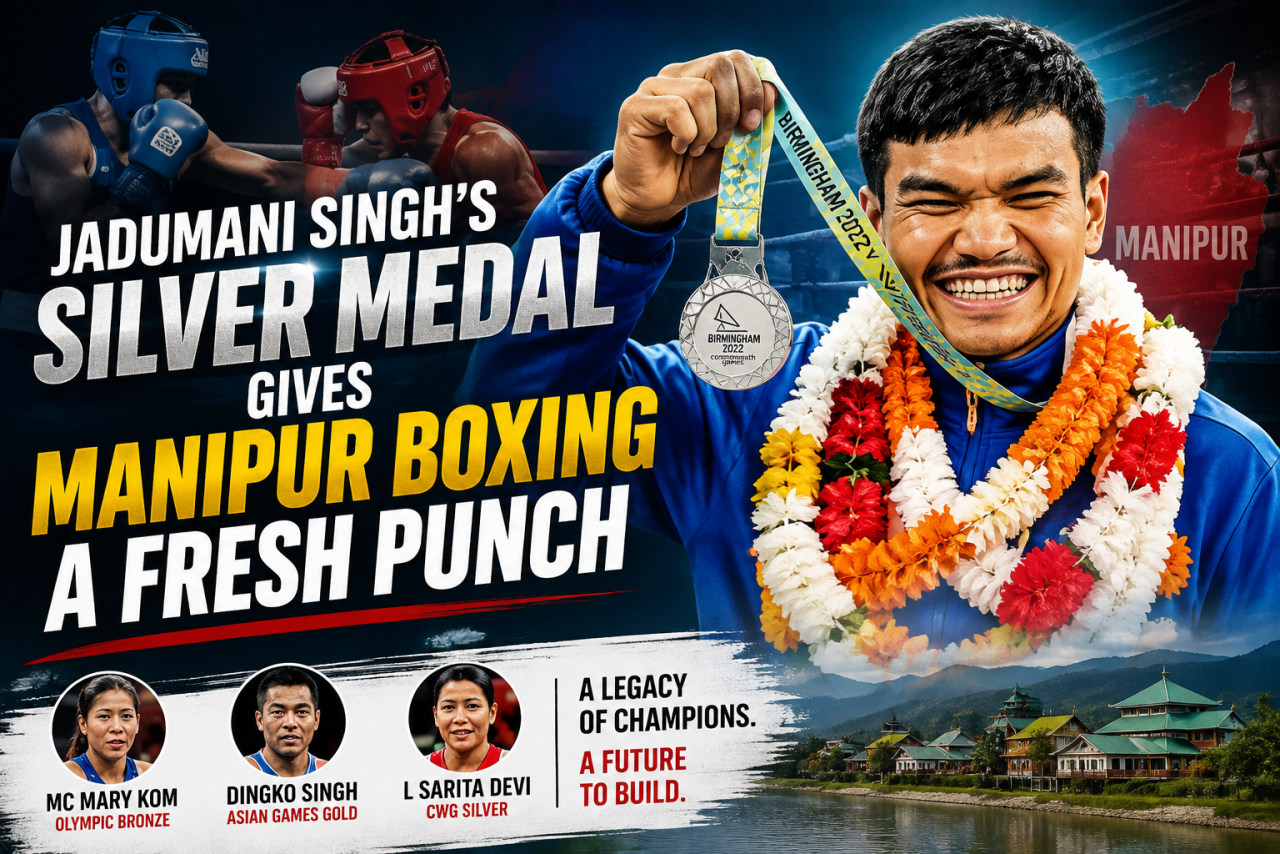
Jadumani Singh’s silver is not just a medal. It could be the fresh punch Manipur’s boxing tradition needs.
Jadumani Singh’s silver medal at the Glasgow Commonwealth Games was more than a sporting achievement for Manipur. It was a reminder that talent in the northeastern state has never been in short supply. What has often been missing is the sustained support needed to turn raw ability into international success.
After years of producing celebrated boxers such as MC Mary Kom, Dingko Singh, L Sarita Devi, Suranjoy Singh and Devendro Singh, Manipur’s boxing fraternity has seen periods of both glory and uncertainty. Jadumani’s performance offered a fresh reason for the state’s young boxers to believe that the tradition can continue.
His achievement also carries a larger message. Sporting excellence does not emerge only from expensive academies or metropolitan cities. It can come from regions where athletes train with limited resources, travel long distances for competitions and sometimes struggle even to access proper nutrition and scientific support.
The story of Manipur’s boxers reflects this reality.
The state has produced athletes who have represented India at the Olympics, Asian Games and Commonwealth Games. Mary Kom became a global symbol of Indian boxing. Dingko Singh inspired a generation with his Asian Games gold. Sarita Devi, Suranjoy Singh and Devendro Singh added to the state’s reputation as a boxing powerhouse.
Yet success stories can sometimes hide the difficulties behind them.
For a young boxer in Manipur, reaching the national level is only the beginning. Training facilities, qualified coaches, sports science, nutrition, equipment and regular exposure to high-level competitions can make the difference between a promising athlete and an international medalist.
Jadumani’s journey highlights exactly this gap.
The report on his achievement points to the importance of institutions such as the Army Sports Institute, where athletes can receive more structured training and scientific guidance. Such facilities can introduce young sportspersons to strength conditioning, sports psychology, recovery methods and professional competition preparation.
This is particularly important in boxing, where physical strength alone is not enough. A boxer needs speed, technique, stamina, tactical intelligence and mental resilience. Modern boxing is increasingly shaped by sports science, and Indian athletes cannot afford to fall behind in this area.
There is another issue that deserves equal attention: access.
Manipur has produced considerable boxing talent, but athletes from smaller towns and remote areas may find it difficult to travel for tournaments. Air tickets, accommodation, equipment and competition expenses can become serious obstacles for families that cannot afford them.
Even talented athletes can lose opportunities if they cannot reach the right tournament at the right time.
That is why Jadumani Singh’s medal should not simply be celebrated as an individual success. It should be used as an opportunity to examine how India can build a stronger sporting ecosystem in the Northeast.
The answer is not merely to build another stadium. India needs a connected system in which local boxing clubs, state academies, schools, national centres and elite training institutions work together. Young boxers should be identified early and given a clear pathway from grassroots competition to national and international championships.
Nutrition must also become a central part of this system. Boxing is a weight-category sport, and athletes need carefully planned diets while maintaining strength and endurance. Providing proper food, medical supervision and recovery facilities can be as important as providing a boxing ring.
Most importantly, athletes from Manipur need regular opportunities to compete.
A medal can inspire thousands of children, but inspiration becomes meaningful only when those children can see a realistic path towards becoming athletes themselves.
Jadumani Singh has therefore done more than win a silver medal. He has reopened a conversation about Manipur’s boxing future.
The state already has the history, talent and sporting culture. What it needs now is continuity.
If India can combine Manipur’s natural boxing talent with modern coaching, sports science, nutrition, financial assistance and regular competition, the next generation may not merely revive the state’s golden boxing era. It could take it to an entirely new level.
Jadumani’s silver, therefore, should not be seen as the end of a journey. It should be treated as the first punch of a new chapter in Manipur boxing.
Jadumani Singh’s silver medal at the Glasgow Commonwealth Games was more than a sporting achievement for Manipur. It was a reminder that talent in the northeastern state has never been in short supply. What has often been missing is the sustained support needed to turn raw ability into international success.
After years of producing celebrated boxers such as MC Mary Kom, Dingko Singh, L Sarita Devi, Suranjoy Singh and Devendro Singh, Manipur’s boxing fraternity has seen periods of both glory and uncertainty. Jadumani’s performance offered a fresh reason for the state’s young boxers to believe that the tradition can continue.
His achievement also carries a larger message. Sporting excellence does not emerge only from expensive academies or metropolitan cities. It can come from regions where athletes train with limited resources, travel long distances for competitions and sometimes struggle even to access proper nutrition and scientific support.
The story of Manipur’s boxers reflects this reality.
The state has produced athletes who have represented India at the Olympics, Asian Games and Commonwealth Games. Mary Kom became a global symbol of Indian boxing. Dingko Singh inspired a generation with his Asian Games gold. Sarita Devi, Suranjoy Singh and Devendro Singh added to the state’s reputation as a boxing powerhouse.
Yet success stories can sometimes hide the difficulties behind them.
For a young boxer in Manipur, reaching the national level is only the beginning. Training facilities, qualified coaches, sports science, nutrition, equipment and regular exposure to high-level competitions can make the difference between a promising athlete and an international medalist.
Jadumani’s journey highlights exactly this gap.
The report on his achievement points to the importance of institutions such as the Army Sports Institute, where athletes can receive more structured training and scientific guidance. Such facilities can introduce young sportspersons to strength conditioning, sports psychology, recovery methods and professional competition preparation.
This is particularly important in boxing, where physical strength alone is not enough. A boxer needs speed, technique, stamina, tactical intelligence and mental resilience. Modern boxing is increasingly shaped by sports science, and Indian athletes cannot afford to fall behind in this area.
There is another issue that deserves equal attention: access.
Manipur has produced considerable boxing talent, but athletes from smaller towns and remote areas may find it difficult to travel for tournaments. Air tickets, accommodation, equipment and competition expenses can become serious obstacles for families that cannot afford them.
Even talented athletes can lose opportunities if they cannot reach the right tournament at the right time.
That is why Jadumani Singh’s medal should not simply be celebrated as an individual success. It should be used as an opportunity to examine how India can build a stronger sporting ecosystem in the Northeast.
The answer is not merely to build another stadium. India needs a connected system in which local boxing clubs, state academies, schools, national centres and elite training institutions work together. Young boxers should be identified early and given a clear pathway from grassroots competition to national and international championships.
Nutrition must also become a central part of this system. Boxing is a weight-category sport, and athletes need carefully planned diets while maintaining strength and endurance. Providing proper food, medical supervision and recovery facilities can be as important as providing a boxing ring.
Most importantly, athletes from Manipur need regular opportunities to compete.
A medal can inspire thousands of children, but inspiration becomes meaningful only when those children can see a realistic path towards becoming athletes themselves.
Jadumani Singh has therefore done more than win a silver medal. He has reopened a conversation about Manipur’s boxing future.
The state already has the history, talent and sporting culture. What it needs now is continuity.
If India can combine Manipur’s natural boxing talent with modern coaching, sports science, nutrition, financial assistance and regular competition, the next generation may not merely revive the state’s golden boxing era. It could take it to an entirely new level.
Jadumani’s silver, therefore, should not be seen as the end of a journey. It should be treated as the first punch of a new chapter in Manipur boxing.












Leave a Comment