
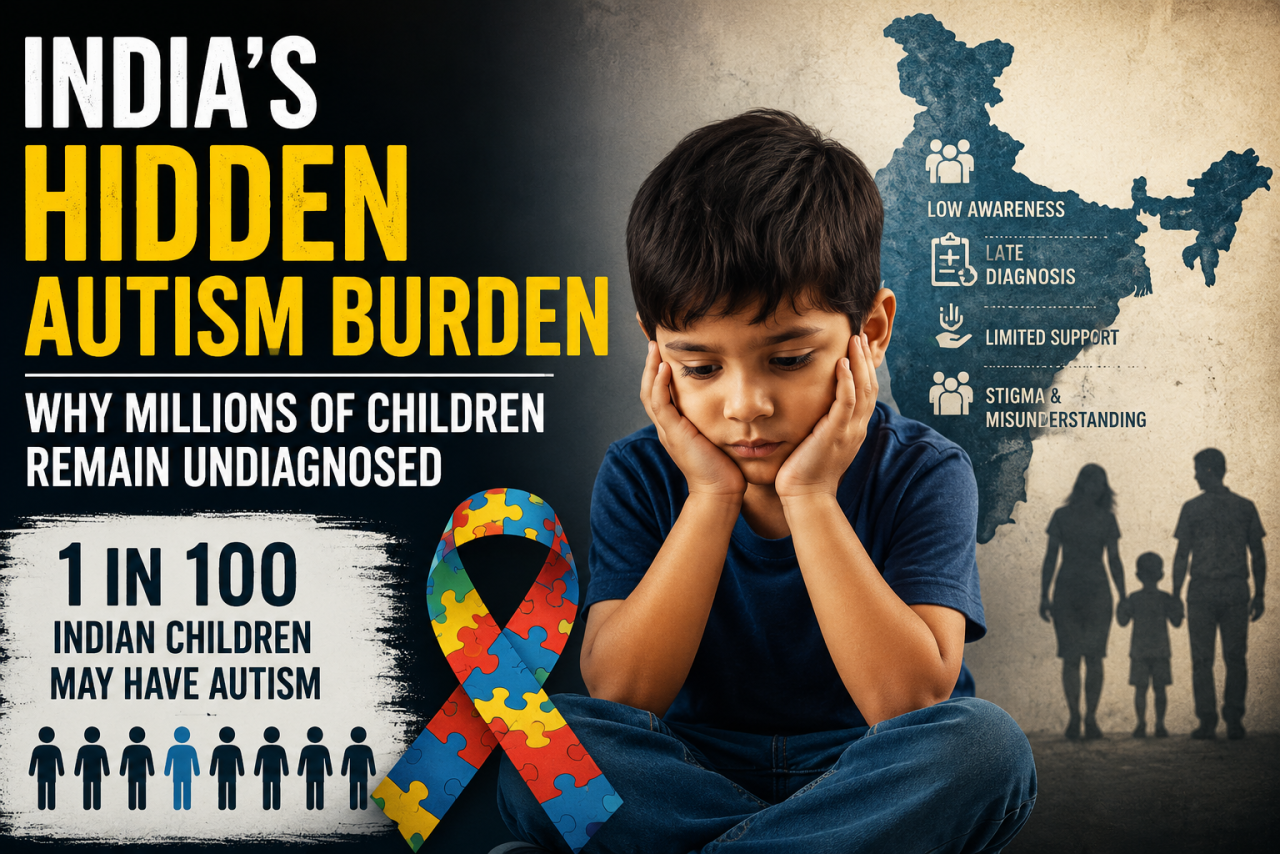
One in 100 Indian children may have autism, yet countless children remain undiagnosed. India’s real challenge is no longer recognising autism, but ensuring that every child can be identified and supported in time.
India may be only beginning to understand the true scale of autism among its children. A landmark study led by INCLEN Trust International and published in PLOS Medicine found that about one in 100 children under the age of 10 in India has Autism Spectrum Disorder (ASD). The same research found that nearly one in eight children has at least one neurodevelopmental condition.
The findings point to a much larger challenge than the country's official records have suggested. They also raise an uncomfortable question: how many children with autism are still growing up without a diagnosis, appropriate support, or access to early intervention?
Why India’s Autism Numbers Were Hidden for So Long
Autism has always existed in India, but for decades it remained poorly recognised and underdiagnosed.
India's 2011 Census reported an autism prevalence figure of around 1.3 percent, but researchers have argued that such figures may substantially underestimate the actual number of children affected. One reason is the way the information was collected. Census data depended heavily on self-reporting by families, many of whom had never encountered the term autism or had no access to professionals capable of identifying developmental conditions.
The INCLEN study used a different approach. Researchers screened nearly 4,000 children across rural, urban, and tribal areas and followed the screening process with clinical assessment. This approach helped identify children who might otherwise have remained invisible in official statistics.
The study also found considerable variation between locations. Autism prevalence ranged from about 0.4 percent in North Goa to approximately 1.8 percent in Palwal, Haryana.
Researchers caution that such differences should not automatically be interpreted as evidence that autism is naturally more common in one region than another. Variations in awareness, screening practices, access to specialists, and healthcare infrastructure can strongly influence how many children are identified.
The Diagnosis Gap Is Costing Children Valuable Time
For children with autism, early identification can make an important difference.
Development during the first few years of life is rapid. Early intervention can help children develop communication, social, behavioural, and everyday skills according to their individual needs. Yet many Indian children are diagnosed considerably later than children in countries with stronger developmental screening systems.
In India, the average age of autism diagnosis is often reported to be between four and six years, while diagnosis in countries with more established systems can occur much earlier.
Those additional years matter.
A child may spend the early part of life struggling with communication or social interaction while parents are told that the child will eventually "catch up". Some families may not know where to seek help. Others may encounter long waiting periods, expensive private services, or a shortage of trained professionals.
The problem is particularly serious outside major cities.
A Shortage of Specialists and Accessible Screening
India's healthcare infrastructure faces a significant shortage of professionals trained to identify and manage developmental conditions.
Research from major medical institutions has highlighted the limited availability of developmental pediatricians compared with the country's enormous child population. Specialist services are concentrated heavily in metropolitan and larger urban centres, leaving families in smaller towns and rural areas with fewer options.
Language creates another barrier.
Many standardised screening and diagnostic resources are not available in enough Indian languages. For families who are not comfortable communicating in English or Hindi, this can make an already complicated process even more difficult.
The result is a system in which geography, income, education, and language can influence whether a child is identified and supported.
That should not determine a child's future.
What the Law Promises and What Families Experience
India has formally recognised autism as a disability under the Rights of Persons with Disabilities Act, 2016. The law provides a framework for protecting the rights of persons with disabilities and includes provisions relating to education, employment, accessibility, and non-discrimination.
But legislation alone cannot close the autism gap.
In several urban centres, schools and institutions have developed resource rooms, special education services, and inclusive education initiatives. Yet implementation remains uneven. Many schools, particularly in rural and underserved areas, lack trained staff, appropriate screening resources, and sufficient awareness of developmental disabilities.
This creates a significant difference between entitlement and access.
A right written into law becomes meaningful only when a family can actually use it.
The Economic Burden on Families
The financial burden can be another major obstacle.
Once a child is diagnosed, families may need speech therapy, occupational therapy, behavioural interventions, special education, assistive services, or other forms of support depending on the child's needs.
For middle-class and low-income households, regular private therapy can become financially difficult. Families living in rural areas may also have to travel long distances to reach specialists, adding transportation and accommodation costs to the expense of treatment and education.
Non-profit organisations have attempted to bridge some of these gaps by training teachers and parents, promoting early intervention, translating educational materials, and encouraging inclusive practices.
But voluntary organisations cannot substitute for a comprehensive public system serving a population as large and diverse as India's.
The Stigma That Keeps Children Invisible
Perhaps the most difficult barrier to overcome is not medical but social.
In many communities, developmental differences are still misunderstood. A child's delayed speech, unusual behaviour, difficulty interacting with others, or repetitive movements may be dismissed as a temporary phase.
Some parents may even be blamed for the child's behaviour.
In other cases, families may turn first to spiritual or traditional explanations rather than seeking developmental assessment. Such beliefs are often deeply rooted in culture and cannot be changed simply by issuing medical advice.
The consequence, however, can be serious.
When diagnosis is delayed, children may miss opportunities for early support. Parents may spend years searching for explanations, while children struggle in classrooms and social environments that were never designed to accommodate their needs.
Greater awareness is therefore not simply about teaching people what autism is. It is about replacing blame with understanding.
India Already Has Tools. The Challenge Is Reach.
India does not have to start from zero.
Screening and assessment tools designed or adapted for the Indian context already exist. These include the Indian Scale for Assessment of Autism and the Trivandrum Autism Behavioral Checklist, which are used in clinical and educational settings.
The larger challenge is ensuring that such tools reach the children who need them.
India needs more trained developmental professionals outside major cities, screening systems that work in multiple Indian languages, better referral networks, and stronger integration of developmental screening into routine child healthcare.
Teachers and frontline health workers can also play an important role by recognising developmental warning signs and guiding families towards appropriate professional evaluation.
From Recognition to Action
Estimates suggesting that roughly one in 100 children may have autism should not be viewed merely as another statistic.
Behind every percentage is a child.
And behind every child is a family trying to understand what is happening and find the right support.
If millions of Indian children are affected by autism and other neurodevelopmental conditions, the country's response cannot depend entirely on specialist hospitals in major cities or private therapy that many families cannot afford.
The priority should be to take awareness, screening, diagnosis, education, and support closer to where children actually live.
India has already recognised autism in law. It has developed assessment tools and has a growing network of professionals and organisations working in the field.
The next step is scale.
The real measure of progress will not be how many policies India announces or how many studies it publishes. It will be whether a parent in a small town or village can recognise the signs, find a trained professional, obtain a reliable diagnosis, and get meaningful support without being pushed into years of uncertainty.
India's autism burden may have been hidden for years.
It should not remain invisible any longer.
India may be only beginning to understand the true scale of autism among its children. A landmark study led by INCLEN Trust International and published in PLOS Medicine found that about one in 100 children under the age of 10 in India has Autism Spectrum Disorder (ASD). The same research found that nearly one in eight children has at least one neurodevelopmental condition.
The findings point to a much larger challenge than the country's official records have suggested. They also raise an uncomfortable question: how many children with autism are still growing up without a diagnosis, appropriate support, or access to early intervention?
Why India’s Autism Numbers Were Hidden for So Long
Autism has always existed in India, but for decades it remained poorly recognised and underdiagnosed.
India's 2011 Census reported an autism prevalence figure of around 1.3 percent, but researchers have argued that such figures may substantially underestimate the actual number of children affected. One reason is the way the information was collected. Census data depended heavily on self-reporting by families, many of whom had never encountered the term autism or had no access to professionals capable of identifying developmental conditions.
The INCLEN study used a different approach. Researchers screened nearly 4,000 children across rural, urban, and tribal areas and followed the screening process with clinical assessment. This approach helped identify children who might otherwise have remained invisible in official statistics.
The study also found considerable variation between locations. Autism prevalence ranged from about 0.4 percent in North Goa to approximately 1.8 percent in Palwal, Haryana.
Researchers caution that such differences should not automatically be interpreted as evidence that autism is naturally more common in one region than another. Variations in awareness, screening practices, access to specialists, and healthcare infrastructure can strongly influence how many children are identified.
The Diagnosis Gap Is Costing Children Valuable Time
For children with autism, early identification can make an important difference.
Development during the first few years of life is rapid. Early intervention can help children develop communication, social, behavioural, and everyday skills according to their individual needs. Yet many Indian children are diagnosed considerably later than children in countries with stronger developmental screening systems.
In India, the average age of autism diagnosis is often reported to be between four and six years, while diagnosis in countries with more established systems can occur much earlier.
Those additional years matter.
A child may spend the early part of life struggling with communication or social interaction while parents are told that the child will eventually "catch up". Some families may not know where to seek help. Others may encounter long waiting periods, expensive private services, or a shortage of trained professionals.
The problem is particularly serious outside major cities.
A Shortage of Specialists and Accessible Screening
India's healthcare infrastructure faces a significant shortage of professionals trained to identify and manage developmental conditions.
Research from major medical institutions has highlighted the limited availability of developmental pediatricians compared with the country's enormous child population. Specialist services are concentrated heavily in metropolitan and larger urban centres, leaving families in smaller towns and rural areas with fewer options.
Language creates another barrier.
Many standardised screening and diagnostic resources are not available in enough Indian languages. For families who are not comfortable communicating in English or Hindi, this can make an already complicated process even more difficult.
The result is a system in which geography, income, education, and language can influence whether a child is identified and supported.
That should not determine a child's future.
What the Law Promises and What Families Experience
India has formally recognised autism as a disability under the Rights of Persons with Disabilities Act, 2016. The law provides a framework for protecting the rights of persons with disabilities and includes provisions relating to education, employment, accessibility, and non-discrimination.
But legislation alone cannot close the autism gap.
In several urban centres, schools and institutions have developed resource rooms, special education services, and inclusive education initiatives. Yet implementation remains uneven. Many schools, particularly in rural and underserved areas, lack trained staff, appropriate screening resources, and sufficient awareness of developmental disabilities.
This creates a significant difference between entitlement and access.
A right written into law becomes meaningful only when a family can actually use it.
The Economic Burden on Families
The financial burden can be another major obstacle.
Once a child is diagnosed, families may need speech therapy, occupational therapy, behavioural interventions, special education, assistive services, or other forms of support depending on the child's needs.
For middle-class and low-income households, regular private therapy can become financially difficult. Families living in rural areas may also have to travel long distances to reach specialists, adding transportation and accommodation costs to the expense of treatment and education.
Non-profit organisations have attempted to bridge some of these gaps by training teachers and parents, promoting early intervention, translating educational materials, and encouraging inclusive practices.
But voluntary organisations cannot substitute for a comprehensive public system serving a population as large and diverse as India's.
The Stigma That Keeps Children Invisible
Perhaps the most difficult barrier to overcome is not medical but social.
In many communities, developmental differences are still misunderstood. A child's delayed speech, unusual behaviour, difficulty interacting with others, or repetitive movements may be dismissed as a temporary phase.
Some parents may even be blamed for the child's behaviour.
In other cases, families may turn first to spiritual or traditional explanations rather than seeking developmental assessment. Such beliefs are often deeply rooted in culture and cannot be changed simply by issuing medical advice.
The consequence, however, can be serious.
When diagnosis is delayed, children may miss opportunities for early support. Parents may spend years searching for explanations, while children struggle in classrooms and social environments that were never designed to accommodate their needs.
Greater awareness is therefore not simply about teaching people what autism is. It is about replacing blame with understanding.
India Already Has Tools. The Challenge Is Reach.
India does not have to start from zero.
Screening and assessment tools designed or adapted for the Indian context already exist. These include the Indian Scale for Assessment of Autism and the Trivandrum Autism Behavioral Checklist, which are used in clinical and educational settings.
The larger challenge is ensuring that such tools reach the children who need them.
India needs more trained developmental professionals outside major cities, screening systems that work in multiple Indian languages, better referral networks, and stronger integration of developmental screening into routine child healthcare.
Teachers and frontline health workers can also play an important role by recognising developmental warning signs and guiding families towards appropriate professional evaluation.
From Recognition to Action
Estimates suggesting that roughly one in 100 children may have autism should not be viewed merely as another statistic.
Behind every percentage is a child.
And behind every child is a family trying to understand what is happening and find the right support.
If millions of Indian children are affected by autism and other neurodevelopmental conditions, the country's response cannot depend entirely on specialist hospitals in major cities or private therapy that many families cannot afford.
The priority should be to take awareness, screening, diagnosis, education, and support closer to where children actually live.
India has already recognised autism in law. It has developed assessment tools and has a growing network of professionals and organisations working in the field.
The next step is scale.
The real measure of progress will not be how many policies India announces or how many studies it publishes. It will be whether a parent in a small town or village can recognise the signs, find a trained professional, obtain a reliable diagnosis, and get meaningful support without being pushed into years of uncertainty.
India's autism burden may have been hidden for years.
It should not remain invisible any longer.





















Leave a Comment