
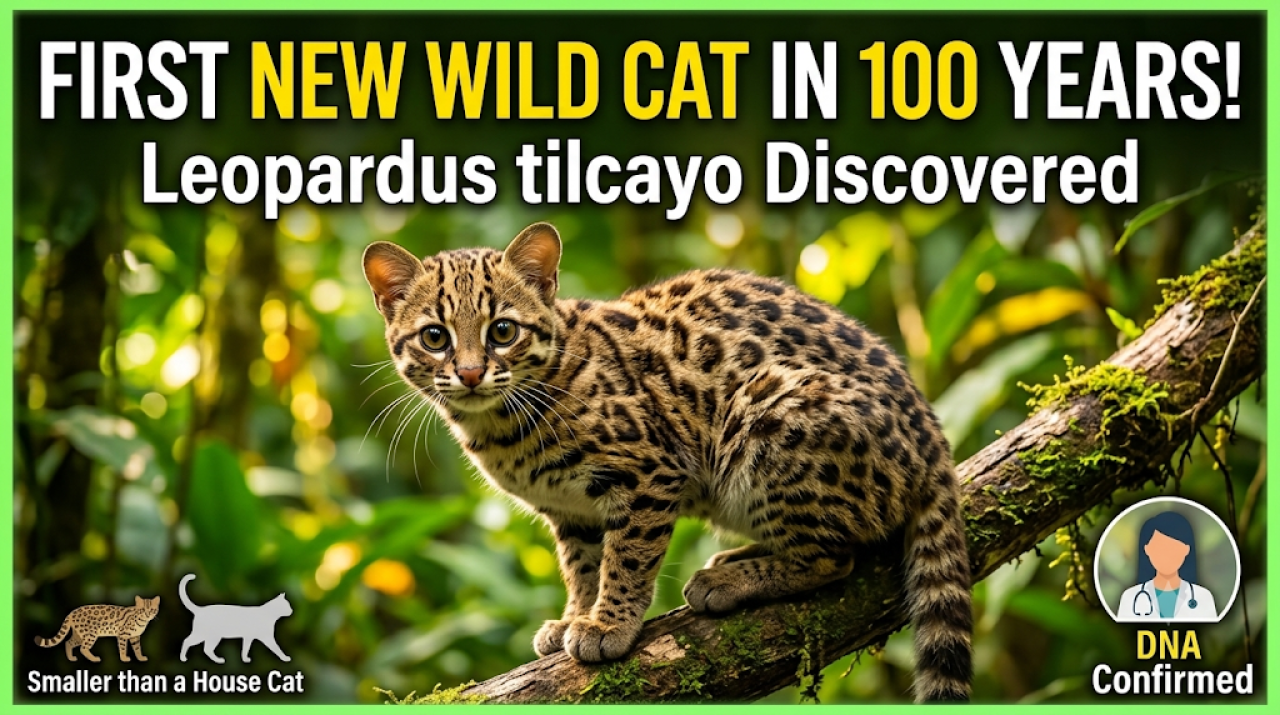
A tiny wild cat weighing just 1.4 kilograms has been identified as a new species in Bolivia’s Yungas forests, marking a rare breakthrough in feline science.
A tiny wild cat found roaming the Yungas forests of Bolivia has officially been identified as a completely new feline species. Named Leopardus tilcayo, or locally known simply as the tilcayo, this remarkable finding marks the first time in more than a century that scientists have discovered a brand-new species of cat in the region.
The animal belongs to the tiger cat group, a family of small wild felines spread across parts of South America. However, Leopardus tilcayo stands out because of its remarkably small size and distinct appearance.
Measuring around 46 centimetres long and weighing just 1.4 kilograms, this full-grown wild cat is actually smaller than a typical house cat. Despite its tiny frame, it possesses unique physical traits that distinguish it from other known members of its cat family.
It features striking leopard-like spots covering its fur, short rounded ears, unusually long whiskers and a distinctive small face.
A Chance Encounter Led to the Discovery
The story behind this rare discovery began in 2016.
Bolivian biologist and National Geographic Explorer Paola Nogales-Ascarrunz received an unexpected phone call from the Senda Verde wildlife sanctuary. Staff at the sanctuary informed her that someone had brought in a "weird cat."
A local resident had originally spotted the tiny animal near the edge of a forest. Believing it was simply an unusual domestic pet, the man brought it home.
It took nearly a year before he noticed wild behaviours in the animal and realised it was not a typical household pet. Understanding that the animal required specialised care, he eventually brought it to the Senda Verde wildlife sanctuary.
Physical Features Raised Questions
When Nogales-Ascarrunz, who leads the Bolivian Felids Research Program, arrived to examine the cat, its physical features immediately caught her attention.
The combination of its tiny body, facial shape and unusual coat pattern did not match any documented species in the region.
That raised a crucial question: Was the animal simply an unusual individual of a known species, or was it something entirely different?
DNA Testing Confirmed a New Species
To determine whether the animal was truly unique, researchers conducted genetic testing.
DNA analysis showed that the cat was not merely an unusual individual or a known subspecies of an existing feline. Instead, the results indicated that it represented an entirely new species previously unknown to modern science.
The species was named Leopardus tilcayo.
A Remarkable Finding for Wildlife Science
What started as a chance encounter by a local resident eventually became a significant discovery for wildlife research and conservation.
The identification of Leopardus tilcayo highlights how much remains to be studied in South America's forests, where wildlife that has escaped scientific documentation may still exist.
The discovery also underlines the importance of protecting habitats such as Bolivia's Yungas forests, where biodiversity continues to reveal new scientific surprises.
A tiny wild cat found roaming the Yungas forests of Bolivia has officially been identified as a completely new feline species. Named Leopardus tilcayo, or locally known simply as the tilcayo, this remarkable finding marks the first time in more than a century that scientists have discovered a brand-new species of cat in the region.
The animal belongs to the tiger cat group, a family of small wild felines spread across parts of South America. However, Leopardus tilcayo stands out because of its remarkably small size and distinct appearance.
Measuring around 46 centimetres long and weighing just 1.4 kilograms, this full-grown wild cat is actually smaller than a typical house cat. Despite its tiny frame, it possesses unique physical traits that distinguish it from other known members of its cat family.
It features striking leopard-like spots covering its fur, short rounded ears, unusually long whiskers and a distinctive small face.
A Chance Encounter Led to the Discovery
The story behind this rare discovery began in 2016.
Bolivian biologist and National Geographic Explorer Paola Nogales-Ascarrunz received an unexpected phone call from the Senda Verde wildlife sanctuary. Staff at the sanctuary informed her that someone had brought in a "weird cat."
A local resident had originally spotted the tiny animal near the edge of a forest. Believing it was simply an unusual domestic pet, the man brought it home.
It took nearly a year before he noticed wild behaviours in the animal and realised it was not a typical household pet. Understanding that the animal required specialised care, he eventually brought it to the Senda Verde wildlife sanctuary.
Physical Features Raised Questions
When Nogales-Ascarrunz, who leads the Bolivian Felids Research Program, arrived to examine the cat, its physical features immediately caught her attention.
The combination of its tiny body, facial shape and unusual coat pattern did not match any documented species in the region.
That raised a crucial question: Was the animal simply an unusual individual of a known species, or was it something entirely different?
DNA Testing Confirmed a New Species
To determine whether the animal was truly unique, researchers conducted genetic testing.
DNA analysis showed that the cat was not merely an unusual individual or a known subspecies of an existing feline. Instead, the results indicated that it represented an entirely new species previously unknown to modern science.
The species was named Leopardus tilcayo.
A Remarkable Finding for Wildlife Science
What started as a chance encounter by a local resident eventually became a significant discovery for wildlife research and conservation.
The identification of Leopardus tilcayo highlights how much remains to be studied in South America's forests, where wildlife that has escaped scientific documentation may still exist.
The discovery also underlines the importance of protecting habitats such as Bolivia's Yungas forests, where biodiversity continues to reveal new scientific surprises.




























Leave a Comment