
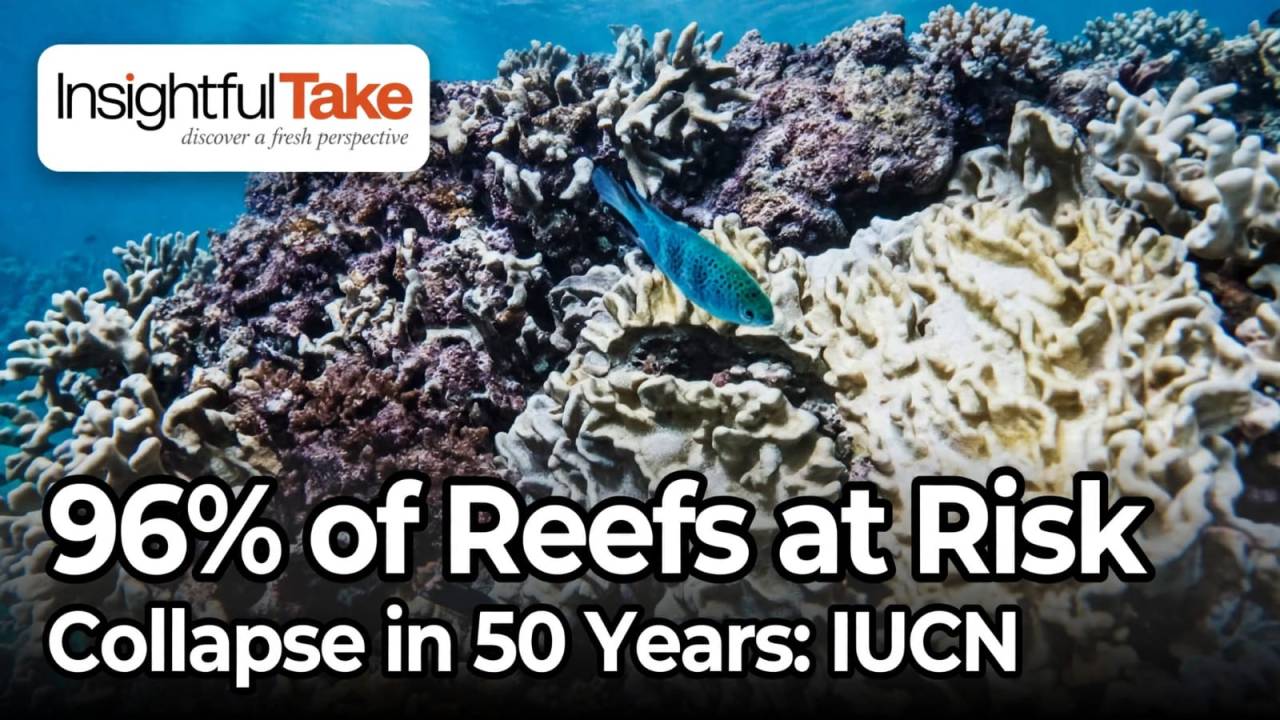
An IUCN assessment warns that 96% of the world's assessed coral reef ecosystems are critically endangered, threatening marine biodiversity, coastal livelihoods and natural protection against storms.
Most people will never swim over a coral reef or see the colourful marine life that depends on it. Yet the disappearance of these underwater ecosystems could affect millions of lives, including those far from the sea.
The International Union for Conservation of Nature (IUCN) has issued a warning about the future of coral reefs. Its latest global assessment examined 127 tropical and subtropical reef ecosystems covering 188,362 square kilometres. It classified 96% of them as critically endangered, the highest threat category under its ecosystem assessment framework.
The findings, presented at the UN biodiversity summit in Yerevan, suggest that nearly all shallow-water coral reefs face an extremely high risk of collapse by 2075 if current environmental pressures continue.
The warning goes beyond the possible disappearance of colourful marine habitats. Coral reefs support fisheries, protect coastlines, sustain tourism and provide shelter for thousands of marine species.
What Happens When a Coral Reef Collapses
Coral reefs are built by colonies of tiny marine animals called coral polyps. Over time, hard corals produce calcium carbonate skeletons that form large underwater structures.
These structures provide food, shelter and breeding grounds for numerous marine organisms.
When rising temperatures, pollution or other pressures kill large numbers of corals, the reef begins losing its living foundation. Algae, sponges and loose rubble may gradually replace healthy coral colonies.
The physical structure may remain for some time, but its ability to support marine life and protect coastlines can decline sharply.
Scientists describe ecosystem collapse as a severe loss of the defining characteristics and functions that make a reef ecosystem viable.
Among the major reef regions facing serious threats are Australia's Great Barrier Reef, the Coral Triangle in Southeast Asia and the western Pacific, the Mesoamerican Barrier Reef in the Caribbean and reefs in the Red Sea.
These regions contain some of the world's richest concentrations of marine biodiversity.
Rising Ocean Temperatures Are the Biggest Threat
Ocean warming remains the most widespread threat to coral reefs.
Corals survive within relatively narrow temperature ranges. When seawater becomes unusually warm for prolonged periods, corals experience stress and may expel the microscopic algae living inside their tissues.
This process, known as coral bleaching, causes corals to lose much of their colour and an important source of energy.
Bleaching does not always kill corals immediately. Some recover when temperatures return to normal. However, repeated or prolonged heat stress can lead to widespread mortality.
As global temperatures rise, bleaching events are becoming more frequent and severe, leaving reefs with less time to recover.
The IUCN assessment identifies heat stress as the most consistent threat across coral reef ecosystems.
Climate change is therefore not simply altering ocean temperatures. It is weakening the biological systems that support marine life.
Overfishing Makes Recovery More Difficult
Rising temperatures are not the only problem.
According to the assessment, overfishing involving important reef fish groups, including parrotfish and groupers, threatens 63% of reef ecosystems.
Parrotfish play a particularly important role in maintaining reef health. They feed on algae growing over coral surfaces, helping prevent excessive algal growth that can obstruct coral recovery.
When these fish populations decline, algae can spread more easily across damaged reefs.
This makes it harder for young corals to establish themselves after bleaching events.
Groupers also contribute to reef food webs, although their ecological role differs from that of algae-eating parrotfish.
Coastal construction, untreated wastewater, plastic pollution, destructive fishing practices and poorly managed tourism add further pressure.
A reef weakened by rising temperatures may still recover if local environmental conditions remain favourable. But when overfishing and pollution occur alongside repeated heat stress, its chances of recovery become much smaller.
Why the Year 2075 Matters
The IUCN assessment considered a middle-of-the-road climate scenario used by the Intergovernmental Panel on Climate Change (IPCC).
This scenario does not represent the most extreme possible warming pathway.
Even under these assumptions, the assessment projects an extremely high risk of collapse for nearly all shallow-water coral reef ecosystems by 2075.
The year should not be understood as a fixed date when every reef will disappear. It represents a projected risk under specific climate and environmental conditions.
The broader concern is that existing efforts to reduce greenhouse gas emissions may not be sufficient to prevent severe damage.
The Paris Agreement seeks to keep global warming well below 2°C above pre-industrial levels while pursuing efforts to limit it to 1.5°C.
Coral reefs are particularly vulnerable to warming, making them an important indicator of the consequences of exceeding these temperature limits.
Why Coral Reefs Matter Beyond the Oceans
Coral reefs occupy a relatively small portion of the ocean floor but support an extraordinary variety of marine life.
They are commonly associated with roughly one-quarter of marine species at some stage of their lives.
For coastal communities, reefs are much more than tourist attractions.
They provide fishing grounds, support employment and help maintain local food supplies. They also serve as natural barriers against powerful waves and storm surges.
A healthy reef can absorb and dissipate wave energy before it reaches the coastline.
When reefs deteriorate, coastal settlements may become more exposed to erosion, flooding and storm damage.
Replacing this natural protection with artificial coastal infrastructure can be expensive.
The economic consequences may extend to governments, businesses and consumers who have never visited a coral reef.
India Has Much to Lose
India's coral reef ecosystems are concentrated in several important regions, including Lakshadweep, the Andaman and Nicobar Islands, the Gulf of Mannar and the Gulf of Kutch.
These ecosystems support marine biodiversity, fisheries, tourism and coastal livelihoods.
In Lakshadweep, coral reefs are particularly important because they help protect low-lying islands from waves and erosion.
Damage to these reefs could increase the vulnerability of island communities already facing rising sea levels and changing weather patterns.
The Andaman and Nicobar Islands also depend on healthy marine ecosystems for fisheries and tourism.
In the Gulf of Mannar, coral reefs form part of a wider marine environment that supports fishing communities and other coastal economic activities.
For India, reef conservation is therefore closely connected to coastal security, environmental protection and economic stability.
The consequences of reef degradation may eventually be reflected in public spending on disaster management, infrastructure and livelihood support.
Coral Reefs Are Also a Climate Warning
The decline of coral reefs offers an early indication of how rising temperatures can disrupt complex natural systems.
Corals respond quickly to changes in seawater temperature, making their condition a useful measure of ocean heat stress.
Other ecosystems face different but related climate pressures.
Agricultural regions experience heat stress and changing rainfall patterns. Forests face drought and fire risks. Coastal settlements confront rising seas and stronger flooding threats.
These impacts do not occur in identical ways, but they share a common driver in global warming.
The deterioration of coral reefs demonstrates how environmental changes can spread through interconnected systems, affecting biodiversity, food supplies and human livelihoods.
Can the World's Coral Reefs Still Recover
Despite the alarming findings, scientists have not declared coral reefs beyond recovery.
The assessment's scientific lead, Mishal Gudka, described the findings as a "wake-up call rather than a cause for despair."
Some coral reefs have recovered after major bleaching events when environmental conditions improved and sufficient time passed before the next disturbance.
However, successful recovery depends on several factors.
Reducing greenhouse gas emissions is essential to limiting future ocean warming. At the same time, governments can improve reef resilience by protecting fish populations, controlling pollution and regulating coastal development.
Marine protected areas, sustainable fishing practices and stronger environmental monitoring can also help reduce local pressures.
Coral restoration programmes may support damaged reef areas, although they cannot replace large-scale climate action.
Consumers and coastal businesses also have a role through responsible seafood sourcing and tourism practices.
The projected risk of collapse by 2075 is a warning based on current scientific understanding, not an unavoidable outcome.
Coral reefs protect coastlines, support food supplies and sustain marine life. Their future will depend on whether global climate action and local conservation efforts can advance quickly enough to give these ecosystems a chance to recover.























Leave a Comment