
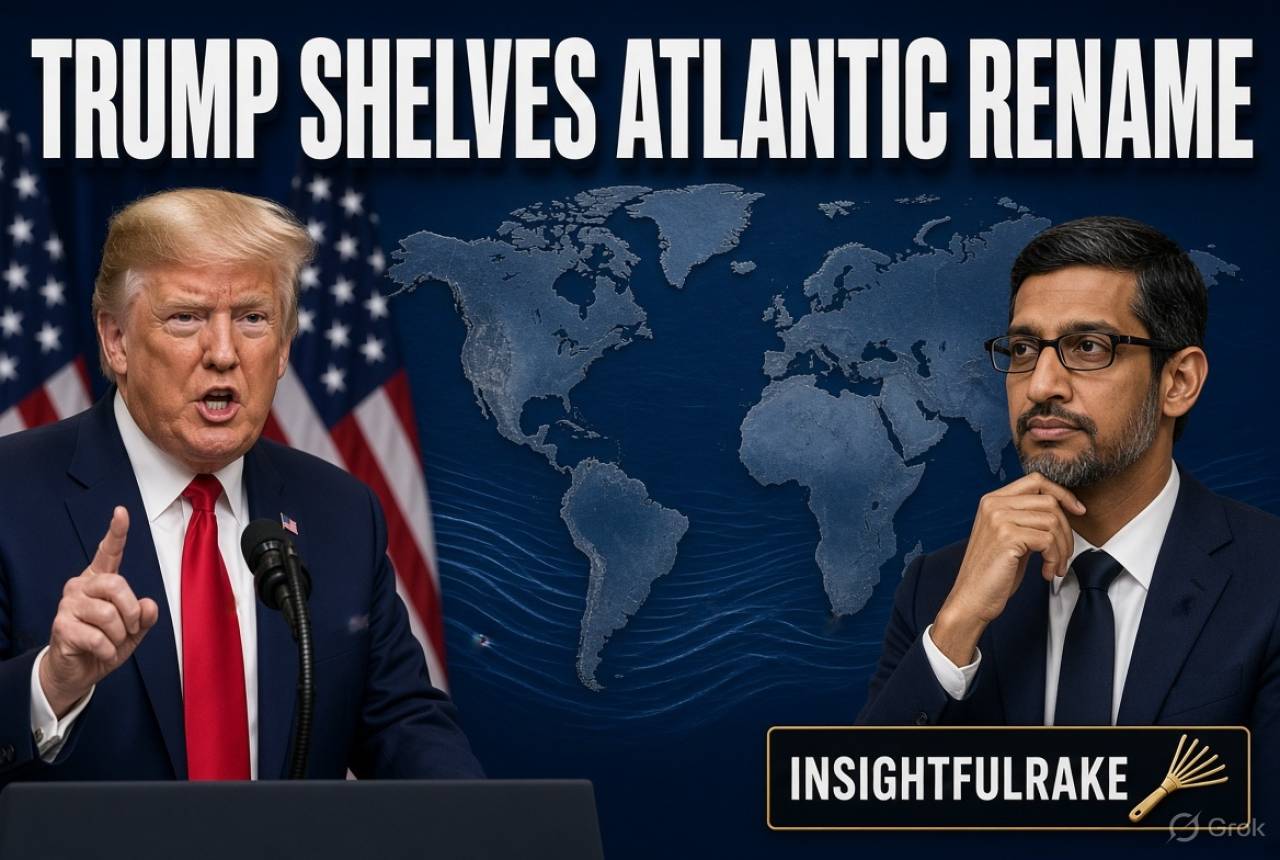
The US President says Google CEO Sundar Pichai advised against renaming the Atlantic Ocean, citing its international reach and the complications such a move could create.
US President Donald Trump has said he considered renaming the Atlantic Ocean but decided against pursuing the idea after speaking with Google CEO Sundar Pichai. Addressing a rally in South Carolina, Trump claimed that Pichai cautioned him about the international implications of changing the name of an ocean shared by numerous countries.
According to Trump's account, the Google chief explained that renaming an ocean would be far more complicated than changing the name of a lake or gulf. Trump said the conversation persuaded him to leave the Atlantic Ocean's name unchanged.
The remarks have drawn attention to the relationship between political decisions, digital mapping platforms and internationally recognised geographical names.
From the Gulf of America to the Atlantic Ocean
Trump's interest in renaming geographical features follows his administration's decision to adopt the name "Gulf of America" for the Gulf of Mexico in official US federal usage.
Google Maps subsequently updated its displays for users in the United States to reflect the new designation. Outside the country, naming conventions have varied according to location and established mapping practices.
At the South Carolina rally, Trump described how earlier naming changes had encouraged him to consider larger geographical features.
"Recently, I changed the name of a lake… you know the lake. But I did it very lightly. And the damn thing got changed, actually. That's power, right?" Trump said.
He also referred to Lake Ontario and suggested that the experience had prompted him to consider renaming either the Atlantic or Pacific Ocean.
What Trump Said About His Conversation With Pichai
Trump described Google CEO Sundar Pichai as a brilliant executive and recalled approaching him with the ocean-renaming proposal.
"I spoke to a brilliant guy, Sundar. He heads all of Google. He's a brilliant guy. Sergey and Sundar. Totally brilliant guys," Trump told the gathering, also mentioning Google co-founder Sergey Brin.
Trump then recounted asking Pichai whether Google could accommodate a new name for the Atlantic Ocean.
"Sundar, I'm thinking of the Atlantic Ocean. Can you handle it?" Trump reportedly asked.
According to Trump's version of the conversation, Pichai advised against the proposal because oceans extend across multiple countries and cannot be treated like smaller geographical features.
"Oceans are different, sir… they cover really a lot of countries. Please don't ask us to do that," Trump quoted Pichai as saying.
Trump indicated that he accepted the caution.
"So, I'll probably pass it… I think let's keep it the Atlantic Ocean," he said.
The account comes from Trump's public remarks. Google has not independently confirmed the reported private conversation.
Why Renaming an Ocean Is Complicated
The Atlantic Ocean stretches between the Americas to the west and Europe and Africa to the east. Its waters connect countries across several continents and form one of the world's most important maritime regions.
Unlike a geographical feature lying entirely within one country's territory, an ocean is part of a wider international system of navigation, trade, scientific research and geographical identification.
A US president can direct federal agencies to use particular names in official American documents and maps. However, such decisions do not automatically establish internationally accepted names.
Global recognition depends on established geographical conventions, national mapping authorities and international coordination.
Even if an American administration adopted a different name for the Atlantic Ocean, other countries would not be obliged to follow it.
For a company such as Google, which provides mapping services worldwide, conflicting national naming preferences create additional complications.
Google's Role in Geographical Naming
Google Maps serves users across countries with different political systems, territorial claims and naming conventions.
The company has previously adjusted geographical labels according to official government sources and users' locations.
Following the US government's adoption of "Gulf of America," Google updated the name displayed to American users. Its approach in other countries reflected different naming conventions.
The Atlantic Ocean would present a much larger challenge because its name is recognised across numerous jurisdictions and used extensively in international navigation, education, research and commerce.
A unilateral change could create inconsistencies between American maps and those used elsewhere.
Digital mapping platforms do not determine international sovereignty or geographical recognition. However, their decisions can influence which names people encounter in everyday life.
International Reaction and Diplomatic Concerns
Previous geographical renaming decisions have already generated objections from neighbouring countries.
Mexico opposed the Gulf of Mexico name change, while proposals involving Lake Ontario attracted criticism in Canada. Both cases demonstrated how geographical names can become subjects of diplomatic disagreement.
The Atlantic Ocean involves a much wider group of countries. Any attempt to change its name in American official usage would be unlikely to produce a corresponding change in international practice.
For governments, geographical names carry historical, cultural and diplomatic significance. They also appear in maritime charts, treaties, shipping records and educational materials.
A change introduced by one government would therefore have limited international authority without wider acceptance.
Why Pichai's Reported Response Matters
Pichai's reported intervention has attracted particular attention because of his position as an Indian-American technology executive leading one of the world's largest technology companies.
The exchange also illustrates the influence of private digital platforms in matters traditionally associated with governments and international institutions.
Google Maps is not an international geographical naming authority. Nevertheless, the platform's global reach means its labelling decisions can affect how people identify places.
For Google, maintaining different names across national markets requires balancing official government records with established international usage.
The reported conversation suggests that even where a technology company accommodates domestic naming changes, extending the same approach to an entire ocean presents a different challenge.
Trump Has Floated Other Naming Changes
The Atlantic Ocean was not Trump's only proposed geographical renaming.
Earlier in October, he suggested possibilities including "Trump Ocean" and "Ocean of the Americas" for either the Atlantic or Pacific Ocean. He also discussed potential changes involving major American rivers.
However, Trump has also described some of these remarks as jokes. During a subsequent rally in Florida on October 23, he again recounted the reported conversation with Pichai and said he had been kidding about renaming the Atlantic.
No formal Atlantic Ocean renaming order has been announced. Trump's remarks therefore do not establish that the proposal was being developed as official government policy.
The Atlantic Ocean Keeps Its Name
The Atlantic Ocean continues to appear under its established name in international geographical usage.
Trump's account of his conversation with Pichai has brought attention to the limits of national authority over globally recognised geographical names.
The episode also shows how digital mapping companies have become involved in disputes over geographical identity. Governments can change names for domestic official purposes, but securing wider international recognition is a separate matter.
Whether Trump revisits the idea remains uncertain. His remarks have nevertheless brought renewed attention to the relationship between political authority, corporate mapping decisions and internationally accepted geographical names.
For now, the Atlantic remains the Atlantic.


















Leave a Comment