
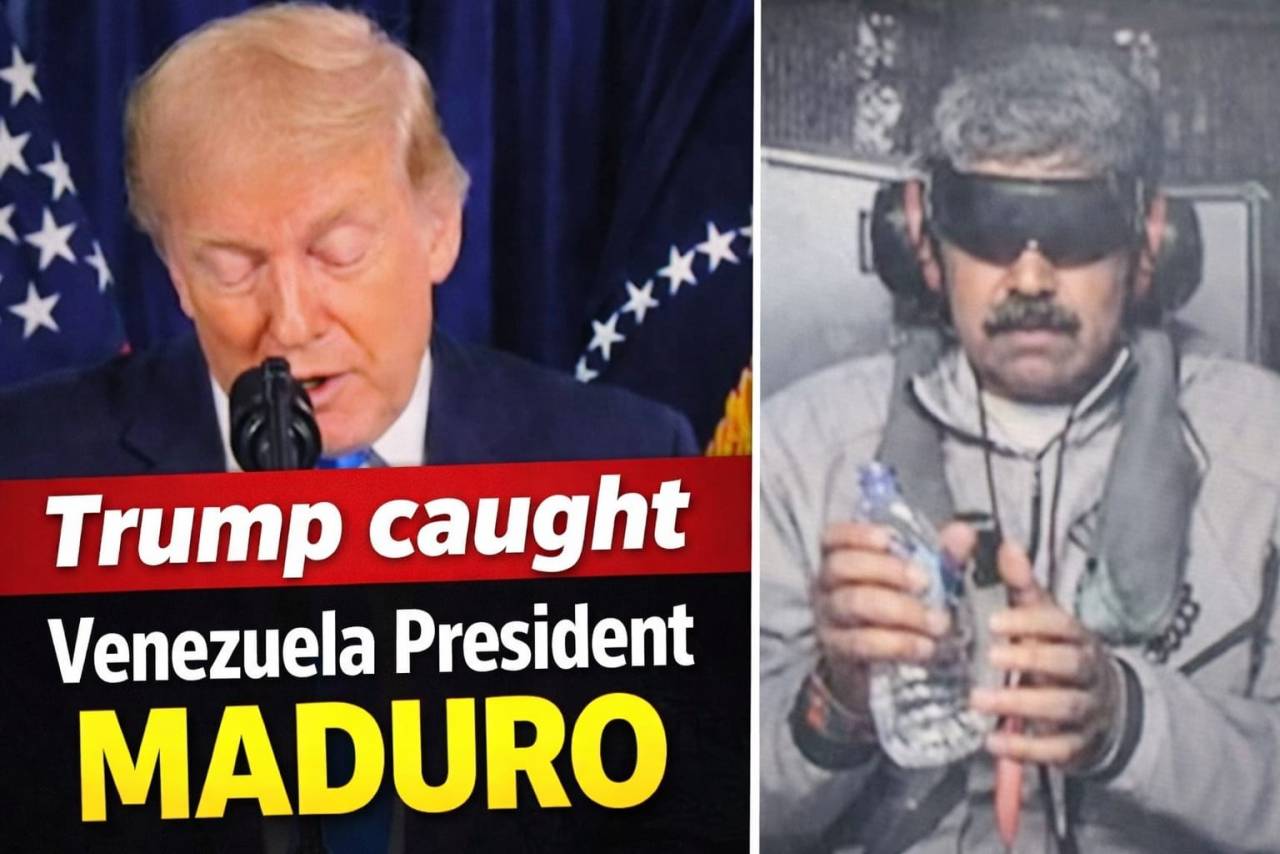
In a dramatic announcement today, January 3, 2026, U.S. President Donald Trump confirmed that elite American forces have captured Venezuelan President Nicolás Maduro and his wife, Cilia Flores, in a coordinated operation inside Venezuela. White House national security advisor Dan Caine provided details during a press briefing, confirming that the operation has concluded successfully and that Maduro is now in U.S. custody.
According to the U.S. administration, the operation targeted strategic military locations in Caracas, including key bases and command centers. Trump hailed the mission as a “major step in the fight against narco-terrorism and corruption” and said Maduro would face U.S. courts for his alleged involvement in drug trafficking and other criminal activities.
This unprecedented operation marks one of the most significant escalations in U.S.–Latin America relations in decades. The capture of a sitting foreign head of state by direct U.S. military action is virtually without precedent in modern history.
Confirmed Details and Reports
Multiple major international outlets, including CBS News, Reuters, and Al Jazeera, reported Trump’s announcement. Dan Caine emphasized that the operation was meticulously planned and executed, with efforts to minimize civilian casualties.
However, the Venezuelan government has denounced the operation as illegal aggression, demanding proof of life and location for its president and wife. While U.S. authorities maintain the operation’s success, Venezuela’s official position remains hostile and disputes the U.S. claims.
Why the U.S. Acted
The Trump administration has repeatedly cited Maduro’s alleged involvement in drug trafficking, terrorism, and human rights violations as justification for its actions. Over the past year, the U.S. had increased pressure on Venezuela through sanctions and diplomatic isolation, warning that military action could be necessary if Maduro did not step down voluntarily.
U.S. officials argue that Maduro’s removal will not only hold him accountable for criminal activities but may also pave the way for political reform and stabilization in Venezuela.
Legal and Ethical Debate
Despite U.S. claims, the operation raises significant questions under international law. Experts point out that forcibly removing a sitting head of state from their country could violate principles of sovereignty, unless justified under self-defense — a point the U.S. has not formally invoked.
Domestically, some lawmakers and legal scholars have questioned whether the president’s authorization of the operation fully aligns with constitutional provisions regarding the deployment of military force abroad.
Global Reaction
Global leaders have reacted strongly. Several Latin American countries and international organizations condemned the U.S. action as an illegal intervention. Conversely, some opposition groups in Venezuela welcomed the move as a potential turning point. Analysts warn that the operation could further polarize regional politics and heighten tensions between the U.S. and nations that view this as a breach of international norms.
President Trump’s confirmation and Dan Caine’s briefing make it clear that the U.S. claims Nicolás Maduro’s capture is a reality. The legal, diplomatic, and political repercussions are set to unfold in the coming days, marking a landmark moment in international relations.
























Leave a Comment