
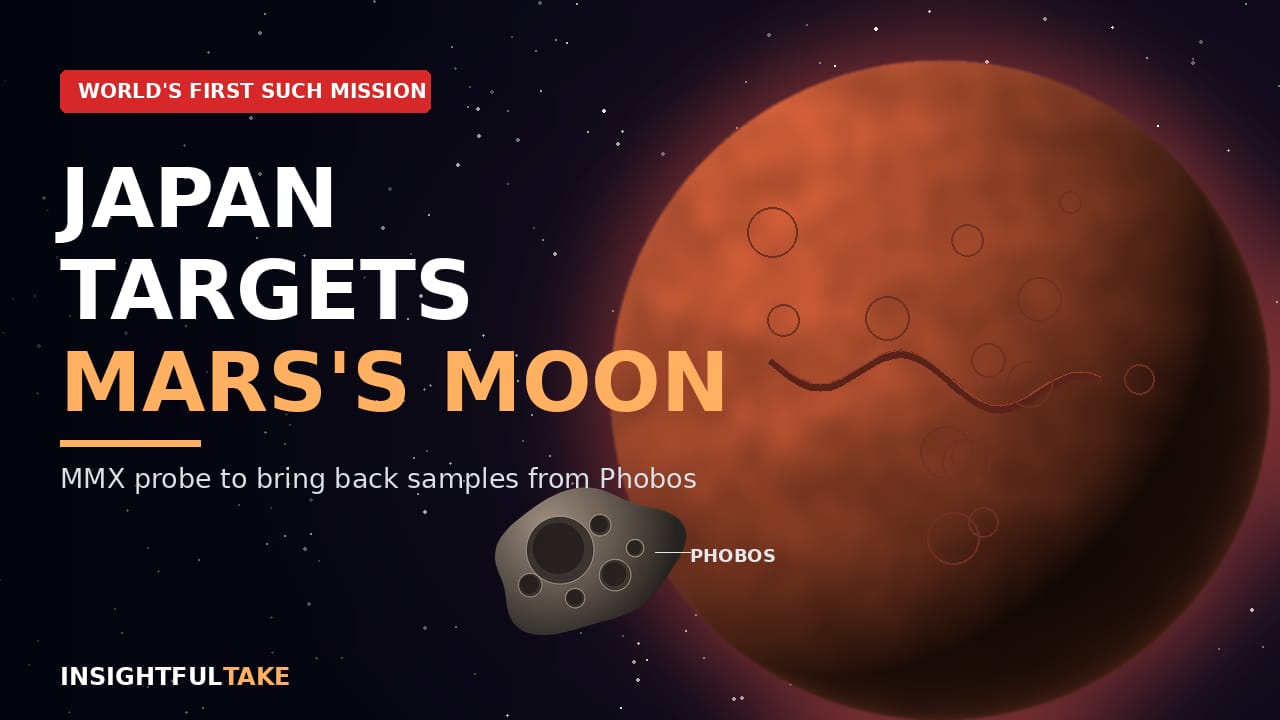
Japan’s MMX mission aims to bring back samples from Phobos, Mars’s mysterious moon, potentially revealing how the moons formed and offering clues about the Red Planet’s history.
Japan is preparing for an ambitious space mission for bringing back samples from the moon of another planet. The Japan Aerospace Exploration Agency (JAXA) plans to launch its Martian Moons eXploration spacecraft, known as MMX, aboard the H3 rocket, the country’s mainstay launch vehicle. Its target is Phobos, one of the two small, potato-shaped moons orbiting Mars.
The ambition is considerable. Mars has attracted dozens of missions since the 1960s, yet its moons have remained largely unexplored. Phobos measures roughly 20 to 30 kilometres across and orbits just 6,000 kilometres above the planet’s surface, completing about three orbits a day. Despite its proximity to Mars, the moon remains an enigma.
A Puzzle Over Origins
The central question is how these moons formed. Scientists remain divided. One theory holds that Phobos and its smaller sibling, Deimos, are remnants of debris thrown into orbit when a large celestial object collided with Mars long ago. Another suggests that they are asteroids captured by the planet’s gravitational pull.
JAXA hopes the mission will help resolve this debate. By studying material collected directly from Phobos, researchers expect to gain important clues about the origins of both moons. The findings could also shed light on how Mars evolved and improve our understanding of the early history of the solar system.
The mission’s principal investigator, Kiyoshi Kuramoto, has expressed optimism that analysing the samples could bring scientists closer to a firm conclusion. The spacecraft is expected to undertake a journey lasting about five years before returning its precious cargo to Earth.
Why Phobos?
Scientists selected Phobos over Deimos primarily because of its closer orbit to Mars. This proximity increases the likelihood that the moon contains material ejected from the Martian surface by meteorite impacts.
Researchers estimate that around 0.1 per cent of the material collected from Phobos could have originated on Mars itself. If confirmed, this would provide an additional scientific opportunity: studying fragments of the Red Planet without having to collect them directly from its surface.
Project manager Yasuhiro Kawakatsu has suggested that studying Mars through its moons could offer valuable insights into the planet’s history. Despite their potential scientific importance, neither Phobos nor Deimos has been investigated comprehensively. Their composition may preserve clues about Mars’s past that are difficult to obtain from the planet’s surface alone.
Names Rooted in Mythology
The moons’ names come from Greek mythology. Phobos and Deimos, personifications of fear and terror, were the sons of Ares, the Greek god of war. The Romans identified Ares with Mars, the god whose name was later given to the planet.
The names are fitting for celestial bodies that have long fascinated astronomers and challenged scientists seeking to understand their origins.
A Difficult Road to Phobos
Reaching Phobos will be a formidable technical challenge. Russia has made several attempts to explore the moon, including the Phobos-Grunt mission launched in 2011, but these efforts failed to achieve their objectives.
The history of Mars exploration is marked by setbacks, highlighting the difficulties of operating spacecraft across vast distances and landing on small, irregularly shaped celestial bodies.
Japan, however, brings valuable experience to the task. Its earlier Hayabusa and Hayabusa2 missions successfully collected samples from asteroids and returned them to Earth. That experience provides an important foundation for the MMX mission.
Although Japan is leading the project, MMX is an international undertaking. NASA and other space agencies are contributing equipment and communications support, reflecting the growing role of international cooperation in deep-space exploration.
Looking Beyond the Samples
The mission’s significance extends beyond understanding the origins of Mars’s moons. Its findings could also help scientists and space agencies prepare for future crewed missions to the Red Planet.
The United States, China and other countries have explored plans for sending astronauts to Mars. In this context, Phobos could become a useful staging point for future missions, potentially providing a location for equipment, communications systems and other infrastructure supporting exploration.
However, establishing a human presence on Phobos would require extensive further research. Scientists must better understand its surface, composition, gravitational environment and exposure to radiation before determining whether it could support future exploration activities.
The samples returned by MMX could help researchers investigate the moon’s geological history and composition. Combined with observations from the spacecraft, the findings may also improve understanding of the dust, terrain and environmental conditions that future missions would encounter.
A Mission With Historic Potential
If the launch, exploration and sample-return phases succeed, Japan could achieve a major milestone in space exploration by bringing material back from a moon orbiting another planet. The mission would also strengthen the country’s position among the leading spacefaring nations.
The scientific rewards could extend well beyond Phobos itself. By revealing how the Martian moons formed and whether they contain material from Mars, MMX could help answer fundamental questions about the Red Planet’s evolution and the early solar system.
The mission also carries considerable risks. Travelling to Phobos, operating near its irregular surface and returning samples to Earth will test spacecraft technology and mission planning.
Whatever the outcome, MMX represents an ambitious attempt to investigate one of Mars’s least-understood neighbours. Its success could bring scientists closer to understanding not only the origins of these mysterious moons but also the history of the planet they orbit.



























Leave a Comment