
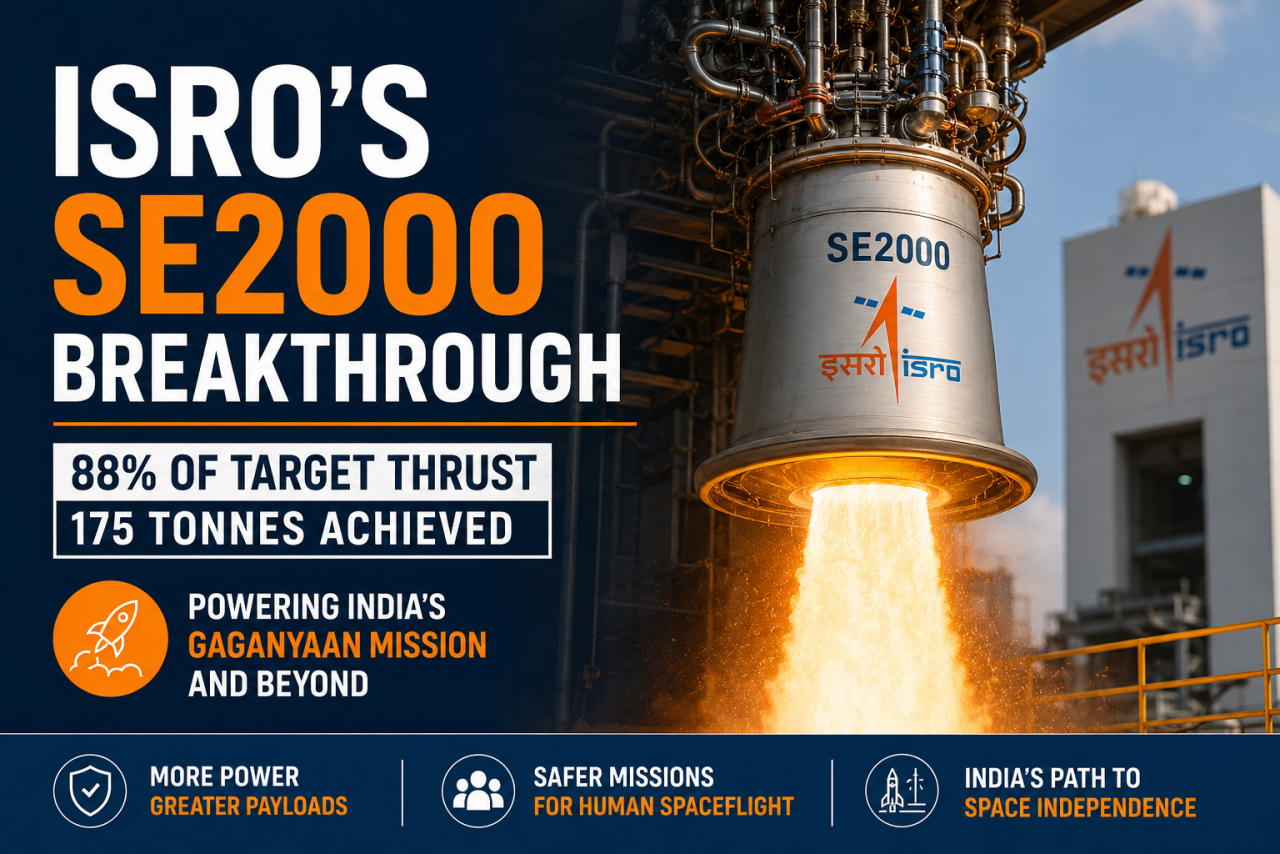
ISRO's latest successful test of the indigenous SE2000 semi-cryogenic engine marks a major leap toward Gaganyaan, heavier payload launches, and India's long-term goal of becoming a leading human spaceflight nation.
The Indian Space Research Organisation (ISRO) has cleared a critical technical hurdle in its pursuit of a heavier-lift, human-rated launch capability. On June 24, at the ISRO Propulsion Complex in Tamil Nadu, engineers conducted a hot test of the power head for the semi-cryogenic SE2000 engine, achieving 88% of its target thrust and sustaining stable operation at a thrust level of 175 tonnes. The test followed earlier trials that reached 47% and 60% thrust, marking a steady climb toward what ISRO describes as "sufficient confidence" in the system's full-thrust performance, targeted at 200 tonnes.
The SE2000 is not a peripheral project. It is designed to replace the L110 core stage on the LVM3, India's heaviest operational launch vehicle, which currently delivers roughly 2,000 kilonewtons of thrust in its liquid core stage and serves as the backbone of the country's heavy-lift missions. Unlike the existing liquid engine, the SE2000 runs on liquid oxygen (LOX) and kerosene instead of more toxic and harder-to-handle propellant combinations used in some legacy systems. The shift is expected to improve operational efficiency, increase payload capacity, and, crucially for the Gaganyaan human spaceflight programme, enhance safety margins for crewed missions.
Where This Fits Into the Global Picture
Semi-cryogenic propulsion using LOX and kerosene has formed the backbone of the world's most capable launch systems for decades. The United States' Falcon 9 and Falcon Heavy rely on SpaceX's Merlin engines, which also use LOX and kerosene, enabling Falcon Heavy to lift more than 60 tonnes to low Earth orbit. Russia's RD-180 and RD-191 engines, likewise fuelled by kerosene, have powered Atlas and Angara launch vehicles for years and were once licensed to American manufacturers because the technology was considered difficult to replicate domestically. China's Long March 5 employs the YF-100 LOX-kerosene engine, generating around 120 tonnes of thrust per engine and operating in clustered configurations.
Against this backdrop, India's SE2000, targeting 200 tonnes of thrust, places it in a comparable thrust class to individual engines used by established spacefaring nations. However, India is still completing qualification testing rather than operating the engine in active missions. The distinction is less about engineering capability and more about flight heritage. The United States and Russia possess decades of operational LOX-kerosene experience across hundreds of launches, while China has built a substantial record over the past fifteen years. India's semi-cryogenic programme, by contrast, is only now approaching full-thrust validation.
What the Milestone Means for Gaganyaan and Beyond
The timing is significant. ISRO has structured its human spaceflight ambitions around the LVM3, the launch vehicle expected to carry Indian astronauts into orbit under the Gaganyaan programme. A more powerful and efficient core stage directly expands the margin available for crew safety systems while enabling heavier payloads—both essential for sustained human spaceflight and India's stated objective of establishing its own space station by the mid-2030s.
India has reached this stage largely through indigenous development, without the engine-sharing or licensing arrangements that supported Russian and early Chinese kerosene-engine programmes. That emphasis on self-reliance has come at the cost of time. The SE2000 has been under development for more than a decade, a slower trajectory than comparable programmes in the United States, where private investment and iterative testing accelerated the development of the Merlin engine.
The June 24 hot test does not place India on par with the world's most advanced spacefaring nations overnight. What it does demonstrate is a narrowing of the technological gap in a propulsion class that has underpinned heavy-lift and human-rated launch systems since the Cold War. As qualification trials continue toward operational deployment, India's semi-cryogenic programme has moved beyond proof of concept and into the final stages of maturity, strengthening the country's long-term ambitions in human spaceflight, deep-space exploration, and independent access to space.
The Indian Space Research Organisation (ISRO) has cleared a critical technical hurdle in its pursuit of a heavier-lift, human-rated launch capability. On June 24, at the ISRO Propulsion Complex in Tamil Nadu, engineers conducted a hot test of the power head for the semi-cryogenic SE2000 engine, achieving 88% of its target thrust and sustaining stable operation at a thrust level of 175 tonnes. The test followed earlier trials that reached 47% and 60% thrust, marking a steady climb toward what ISRO describes as "sufficient confidence" in the system's full-thrust performance, targeted at 200 tonnes.
The SE2000 is not a peripheral project. It is designed to replace the L110 core stage on the LVM3, India's heaviest operational launch vehicle, which currently delivers roughly 2,000 kilonewtons of thrust in its liquid core stage and serves as the backbone of the country's heavy-lift missions. Unlike the existing liquid engine, the SE2000 runs on liquid oxygen (LOX) and kerosene instead of more toxic and harder-to-handle propellant combinations used in some legacy systems. The shift is expected to improve operational efficiency, increase payload capacity, and, crucially for the Gaganyaan human spaceflight programme, enhance safety margins for crewed missions.
Where This Fits Into the Global Picture
Semi-cryogenic propulsion using LOX and kerosene has formed the backbone of the world's most capable launch systems for decades. The United States' Falcon 9 and Falcon Heavy rely on SpaceX's Merlin engines, which also use LOX and kerosene, enabling Falcon Heavy to lift more than 60 tonnes to low Earth orbit. Russia's RD-180 and RD-191 engines, likewise fuelled by kerosene, have powered Atlas and Angara launch vehicles for years and were once licensed to American manufacturers because the technology was considered difficult to replicate domestically. China's Long March 5 employs the YF-100 LOX-kerosene engine, generating around 120 tonnes of thrust per engine and operating in clustered configurations.
Against this backdrop, India's SE2000, targeting 200 tonnes of thrust, places it in a comparable thrust class to individual engines used by established spacefaring nations. However, India is still completing qualification testing rather than operating the engine in active missions. The distinction is less about engineering capability and more about flight heritage. The United States and Russia possess decades of operational LOX-kerosene experience across hundreds of launches, while China has built a substantial record over the past fifteen years. India's semi-cryogenic programme, by contrast, is only now approaching full-thrust validation.
What the Milestone Means for Gaganyaan and Beyond
The timing is significant. ISRO has structured its human spaceflight ambitions around the LVM3, the launch vehicle expected to carry Indian astronauts into orbit under the Gaganyaan programme. A more powerful and efficient core stage directly expands the margin available for crew safety systems while enabling heavier payloads—both essential for sustained human spaceflight and India's stated objective of establishing its own space station by the mid-2030s.
India has reached this stage largely through indigenous development, without the engine-sharing or licensing arrangements that supported Russian and early Chinese kerosene-engine programmes. That emphasis on self-reliance has come at the cost of time. The SE2000 has been under development for more than a decade, a slower trajectory than comparable programmes in the United States, where private investment and iterative testing accelerated the development of the Merlin engine.
The June 24 hot test does not place India on par with the world's most advanced spacefaring nations overnight. What it does demonstrate is a narrowing of the technological gap in a propulsion class that has underpinned heavy-lift and human-rated launch systems since the Cold War. As qualification trials continue toward operational deployment, India's semi-cryogenic programme has moved beyond proof of concept and into the final stages of maturity, strengthening the country's long-term ambitions in human spaceflight, deep-space exploration, and independent access to space.




























Leave a Comment