
India’s rural employment generation has fallen sharply just as VB-G RAM G replaces MGNREGS. What is behind the slowdown?
India's flagship rural employment guarantee programme has generated far fewer workdays this year than last, even during what is usually its busiest stretch, raising uncomfortable questions just weeks after the scheme was rebranded and restructured by the Centre.
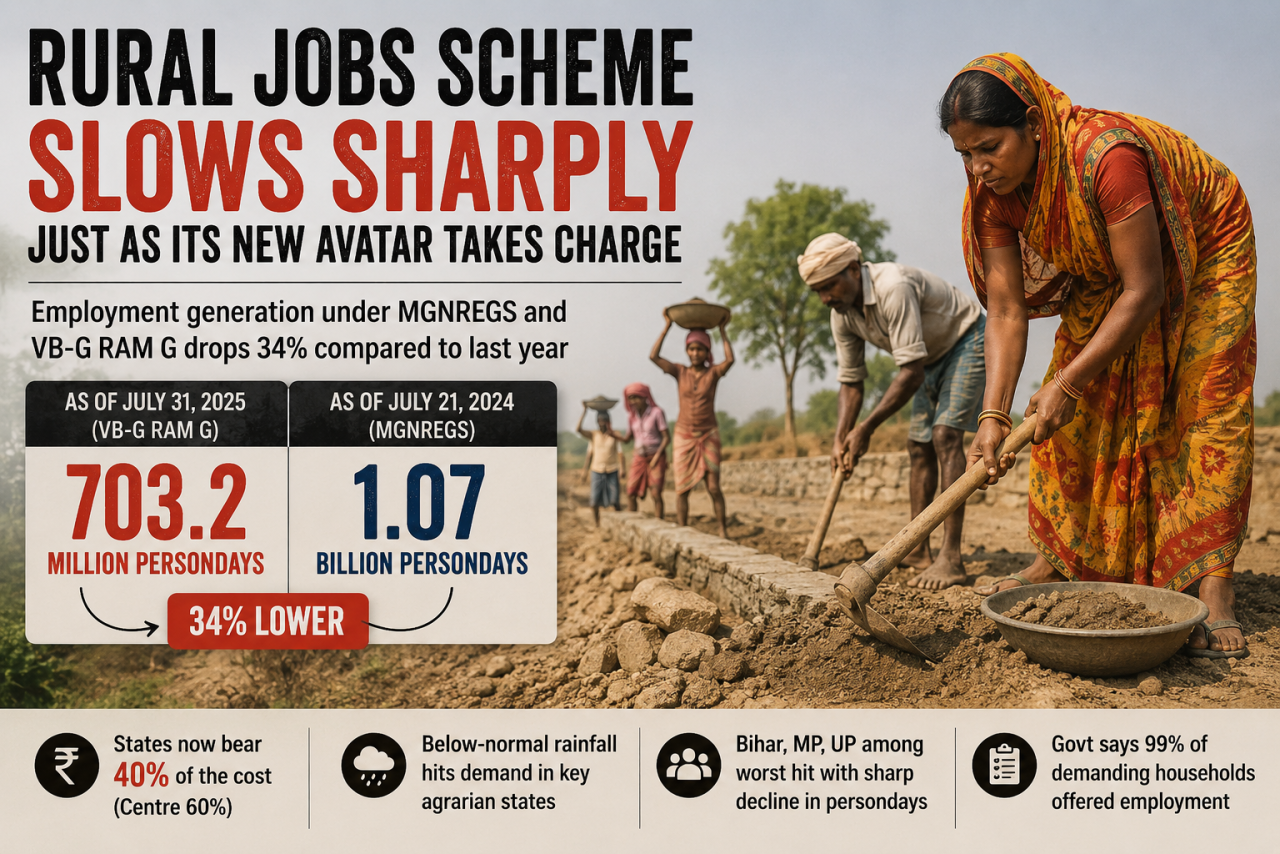
Data tabled in the Rajya Sabha and a government release from July 25 show that the Mahatma Gandhi National Rural Employment Guarantee Scheme (MGNREGS) and its successor, the Viksit Bharat–Guarantee for Rozgar and Aajeevika Mission (Gramin), or VB-G RAM G, generated 703.2 million persondays as of July 31. That is around 34 percent lower than the 1.07 billion persondays recorded by July 21 last year, despite this year's count covering ten additional days.
The gap is significant because the first four months of the financial year typically account for a large share of annual employment generation under the programme. Last year, by July 21 alone, 46.3 percent of the year's total 2.31 billion persondays had already been generated. This year's pace suggests the scheme is badly lagging that trajectory.
What Changed, and When
VB-G RAM G came into effect on July 1, replacing MGNREGS after a redesign by the Centre. The scheme traces its roots to the Mahatma Gandhi National Rural Employment Guarantee Act, enacted in 2005 under the UPA government led by Prime Minister Manmohan Singh, and has long been considered one of India's most significant rural welfare guarantees, offering up to 100 days of guaranteed wage employment to rural households.
Himanshu, associate professor of economics at the Centre for Economic Studies and Planning, Jawaharlal Nehru University, told Hindustan Times that the timing of the transition may itself explain part of the slowdown. States may be hesitant to ramp up spending while uncertain how the new funding arrangement will work, he said. Under VB-G RAM G, states must bear 40 percent of the total cost, with the Centre funding the remaining 60 percent, a formula shift from the earlier scheme.
Himanshu added that the decline is concentrated in states that have traditionally accounted for the largest share of employment generation under the scheme, precisely the states now showing the biggest shortfalls.
States Bearing the Brunt
The numbers are stark. Bihar generated 73.98 million persondays by July 31 this year, compared with 223.22 million across the whole of FY2025-26. Madhya Pradesh generated 28.03 million persondays against 190.70 million, while Uttar Pradesh generated 38.59 million against 240.61 million.
These are among India's most agrarian states, and several have also faced below-normal rainfall this season, delaying sowing and, with it, the seasonal demand for guaranteed work.
Himanshu called the pattern "distressing," noting that some of the largest shortfalls are in bigger agrarian states already facing the worst rainfall deficits, a double burden for rural households who typically rely on the scheme precisely when farm work dries up.
The Government's Defence
The Centre has maintained that the programme remains demand-driven and that employment is generated only when rural households actively seek work.
A senior rural development ministry official said more than 99 percent of households demanding employment have been offered work under VB-G RAM G.
The ministry has also pointed out that several states have notified work-period rules of up to 60 days under the new law, which officials say may have altered how demand is being recorded during the transition rather than reflecting an actual drop in employment offered.
Final Take
Whatever the precise mix of causes, transition friction, an unfamiliar cost-sharing formula, or genuine weather-driven disruption to rural demand, the effect on the ground is the same: fewer guaranteed workdays for households that depend on this scheme as a seasonal safety net, at a moment when erratic rainfall has already squeezed farm incomes in states like Bihar, Jharkhand and Madhya Pradesh.
The scheme has survived multiple governments and been credited with cushioning rural India through droughts, demonetisation and the pandemic. Its rebranding under the current government was pitched as modernisation.
Whether that overhaul strengthens the guarantee or dilutes it will likely become clearer only once the data for the full sowing and monsoon season comes in. But the opening numbers are not reassuring.
India's flagship rural employment guarantee programme has generated far fewer workdays this year than last, even during what is usually its busiest stretch, raising uncomfortable questions just weeks after the scheme was rebranded and restructured by the Centre.
Data tabled in the Rajya Sabha and a government release from July 25 show that the Mahatma Gandhi National Rural Employment Guarantee Scheme (MGNREGS) and its successor, the Viksit Bharat–Guarantee for Rozgar and Aajeevika Mission (Gramin), or VB-G RAM G, generated 703.2 million persondays as of July 31. That is around 34 percent lower than the 1.07 billion persondays recorded by July 21 last year, despite this year's count covering ten additional days.
The gap is significant because the first four months of the financial year typically account for a large share of annual employment generation under the programme. Last year, by July 21 alone, 46.3 percent of the year's total 2.31 billion persondays had already been generated. This year's pace suggests the scheme is badly lagging that trajectory.
What Changed, and When
VB-G RAM G came into effect on July 1, replacing MGNREGS after a redesign by the Centre. The scheme traces its roots to the Mahatma Gandhi National Rural Employment Guarantee Act, enacted in 2005 under the UPA government led by Prime Minister Manmohan Singh, and has long been considered one of India's most significant rural welfare guarantees, offering up to 100 days of guaranteed wage employment to rural households.
Himanshu, associate professor of economics at the Centre for Economic Studies and Planning, Jawaharlal Nehru University, told Hindustan Times that the timing of the transition may itself explain part of the slowdown. States may be hesitant to ramp up spending while uncertain how the new funding arrangement will work, he said. Under VB-G RAM G, states must bear 40 percent of the total cost, with the Centre funding the remaining 60 percent, a formula shift from the earlier scheme.
Himanshu added that the decline is concentrated in states that have traditionally accounted for the largest share of employment generation under the scheme, precisely the states now showing the biggest shortfalls.
States Bearing the Brunt
The numbers are stark. Bihar generated 73.98 million persondays by July 31 this year, compared with 223.22 million across the whole of FY2025-26. Madhya Pradesh generated 28.03 million persondays against 190.70 million, while Uttar Pradesh generated 38.59 million against 240.61 million.
These are among India's most agrarian states, and several have also faced below-normal rainfall this season, delaying sowing and, with it, the seasonal demand for guaranteed work.
Himanshu called the pattern "distressing," noting that some of the largest shortfalls are in bigger agrarian states already facing the worst rainfall deficits, a double burden for rural households who typically rely on the scheme precisely when farm work dries up.
The Government's Defence
The Centre has maintained that the programme remains demand-driven and that employment is generated only when rural households actively seek work.
A senior rural development ministry official said more than 99 percent of households demanding employment have been offered work under VB-G RAM G.
The ministry has also pointed out that several states have notified work-period rules of up to 60 days under the new law, which officials say may have altered how demand is being recorded during the transition rather than reflecting an actual drop in employment offered.
Final Take
Whatever the precise mix of causes, transition friction, an unfamiliar cost-sharing formula, or genuine weather-driven disruption to rural demand, the effect on the ground is the same: fewer guaranteed workdays for households that depend on this scheme as a seasonal safety net, at a moment when erratic rainfall has already squeezed farm incomes in states like Bihar, Jharkhand and Madhya Pradesh.
The scheme has survived multiple governments and been credited with cushioning rural India through droughts, demonetisation and the pandemic. Its rebranding under the current government was pitched as modernisation.
Whether that overhaul strengthens the guarantee or dilutes it will likely become clearer only once the data for the full sowing and monsoon season comes in. But the opening numbers are not reassuring.





















Leave a Comment