
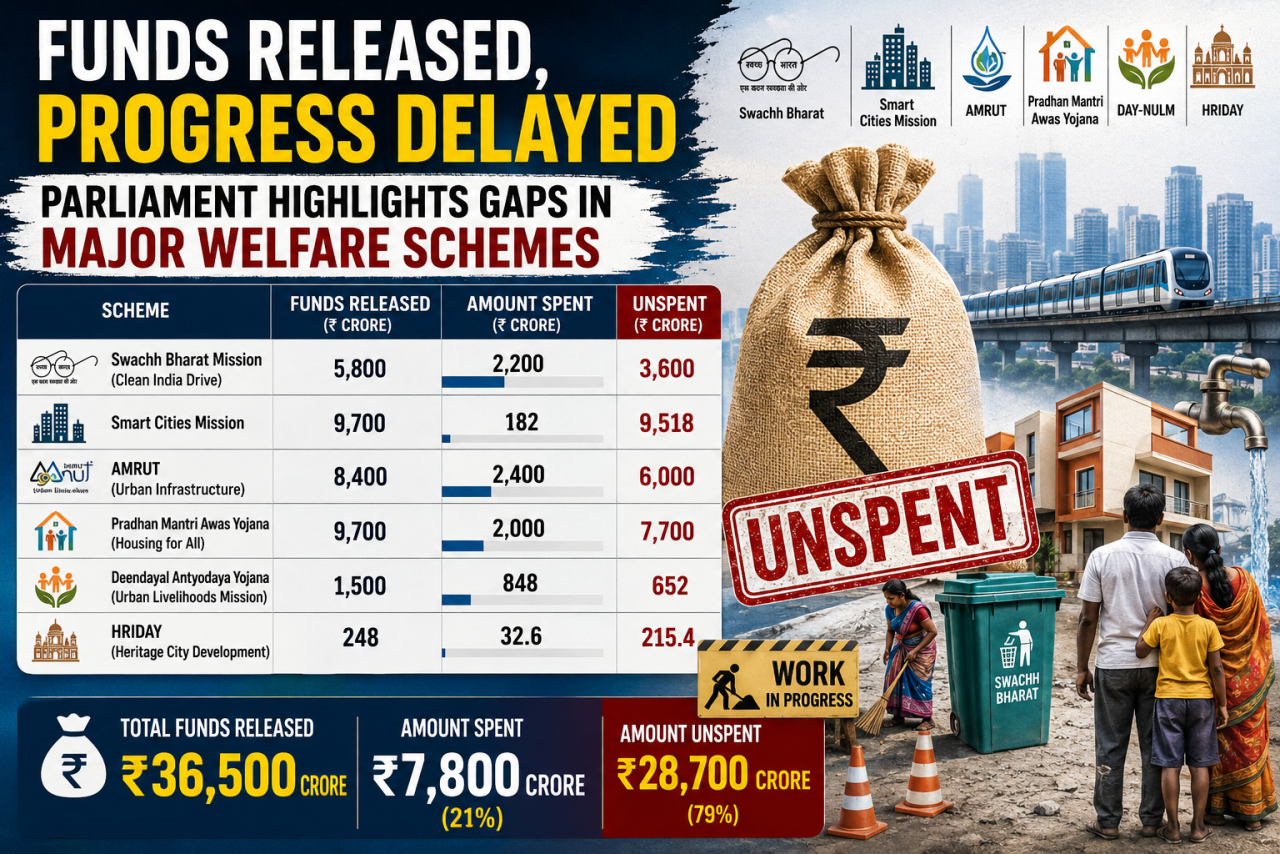
₹36,500 crore released, but only 21% spent. A parliamentary report raises tough questions about delays in India's flagship welfare and urban development schemes.
India has invested heavily in a range of flagship welfare and urban development programmes over the past decade, promising cleaner cities, affordable housing, improved infrastructure, and better livelihoods for millions. Yet a recent parliamentary committee report has raised concerns that while funds are being released, progress on the ground is not always keeping pace.
The report highlights a significant gap between the money allocated to several major government schemes and the amount officially recorded as spent. According to the committee's findings, only about 21 percent of the funds released under six key welfare and urban development initiatives have been utilized so far.
Out of approximately ₹36,500 crore earmarked for these programmes, only around ₹7,800 crore has been reflected as expenditure in official records. The findings have prompted lawmakers to question whether implementation challenges, administrative delays, and bureaucratic hurdles are slowing the impact of projects designed to improve the lives of millions of citizens.
A Wide Gap Between Allocation and Utilization
The parliamentary panel examined expenditure across six major schemes, many of which are considered cornerstones of India's development agenda.
Among the most striking examples is the Smart Cities Mission, launched to modernize urban centres through technology-driven governance, better infrastructure, and improved public services. The report notes that while nearly ₹9,700 crore was released for the programme, only about ₹182 crore has been officially recorded as spent.
The Pradhan Mantri Awas Yojana (PMAY), one of India's largest affordable housing initiatives, also shows a considerable gap. Out of approximately ₹9,700 crore released, only about ₹2,000 crore has been recorded as utilized.
Similarly, the Atal Mission for Rejuvenation and Urban Transformation (AMRUT), which focuses on water supply, sewerage systems, and urban infrastructure, received around ₹8,400 crore but reported expenditure of only ₹2,400 crore.
The Swachh Bharat Mission, aimed at improving sanitation and cleanliness across the country, received roughly ₹5,800 crore in released funds. Official expenditure figures, however, stand at around ₹2,200 crore.
The committee also reviewed the Deendayal Antyodaya Yojana – National Urban Livelihoods Mission, which seeks to improve employment opportunities and skill development for the urban poor. Of the ₹1,500 crore released under the programme, around ₹848 crore has been spent.
Meanwhile, the Heritage City Development and Augmentation Yojana (HRIDAY), created to preserve and improve infrastructure in heritage cities, utilized only ₹32.6 crore out of ₹248 crore released.
Taken together, these figures suggest that a substantial portion of allocated public funds remains outside the expenditure column despite pressing developmental needs across the country.
Parliament Raises Questions
The parliamentary committee expressed concern that many projects appear to be moving slower than expected despite substantial financial support from the Centre.
According to the panel, ambitious targets often run into practical difficulties during implementation. The committee observed that some projects suffer from inadequate planning, delays in approvals, and a lack of preparedness before funds are released.
Lawmakers also questioned whether project timelines are being monitored effectively and whether ministries are accurately assessing the challenges involved before launching large-scale programmes.
The report argues that without stronger implementation mechanisms, the intended benefits of these schemes could take much longer to reach citizens than originally envisioned.
Development Is More Than Budget Announcements
Experts point out that allocating money is only the first step in delivering meaningful development outcomes.
Large public projects require coordination between multiple agencies, including central ministries, state governments, municipal bodies, contractors, and local communities. Delays at any stage can affect overall progress.
For example, urban infrastructure projects often involve land acquisition, environmental clearances, engineering approvals, and extensive coordination between different departments. Housing projects may face delays due to land availability, construction challenges, or administrative procedures.
Similarly, behavioural-change programmes such as sanitation campaigns require sustained community engagement alongside infrastructure investment. As a result, expenditure does not always move at the same speed as budget allocations.
The Role of Bureaucratic Procedures
One of the major reasons cited for the apparent spending gap is the complex system of financial reporting and accountability.
Before additional funds can be released, implementing agencies are required to submit utilization certificates demonstrating that previous allocations have been spent according to approved guidelines. These certificates pass through several administrative levels before being verified and recorded.
In many cases, the process can take months or even years. As a result, expenditure figures reflected in official records may lag behind actual work being carried out on the ground.
This often creates a disconnect between financial data and project activity. Construction may be underway, contracts may have been awarded, and infrastructure may be nearing completion, yet expenditure records may not immediately capture that progress.
Government Disagrees with the Assessment
The Ministry of Housing and Urban Affairs has rejected the suggestion that low expenditure figures necessarily indicate poor implementation.
Government officials argue that the committee's interpretation does not fully account for the accounting procedures involved in large infrastructure programmes. According to the ministry, funds are often recorded as expenditure only after projects reach specific stages of completion and all required documentation is processed.
Officials maintain that substantial work continues across multiple schemes and that the reported figures do not accurately reflect the full scale of ongoing activities.
The ministry also notes that many urban development projects span several years, making short-term expenditure data an incomplete measure of overall performance.
Final Take
The debate surrounding these figures highlights a broader challenge facing India's development efforts: ensuring that financial commitments translate into timely and measurable outcomes.
Over the years, governments have announced increasingly ambitious programmes to improve urban infrastructure, expand housing access, strengthen sanitation systems, and support vulnerable communities. These initiatives have generated high public expectations and attracted significant investments.
However, citizens ultimately judge success not by the size of allocations but by visible improvements in daily life—better roads, reliable water supply, affordable housing, cleaner neighbourhoods, and stronger livelihood opportunities.
The parliamentary committee's observations serve as a reminder that effective governance requires not only funding but also efficient implementation, rigorous monitoring, and accountability at every stage.
India has invested heavily in a range of flagship welfare and urban development programmes over the past decade, promising cleaner cities, affordable housing, improved infrastructure, and better livelihoods for millions. Yet a recent parliamentary committee report has raised concerns that while funds are being released, progress on the ground is not always keeping pace.
The report highlights a significant gap between the money allocated to several major government schemes and the amount officially recorded as spent. According to the committee's findings, only about 21 percent of the funds released under six key welfare and urban development initiatives have been utilized so far.
Out of approximately ₹36,500 crore earmarked for these programmes, only around ₹7,800 crore has been reflected as expenditure in official records. The findings have prompted lawmakers to question whether implementation challenges, administrative delays, and bureaucratic hurdles are slowing the impact of projects designed to improve the lives of millions of citizens.
A Wide Gap Between Allocation and Utilization
The parliamentary panel examined expenditure across six major schemes, many of which are considered cornerstones of India's development agenda.
Among the most striking examples is the Smart Cities Mission, launched to modernize urban centres through technology-driven governance, better infrastructure, and improved public services. The report notes that while nearly ₹9,700 crore was released for the programme, only about ₹182 crore has been officially recorded as spent.
The Pradhan Mantri Awas Yojana (PMAY), one of India's largest affordable housing initiatives, also shows a considerable gap. Out of approximately ₹9,700 crore released, only about ₹2,000 crore has been recorded as utilized.
Similarly, the Atal Mission for Rejuvenation and Urban Transformation (AMRUT), which focuses on water supply, sewerage systems, and urban infrastructure, received around ₹8,400 crore but reported expenditure of only ₹2,400 crore.
The Swachh Bharat Mission, aimed at improving sanitation and cleanliness across the country, received roughly ₹5,800 crore in released funds. Official expenditure figures, however, stand at around ₹2,200 crore.
The committee also reviewed the Deendayal Antyodaya Yojana – National Urban Livelihoods Mission, which seeks to improve employment opportunities and skill development for the urban poor. Of the ₹1,500 crore released under the programme, around ₹848 crore has been spent.
Meanwhile, the Heritage City Development and Augmentation Yojana (HRIDAY), created to preserve and improve infrastructure in heritage cities, utilized only ₹32.6 crore out of ₹248 crore released.
Taken together, these figures suggest that a substantial portion of allocated public funds remains outside the expenditure column despite pressing developmental needs across the country.
Parliament Raises Questions
The parliamentary committee expressed concern that many projects appear to be moving slower than expected despite substantial financial support from the Centre.
According to the panel, ambitious targets often run into practical difficulties during implementation. The committee observed that some projects suffer from inadequate planning, delays in approvals, and a lack of preparedness before funds are released.
Lawmakers also questioned whether project timelines are being monitored effectively and whether ministries are accurately assessing the challenges involved before launching large-scale programmes.
The report argues that without stronger implementation mechanisms, the intended benefits of these schemes could take much longer to reach citizens than originally envisioned.
Development Is More Than Budget Announcements
Experts point out that allocating money is only the first step in delivering meaningful development outcomes.
Large public projects require coordination between multiple agencies, including central ministries, state governments, municipal bodies, contractors, and local communities. Delays at any stage can affect overall progress.
For example, urban infrastructure projects often involve land acquisition, environmental clearances, engineering approvals, and extensive coordination between different departments. Housing projects may face delays due to land availability, construction challenges, or administrative procedures.
Similarly, behavioural-change programmes such as sanitation campaigns require sustained community engagement alongside infrastructure investment. As a result, expenditure does not always move at the same speed as budget allocations.
The Role of Bureaucratic Procedures
One of the major reasons cited for the apparent spending gap is the complex system of financial reporting and accountability.
Before additional funds can be released, implementing agencies are required to submit utilization certificates demonstrating that previous allocations have been spent according to approved guidelines. These certificates pass through several administrative levels before being verified and recorded.
In many cases, the process can take months or even years. As a result, expenditure figures reflected in official records may lag behind actual work being carried out on the ground.
This often creates a disconnect between financial data and project activity. Construction may be underway, contracts may have been awarded, and infrastructure may be nearing completion, yet expenditure records may not immediately capture that progress.
Government Disagrees with the Assessment
The Ministry of Housing and Urban Affairs has rejected the suggestion that low expenditure figures necessarily indicate poor implementation.
Government officials argue that the committee's interpretation does not fully account for the accounting procedures involved in large infrastructure programmes. According to the ministry, funds are often recorded as expenditure only after projects reach specific stages of completion and all required documentation is processed.
Officials maintain that substantial work continues across multiple schemes and that the reported figures do not accurately reflect the full scale of ongoing activities.
The ministry also notes that many urban development projects span several years, making short-term expenditure data an incomplete measure of overall performance.
Final Take
The debate surrounding these figures highlights a broader challenge facing India's development efforts: ensuring that financial commitments translate into timely and measurable outcomes.
Over the years, governments have announced increasingly ambitious programmes to improve urban infrastructure, expand housing access, strengthen sanitation systems, and support vulnerable communities. These initiatives have generated high public expectations and attracted significant investments.
However, citizens ultimately judge success not by the size of allocations but by visible improvements in daily life—better roads, reliable water supply, affordable housing, cleaner neighbourhoods, and stronger livelihood opportunities.
The parliamentary committee's observations serve as a reminder that effective governance requires not only funding but also efficient implementation, rigorous monitoring, and accountability at every stage.




















Leave a Comment