
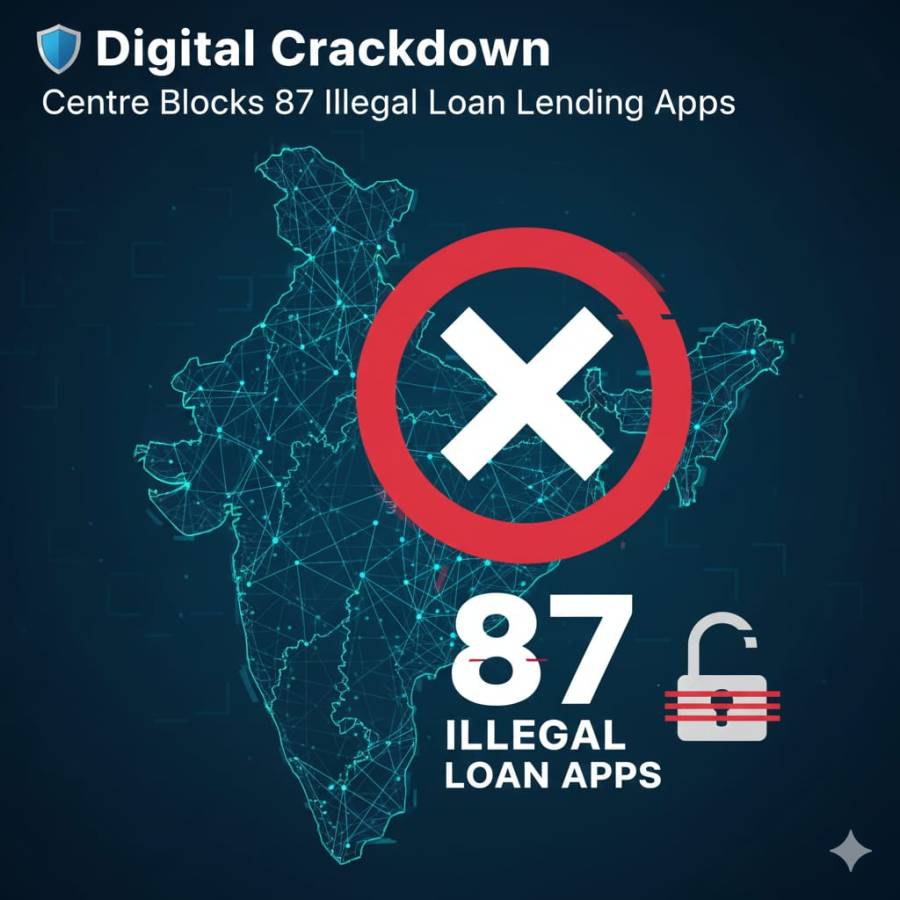
In a significant move to safeguard citizens from predatory digital lending practices, the Union Government has cracked down on illicit loan applications, blocking access to 87 illegal apps operating in India. It carried out by the Ministry of Electronics and Information Technology (MeitY) under the authority of Section 69A of the Information Technology Act, 2000, underscores the government’s commitment to cleaning up the digital financial landscape.
The crucial information was brought to light during a parliamentary proceeding, specifically in a written reply to an unstarred question in the Lok Sabha on December 1st. This legislative disclosure not only informed the public of the action taken but also provided insight into the broader regulatory scrutiny being applied to non-compliant firms and illegal lending activities.
The Mechanism of Enforcement
The blocking of these 87 applications is the culmination of an ongoing regulatory enforcement mechanism. The government’s response highlighted that action against such entities is primarily driven by complaints, references, and information regarding non-compliances. Based on these findings, "suitable action," which may include striking off companies, is then pursued.
This proactive approach is essential in the rapidly evolving fintech sector, where many instant loan apps have come under fire for egregious and often illegal practices. These include charging usurious interest rates, employing aggressive and abusive recovery tactics, and circumventing standard regulatory requirements. By leveraging Section 69A of the IT Act, which empowers MeitY to block public access to online content deemed necessary for the defence of India, sovereignty, public order, and preventing incitement to the commission of any cognizable offence, the government has directly targeted the digital storefronts of these illegal operations.
Regulatory Net Cast Wider
Beyond the immediate action of blocking apps, the government’s reply touched upon the ongoing efforts to improve monitoring and prevent illegal activities perpetrated by non-functional firms, often referred to as "shell companies."
The Ministry of Corporate Affairs (MCA) clarified that regulatory action, including inquiries, inspections, and investigations, is taken against companies involved in illegal activities, including those operating through loan apps, whenever violations are found. However, a key distinction was made regarding the term "shell companies." The MCA noted that while this term is often used colloquially, it has not been formally defined under the Companies Act, 2013, and there is currently no proposal to introduce such a definition. This clarifies that while enforcement is robust, it operates based on defined legal categories of non-compliance, not on the informal label of "shell company."
The response emphasized that checks and inspections are an ongoing and regularly monitored process, suggesting that the recent blocking of the 87 apps is not an isolated event but part of a sustained regulatory campaign.
Protecting the Consumer
The digital lending space, while offering convenience, has been plagued by instances of financial distress and mental harassment caused by rogue operators. The government's intervention serves as a strong deterrent and a much-needed protective shield for vulnerable borrowers. The blocking of these platforms is crucial for breaking the supply chain of these illicit services and protecting citizens' financial and personal data.
As the digital economy continues to expand, so too must the regulatory infrastructure. The government's firm stance, utilizing the full extent of the Information Technology Act, sends a clear signal that the financial well-being and security of its citizens will not be compromised by unregulated digital entities. Consumers are urged to remain vigilant and only utilize lending services provided by licensed and regulated entities, as the government continues its efforts to ensure a safer digital environment.


















Leave a Comment