
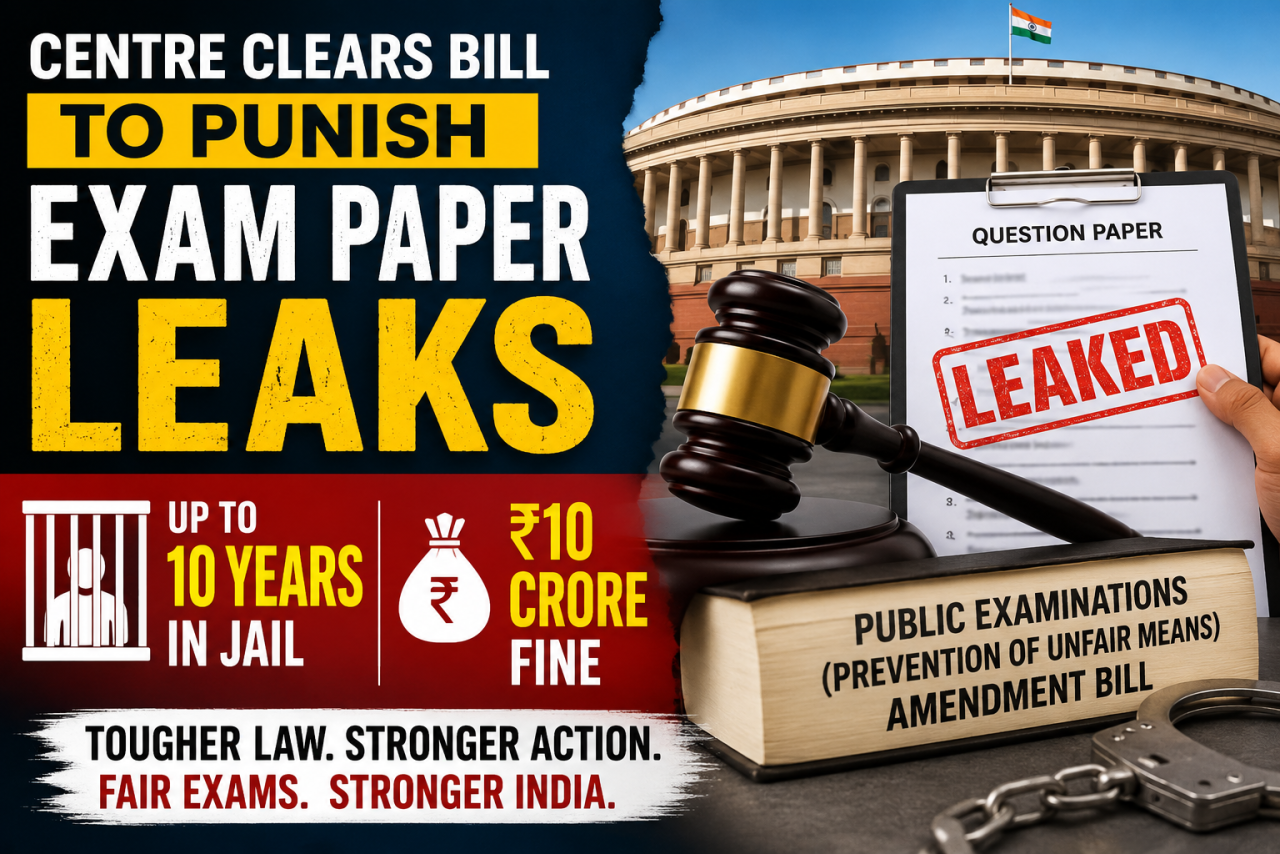
Exam paper leaks could soon attract up to 10 years in jail and a ₹10 crore fine as the Centre approves a tough new bill to protect the integrity of public examinations.
The Union Cabinet, chaired by Prime Minister Narendra Modi, has approved a draft bill proposing some of the toughest penalties yet against examination paper leaks and organised cheating syndicates. The proposed amendments to the Public Examinations (Prevention of Unfair Means) Act, 2024 include imprisonment of up to 10 years and fines of up to ₹10 crore for those found guilty of leaking question papers or operating organised cheating rackets.
The draft legislation is expected to be introduced in the Lok Sabha on Monday. If enacted, it will significantly strengthen India's legal framework against examination fraud, following a series of high-profile paper leak scandals that have shaken public confidence in competitive examinations.
Tougher Punishment for Paper Leak Networks
Under the proposed law, individuals convicted of leaking examination papers could face a minimum prison term of five years, extendable to 10 years, along with a minimum fine of ₹1 crore.
The bill also targets organised criminal networks and institutions that profit from unfair examination practices. Those running large-scale cheating syndicates could face even stricter action, including property seizure in addition to lengthy prison sentences and heavy financial penalties.
Importantly, the legislation seeks to protect students who unknowingly become victims of organised cheating operations rather than treating them as offenders.
Bringing Uniformity Across States
Several states have already enacted their own anti-paper leak laws over the past three decades, but the penalties vary considerably.
Rajasthan's law, introduced in 1992, prescribes imprisonment of three to five years and fines ranging from ₹5,000 to ₹1 lakh. By contrast, Uttar Pradesh's 2024 legislation allows for life imprisonment, property confiscation, and fines of up to ₹10 crore in serious cases.
States including Odisha, Uttarakhand, Chhattisgarh, Assam, Andhra Pradesh, Jharkhand, Rajasthan, Haryana, Bihar, Gujarat, Maharashtra and Himachal Pradesh have also enacted similar legislation between 1997 and 2026.
The proposed central law is expected to establish greater consistency in the punishment of examination-related crimes across the country while complementing existing state laws.
Political Reactions
The proposed legislation has already sparked political debate.
Congress president Mallikarjun Kharge questioned the government's handling of the bill, alleging that its provisions had not been adequately explained to the public. The Congress has indicated that it will seek greater clarity on the bill's implementation when it is discussed in Parliament.
Union Parliamentary Affairs Minister Kiren Rijiju defended the proposal, saying the legislation is intended to safeguard the interests of students and ensure the credibility of public examinations. He also criticised attempts to politicise the issue, arguing that any disruption of parliamentary debate would undermine an important reform aimed at protecting millions of students.
NTA Overhaul After NEET Controversy
The move comes shortly after a major restructuring of the National Testing Agency (NTA), which conducts national entrance examinations such as NEET and JEE.
The agency has removed 47 officials, including joint directors, deputy directors and assistant directors, following recommendations made by a High-Level Committee of Experts headed by former ISRO chairman K. Radhakrishnan.
The committee was constituted after the NEET-UG 2026 paper leak controversy, which triggered nationwide protests by students and parents demanding greater accountability and transparency in the examination system.
Legal and criminal proceedings are also expected against some officials as part of the ongoing investigation.
The NTA has announced that it will implement the committee's recommendations in phases, introducing a revamped recruitment structure and stronger institutional safeguards. The agency is also planning to modernise its examination system and gradually move away from the traditional pen-and-paper format used for NEET.
A Stronger Push for Examination Integrity
The proposed anti-paper leak legislation, coupled with the overhaul of the National Testing Agency, signals the Centre's determination to restore trust in India's examination system.
If passed by Parliament, the law would introduce one of the country's toughest legal frameworks against organised examination fraud, reflecting growing concern over repeated paper leak incidents that have affected lakhs of students and raised serious questions about the integrity of public examinations.
The Union Cabinet, chaired by Prime Minister Narendra Modi, has approved a draft bill proposing some of the toughest penalties yet against examination paper leaks and organised cheating syndicates. The proposed amendments to the Public Examinations (Prevention of Unfair Means) Act, 2024 include imprisonment of up to 10 years and fines of up to ₹10 crore for those found guilty of leaking question papers or operating organised cheating rackets.
The draft legislation is expected to be introduced in the Lok Sabha on Monday. If enacted, it will significantly strengthen India's legal framework against examination fraud, following a series of high-profile paper leak scandals that have shaken public confidence in competitive examinations.
Tougher Punishment for Paper Leak Networks
Under the proposed law, individuals convicted of leaking examination papers could face a minimum prison term of five years, extendable to 10 years, along with a minimum fine of ₹1 crore.
The bill also targets organised criminal networks and institutions that profit from unfair examination practices. Those running large-scale cheating syndicates could face even stricter action, including property seizure in addition to lengthy prison sentences and heavy financial penalties.
Importantly, the legislation seeks to protect students who unknowingly become victims of organised cheating operations rather than treating them as offenders.
Bringing Uniformity Across States
Several states have already enacted their own anti-paper leak laws over the past three decades, but the penalties vary considerably.
Rajasthan's law, introduced in 1992, prescribes imprisonment of three to five years and fines ranging from ₹5,000 to ₹1 lakh. By contrast, Uttar Pradesh's 2024 legislation allows for life imprisonment, property confiscation, and fines of up to ₹10 crore in serious cases.
States including Odisha, Uttarakhand, Chhattisgarh, Assam, Andhra Pradesh, Jharkhand, Rajasthan, Haryana, Bihar, Gujarat, Maharashtra and Himachal Pradesh have also enacted similar legislation between 1997 and 2026.
The proposed central law is expected to establish greater consistency in the punishment of examination-related crimes across the country while complementing existing state laws.
Political Reactions
The proposed legislation has already sparked political debate.
Congress president Mallikarjun Kharge questioned the government's handling of the bill, alleging that its provisions had not been adequately explained to the public. The Congress has indicated that it will seek greater clarity on the bill's implementation when it is discussed in Parliament.
Union Parliamentary Affairs Minister Kiren Rijiju defended the proposal, saying the legislation is intended to safeguard the interests of students and ensure the credibility of public examinations. He also criticised attempts to politicise the issue, arguing that any disruption of parliamentary debate would undermine an important reform aimed at protecting millions of students.
NTA Overhaul After NEET Controversy
The move comes shortly after a major restructuring of the National Testing Agency (NTA), which conducts national entrance examinations such as NEET and JEE.
The agency has removed 47 officials, including joint directors, deputy directors and assistant directors, following recommendations made by a High-Level Committee of Experts headed by former ISRO chairman K. Radhakrishnan.
The committee was constituted after the NEET-UG 2026 paper leak controversy, which triggered nationwide protests by students and parents demanding greater accountability and transparency in the examination system.
Legal and criminal proceedings are also expected against some officials as part of the ongoing investigation.
The NTA has announced that it will implement the committee's recommendations in phases, introducing a revamped recruitment structure and stronger institutional safeguards. The agency is also planning to modernise its examination system and gradually move away from the traditional pen-and-paper format used for NEET.
A Stronger Push for Examination Integrity
The proposed anti-paper leak legislation, coupled with the overhaul of the National Testing Agency, signals the Centre's determination to restore trust in India's examination system.
If passed by Parliament, the law would introduce one of the country's toughest legal frameworks against organised examination fraud, reflecting growing concern over repeated paper leak incidents that have affected lakhs of students and raised serious questions about the integrity of public examinations.


























Leave a Comment