
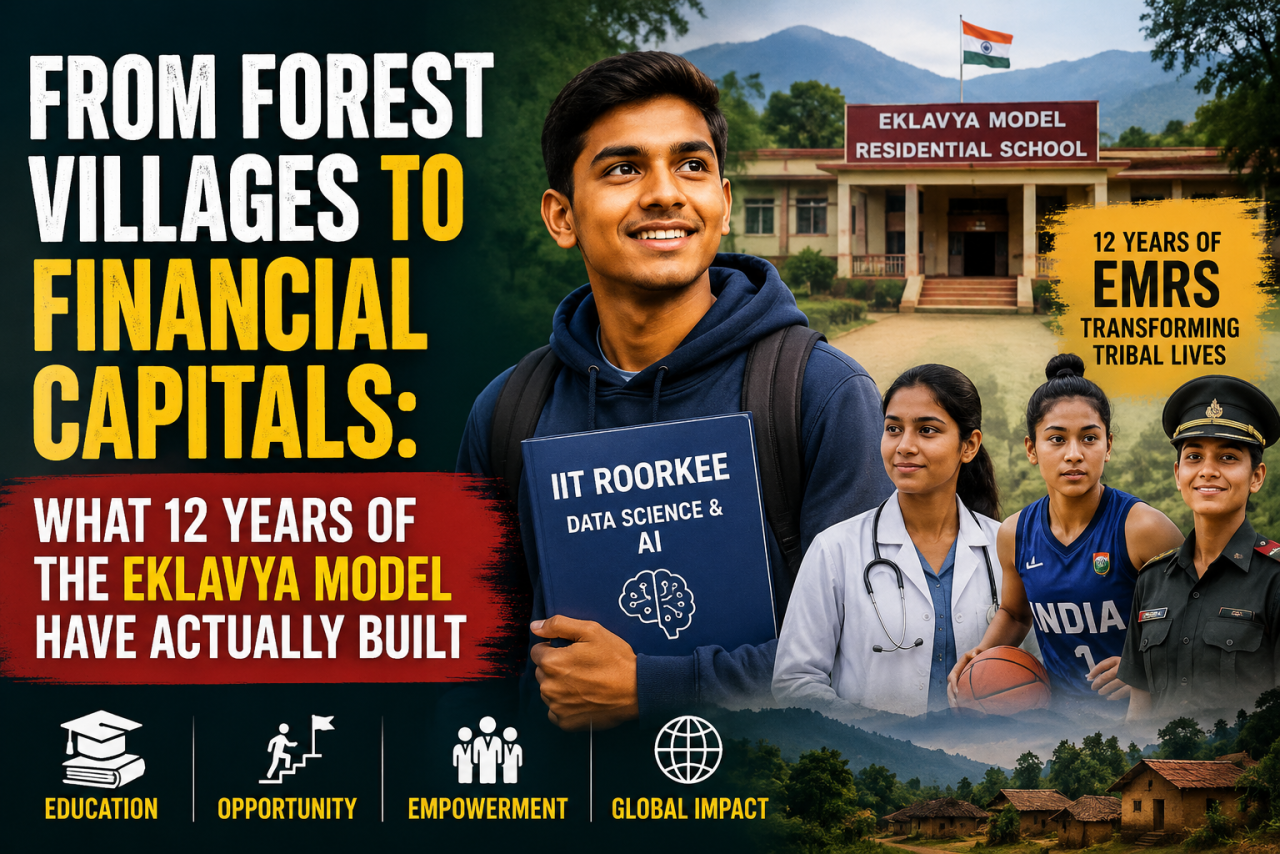
From remote forest villages to IITs, global companies and the Armed Forces, EMRS has changed thousands of lives. But do these success stories reflect the reality across every tribal residential school?
When Rohit Nitwal walked into Eklavya Model Residential School (EMRS) Kalsi in Uttarakhand as an 11-year-old in 2014, he had never spent a single night away from his family. The homesickness lasted months. This July, he leaves for London to join Barclays UK as a data scientist, carrying an IIT Roorkee degree in Data Science and Artificial Intelligence. It is a distance of more than geography, and it is the kind of story the government now points to as evidence that its tribal education programme is working.
As the Narendra Modi government marks 12 years in office, EMRS has become one of its most cited social interventions — a network of residential schools built specifically for children from Scheduled Tribe communities, many of them from regions where even a functioning primary school was, until recently, not a given.
Basically, the EMRS model is simple. It gives tribal students from remote areas access to quality residential schooling that many villages cannot provide. The idea is to create opportunities that were once out of reach—from premier colleges to professional careers.
The individual outcomes are hard to argue with. Vishal Dharmraj Thakare, from EMRS in Maharashtra's Nandurbar district, cleared NEET and is now in his final year of MBBS at Mumbai's Topiwala National Medical College. Tulsa Pujhari moved from EMRS Hirli in Odisha's Kalahandi district to an MSc at IIT Gandhinagar and an MBA at IIT Kharagpur, and now works on social development policy at a research centre in Bhubaneswar. Nima Doma Bhutia, from West Sikkim, became the first woman basketball player from Northeast India to represent the Indian senior women's team at pre-Olympic qualifiers. Simran Mehta, from Himachal Pradesh's Kinnaur district, went from a school in the pine forests near the Himalayas to a commission as Captain in the Armed Forces Medical Services.
Despite their different journeys, the alumni describe a similar experience. They say EMRS gave them discipline, routine and mentors who pushed them to think beyond the limits of their villages.
A typical day combined academics with sports, physical training, remedial classes and self-study. Students also took part in scouting, cultural activities and community service, making campus life far more structured than what many had experienced before.
Nitwal remembers a modest computer lab at EMRS Kalsi that sparked his interest in artificial intelligence. Bhutia says her coach and principal taught her resilience as much as basketball. Across these stories, the common thread is not impressive infrastructure but consistent guidance, encouragement and opportunity.
Ranjana Chopra, Secretary in the Ministry of Tribal Affairs, has framed the programme's goal as parity — ensuring tribal children get opportunities comparable to India's best institutions, and that EMRS schools build not just academic outcomes but confidence and leadership among students from geographically isolated regions.
That framing, though, is also where the harder questions sit. A handful of standout alumni reaching IIT, medical college or the armed forces is a genuinely significant achievement, but it is not, by itself, proof that the model is delivering at scale.
EMRS was conceived as a network covering hundreds of schools across tribal-majority districts. Its real test has always been less about its highest achievers and more about whether every campus can deliver quality education consistently. That means looking beyond success stories to issues such as teacher vacancies, hostel infrastructure and student dropout rates. Many campuses operate in remote areas where recruiting and retaining qualified teachers remains a persistent challenge. The government's own record on filling sanctioned teaching posts in residential tribal schools has been uneven in past years, while expansion announcements have at times outpaced the administrative capacity to staff and run new campuses.
None of that diminishes what Nitwal, Thakare, Pujhari, Bhutia and Mehta have achieved. Their journeys demonstrate what quality residential education can do for children whose opportunities were once limited by geography and economic circumstances.
But as evidence of a 12-year policy legacy, these success stories reveal more about the model's potential than its overall performance. The bigger question is whether every EMRS campus—not just the best-performing ones—can provide the same foundation. That is the story that still needs to be told.
When Rohit Nitwal walked into Eklavya Model Residential School (EMRS) Kalsi in Uttarakhand as an 11-year-old in 2014, he had never spent a single night away from his family. The homesickness lasted months. This July, he leaves for London to join Barclays UK as a data scientist, carrying an IIT Roorkee degree in Data Science and Artificial Intelligence. It is a distance of more than geography, and it is the kind of story the government now points to as evidence that its tribal education programme is working.
As the Narendra Modi government marks 12 years in office, EMRS has become one of its most cited social interventions — a network of residential schools built specifically for children from Scheduled Tribe communities, many of them from regions where even a functioning primary school was, until recently, not a given.
Basically, the EMRS model is simple. It gives tribal students from remote areas access to quality residential schooling that many villages cannot provide. The idea is to create opportunities that were once out of reach—from premier colleges to professional careers.
The individual outcomes are hard to argue with. Vishal Dharmraj Thakare, from EMRS in Maharashtra's Nandurbar district, cleared NEET and is now in his final year of MBBS at Mumbai's Topiwala National Medical College. Tulsa Pujhari moved from EMRS Hirli in Odisha's Kalahandi district to an MSc at IIT Gandhinagar and an MBA at IIT Kharagpur, and now works on social development policy at a research centre in Bhubaneswar. Nima Doma Bhutia, from West Sikkim, became the first woman basketball player from Northeast India to represent the Indian senior women's team at pre-Olympic qualifiers. Simran Mehta, from Himachal Pradesh's Kinnaur district, went from a school in the pine forests near the Himalayas to a commission as Captain in the Armed Forces Medical Services.
Despite their different journeys, the alumni describe a similar experience. They say EMRS gave them discipline, routine and mentors who pushed them to think beyond the limits of their villages.
A typical day combined academics with sports, physical training, remedial classes and self-study. Students also took part in scouting, cultural activities and community service, making campus life far more structured than what many had experienced before.
Nitwal remembers a modest computer lab at EMRS Kalsi that sparked his interest in artificial intelligence. Bhutia says her coach and principal taught her resilience as much as basketball. Across these stories, the common thread is not impressive infrastructure but consistent guidance, encouragement and opportunity.
Ranjana Chopra, Secretary in the Ministry of Tribal Affairs, has framed the programme's goal as parity — ensuring tribal children get opportunities comparable to India's best institutions, and that EMRS schools build not just academic outcomes but confidence and leadership among students from geographically isolated regions.
That framing, though, is also where the harder questions sit. A handful of standout alumni reaching IIT, medical college or the armed forces is a genuinely significant achievement, but it is not, by itself, proof that the model is delivering at scale.
EMRS was conceived as a network covering hundreds of schools across tribal-majority districts. Its real test has always been less about its highest achievers and more about whether every campus can deliver quality education consistently. That means looking beyond success stories to issues such as teacher vacancies, hostel infrastructure and student dropout rates. Many campuses operate in remote areas where recruiting and retaining qualified teachers remains a persistent challenge. The government's own record on filling sanctioned teaching posts in residential tribal schools has been uneven in past years, while expansion announcements have at times outpaced the administrative capacity to staff and run new campuses.
None of that diminishes what Nitwal, Thakare, Pujhari, Bhutia and Mehta have achieved. Their journeys demonstrate what quality residential education can do for children whose opportunities were once limited by geography and economic circumstances.
But as evidence of a 12-year policy legacy, these success stories reveal more about the model's potential than its overall performance. The bigger question is whether every EMRS campus—not just the best-performing ones—can provide the same foundation. That is the story that still needs to be told.















Leave a Comment