
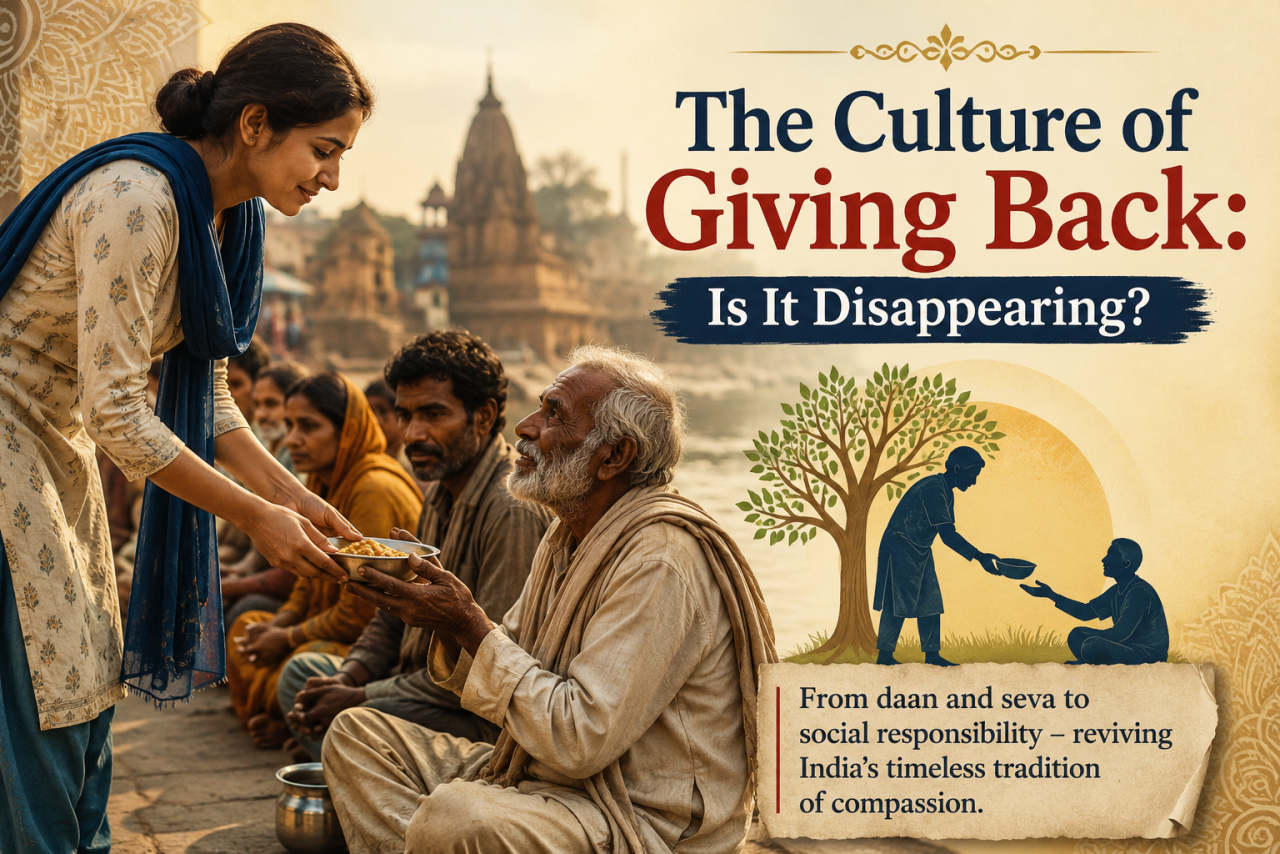
India’s culture of giving was once woven into everyday life. Is modern society slowly turning an old tradition of seva and community responsibility into occasional charity?
There was a time when helping others was not described as charity. It was simply considered a part of life.
A neighbour needed help, people came forward. A traveller needed food, a household offered a meal. A child could not afford books, someone shared what they had. During difficult times, families and communities stood together.
India’s cultural history has long carried this idea of giving without expecting something in return. Whether expressed through daan, seva, hospitality, community support or simply helping someone in need, giving was not always about wealth. It was about recognising a shared human responsibility.
Today, however, our relationship with giving is changing.
We live in an age when money can be transferred within seconds, food can be ordered with a few taps and a crisis unfolding thousands of kilometres away can appear on our phone screens almost instantly. We have more ways to help than ever before.
Yet an uncomfortable question remains.
Are we becoming more aware of suffering but less willing to become part of its solution?
Giving Was Once a Way of Life
Indian society traditionally placed considerable importance on sharing.
The idea of daan was not limited to money. Food, knowledge, time, shelter and even kindness could become forms of giving. A teacher shared knowledge. A farmer shared produce. A household offered food to a guest. Communities supported families during difficult times.
Such practices were woven into everyday life rather than treated as special achievements.
The underlying message was simple. What we possess is not entirely ours if someone around us is in genuine need.
This does not mean that the past was perfect. India has always had inequality, poverty and social divisions. But the cultural ideal of helping others remained an important part of social life.
Somewhere along the way, however, giving began to acquire a different meaning.
From Seva to Occasional Charity
Modern life has made many of us more individualistic.
Success is often measured through education, career, income, property and personal achievement. There is nothing wrong with aspiring for a better life. People have responsibilities towards themselves and their families.
But the question is whether personal progress has gradually weakened our sense of collective responsibility.
Today, giving often appears during particular moments.
A festival arrives, and we donate.
A natural disaster occurs, and people contribute.
A heartbreaking story goes viral, and fundraising begins.
A campaign ends, and attention moves elsewhere.
There is nothing wrong with responding to emergencies. In fact, such generosity demonstrates that compassion remains deeply rooted in society.
The problem begins when compassion becomes temporary.
Poverty does not end when a campaign ends. A child does not stop needing education when a donation drive is over. Environmental degradation cannot be reversed through a single plantation event.
Some problems require something less dramatic but much more meaningful.
Consistency.
Giving Does Not Begin With Wealth
Perhaps one of the biggest misconceptions about giving is that it requires money.
It does not.
A teacher can give an hour to teach a child.
A student can share books that are no longer needed.
A professional can teach a skill.
A family can provide food to someone who needs it.
A young person can volunteer in a community programme.
Someone can plant a tree and, more importantly, protect it.
Someone can simply spend time listening to an elderly neighbour who has nobody to talk to.
These acts may never appear in financial records or social media posts.
But they are also forms of giving.
The real question is therefore not, "How much money can I give?"
It is, "What do I have that can be useful to someone else?"
The Digital Age Has Changed Compassion
Technology has brought the suffering of the world closer to us.
Every day, our phones show us hunger, poverty, conflict, environmental destruction and educational inequality.
We react.
We comment.
We share.
And then we scroll.
This is one of the contradictions of modern life. We may be more informed about social problems than any previous generation, yet awareness does not automatically become action.
A photograph can make us emotional for a moment. A video can make us angry. A personal story can make us want to help.
But what happens after the emotion disappears?
That is where social responsibility begins.
Awareness may open the door. Action is what takes us through it.
The Quiet Tradition That Still Survives
It would be unfair to suggest that India has stopped giving.
It has not.
Across the country, people continue to feed strangers, teach children, support families, donate books, volunteer at community organisations, care for animals, plant trees and contribute to social causes.
Many do so without publicity.
They do not announce every act of kindness. They do not turn every contribution into a social media post.
Perhaps that is one of the most beautiful aspects of giving.
Some of the most meaningful acts of generosity remain invisible.
Organisations and foundations also continue to work in areas such as education, nutrition, environmental awareness, skill development and community support. But organisations cannot replace society itself. Sustainable change requires citizens who are willing to participate, volunteer and take responsibility.
Giving becomes more powerful when it stops being viewed as something that one group does for another and becomes something that members of a society do for one another.
What Are We Teaching Our Children?
Perhaps the most important question concerns the next generation.
Children learn values less from lectures and more from observation.
If they see adults measuring success only through money, possessions and status, they may naturally develop the same definition of success.
But if they see their parents sharing food, helping neighbours, respecting workers, donating books, volunteering or caring for the environment, they learn another lesson.
They learn that success carries responsibility.
A child who learns to share a book today may grow into an adult who shares knowledge tomorrow.
A student who learns to volunteer may become a professional who understands the importance of giving back.
Values are not inherited merely through words.
They are inherited through practice.
Can an Old Tradition Survive in a New India?
Perhaps the culture of giving is not disappearing.
Perhaps it is simply changing.
India is no longer the same society it was generations ago. Urbanisation, technology, migration and changing family structures have transformed everyday life. The old neighbourhood where everyone knew everyone else is disappearing in many cities.
Yet the need for human connection has not disappeared.
The challenge is to carry the spirit of an older tradition into a changing society.
Daan does not have to mean only money.
Seva does not have to belong only to religious spaces.
Community responsibility does not have to end at the boundary of our own family.
The spirit behind these traditions can survive in modern forms, through volunteering, mentoring, community work, environmental action, supporting education and helping people who are struggling.
The form may change.
The value does not have to.
Giving Should Become a Habit
Giving should not require a crisis.
It should not depend on a festival.
It should not need a viral photograph.
It should become part of everyday life.
One hour of volunteering.
One book shared.
One child supported.
One skill taught.
One tree protected.
One meal offered.
One neighbour helped.
Individually, these actions may appear small. Collectively, they can shape the character of a society.
India’s cultural heritage is not limited to monuments, temples, manuscripts, festivals and ancient traditions. It also lives in the values passed quietly from one generation to another.
Among those values is the simple belief that life is not only about what we receive.
It is also about what we give.
The culture of giving back, therefore, may not be disappearing.
But it cannot survive as a memory.
It must be practised.
Because a society is not truly prosperous simply because its people have more.
It becomes richer when its people understand that what they have can also become something meaningful for someone else.
And perhaps that is the question worth asking ourselves today:
What are we willing to give back?
There was a time when helping others was not described as charity. It was simply considered a part of life.
A neighbour needed help, people came forward. A traveller needed food, a household offered a meal. A child could not afford books, someone shared what they had. During difficult times, families and communities stood together.
India’s cultural history has long carried this idea of giving without expecting something in return. Whether expressed through daan, seva, hospitality, community support or simply helping someone in need, giving was not always about wealth. It was about recognising a shared human responsibility.
Today, however, our relationship with giving is changing.
We live in an age when money can be transferred within seconds, food can be ordered with a few taps and a crisis unfolding thousands of kilometres away can appear on our phone screens almost instantly. We have more ways to help than ever before.
Yet an uncomfortable question remains.
Are we becoming more aware of suffering but less willing to become part of its solution?
Giving Was Once a Way of Life
Indian society traditionally placed considerable importance on sharing.
The idea of daan was not limited to money. Food, knowledge, time, shelter and even kindness could become forms of giving. A teacher shared knowledge. A farmer shared produce. A household offered food to a guest. Communities supported families during difficult times.
Such practices were woven into everyday life rather than treated as special achievements.
The underlying message was simple. What we possess is not entirely ours if someone around us is in genuine need.
This does not mean that the past was perfect. India has always had inequality, poverty and social divisions. But the cultural ideal of helping others remained an important part of social life.
Somewhere along the way, however, giving began to acquire a different meaning.
From Seva to Occasional Charity
Modern life has made many of us more individualistic.
Success is often measured through education, career, income, property and personal achievement. There is nothing wrong with aspiring for a better life. People have responsibilities towards themselves and their families.
But the question is whether personal progress has gradually weakened our sense of collective responsibility.
Today, giving often appears during particular moments.
A festival arrives, and we donate.
A natural disaster occurs, and people contribute.
A heartbreaking story goes viral, and fundraising begins.
A campaign ends, and attention moves elsewhere.
There is nothing wrong with responding to emergencies. In fact, such generosity demonstrates that compassion remains deeply rooted in society.
The problem begins when compassion becomes temporary.
Poverty does not end when a campaign ends. A child does not stop needing education when a donation drive is over. Environmental degradation cannot be reversed through a single plantation event.
Some problems require something less dramatic but much more meaningful.
Consistency.
Giving Does Not Begin With Wealth
Perhaps one of the biggest misconceptions about giving is that it requires money.
It does not.
A teacher can give an hour to teach a child.
A student can share books that are no longer needed.
A professional can teach a skill.
A family can provide food to someone who needs it.
A young person can volunteer in a community programme.
Someone can plant a tree and, more importantly, protect it.
Someone can simply spend time listening to an elderly neighbour who has nobody to talk to.
These acts may never appear in financial records or social media posts.
But they are also forms of giving.
The real question is therefore not, "How much money can I give?"
It is, "What do I have that can be useful to someone else?"
The Digital Age Has Changed Compassion
Technology has brought the suffering of the world closer to us.
Every day, our phones show us hunger, poverty, conflict, environmental destruction and educational inequality.
We react.
We comment.
We share.
And then we scroll.
This is one of the contradictions of modern life. We may be more informed about social problems than any previous generation, yet awareness does not automatically become action.
A photograph can make us emotional for a moment. A video can make us angry. A personal story can make us want to help.
But what happens after the emotion disappears?
That is where social responsibility begins.
Awareness may open the door. Action is what takes us through it.
The Quiet Tradition That Still Survives
It would be unfair to suggest that India has stopped giving.
It has not.
Across the country, people continue to feed strangers, teach children, support families, donate books, volunteer at community organisations, care for animals, plant trees and contribute to social causes.
Many do so without publicity.
They do not announce every act of kindness. They do not turn every contribution into a social media post.
Perhaps that is one of the most beautiful aspects of giving.
Some of the most meaningful acts of generosity remain invisible.
Organisations and foundations also continue to work in areas such as education, nutrition, environmental awareness, skill development and community support. But organisations cannot replace society itself. Sustainable change requires citizens who are willing to participate, volunteer and take responsibility.
Giving becomes more powerful when it stops being viewed as something that one group does for another and becomes something that members of a society do for one another.
What Are We Teaching Our Children?
Perhaps the most important question concerns the next generation.
Children learn values less from lectures and more from observation.
If they see adults measuring success only through money, possessions and status, they may naturally develop the same definition of success.
But if they see their parents sharing food, helping neighbours, respecting workers, donating books, volunteering or caring for the environment, they learn another lesson.
They learn that success carries responsibility.
A child who learns to share a book today may grow into an adult who shares knowledge tomorrow.
A student who learns to volunteer may become a professional who understands the importance of giving back.
Values are not inherited merely through words.
They are inherited through practice.
Can an Old Tradition Survive in a New India?
Perhaps the culture of giving is not disappearing.
Perhaps it is simply changing.
India is no longer the same society it was generations ago. Urbanisation, technology, migration and changing family structures have transformed everyday life. The old neighbourhood where everyone knew everyone else is disappearing in many cities.
Yet the need for human connection has not disappeared.
The challenge is to carry the spirit of an older tradition into a changing society.
Daan does not have to mean only money.
Seva does not have to belong only to religious spaces.
Community responsibility does not have to end at the boundary of our own family.
The spirit behind these traditions can survive in modern forms, through volunteering, mentoring, community work, environmental action, supporting education and helping people who are struggling.
The form may change.
The value does not have to.
Giving Should Become a Habit
Giving should not require a crisis.
It should not depend on a festival.
It should not need a viral photograph.
It should become part of everyday life.
One hour of volunteering.
One book shared.
One child supported.
One skill taught.
One tree protected.
One meal offered.
One neighbour helped.
Individually, these actions may appear small. Collectively, they can shape the character of a society.
India’s cultural heritage is not limited to monuments, temples, manuscripts, festivals and ancient traditions. It also lives in the values passed quietly from one generation to another.
Among those values is the simple belief that life is not only about what we receive.
It is also about what we give.
The culture of giving back, therefore, may not be disappearing.
But it cannot survive as a memory.
It must be practised.
Because a society is not truly prosperous simply because its people have more.
It becomes richer when its people understand that what they have can also become something meaningful for someone else.
And perhaps that is the question worth asking ourselves today:
What are we willing to give back?


















Leave a Comment