
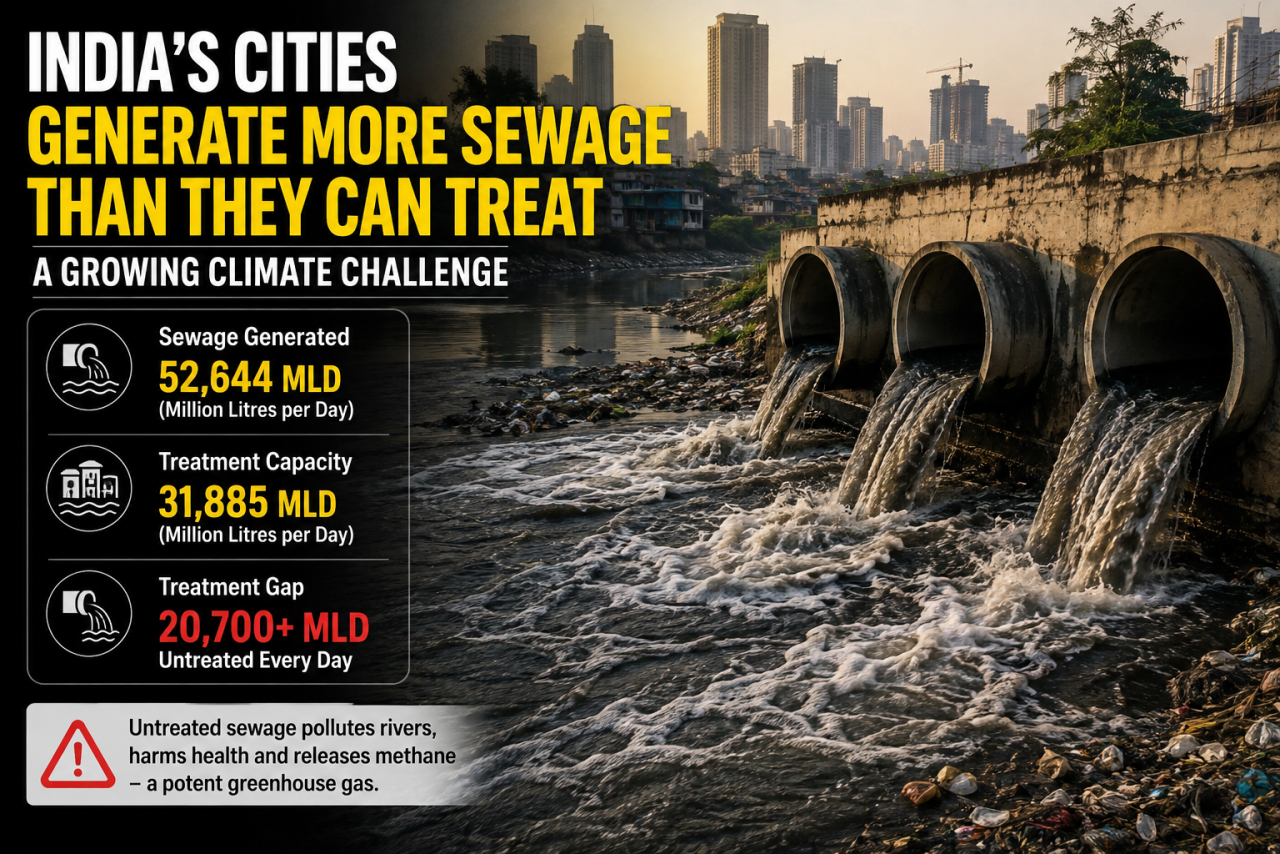
India’s cities generate over 52,000 MLD of sewage every day, but treatment capacity falls more than 20,700 MLD short, creating a growing sanitation, environmental and climate challenge.
India’s urban centres are generating far more sewage than the country’s existing infrastructure can treat, according to a Parliamentary Standing Committee report tabled in Parliament this week. The report puts daily sewage generation at 52,644 million litres per day (MLD), against an installed treatment capacity of just 31,885 MLD. This leaves a gap of more than 20,700 MLD every day, much of which risks entering rivers, groundwater and open drains without adequate treatment.
The figures point to a sanitation crisis with consequences that extend beyond public health and water pollution. Untreated sewage can also contribute to greenhouse gas emissions as organic matter decomposes in oxygen-poor conditions. Methane and nitrous oxide are particularly important in this context because both have far greater warming potential than carbon dioxide.
For India, which has set a target of achieving net-zero emissions by 2070, the growing urban sewage problem presents an additional environmental challenge. As cities expand and populations rise, the country will need to increase not only sewage treatment capacity but also the efficiency, reliability and environmental performance of existing systems.
Treatment Capacity Is Not Translating Into Effective Treatment
The Standing Committee on Housing and Urban Affairs, in its report on sewerage and septage coverage, found that sewage treatment capacity has increased significantly on paper. However, the expansion has not translated into comparable improvements in actual sanitation outcomes.
A third-party survey covering more than 1,000 sewage treatment plants (STPs) found that only 51 per cent complied with the discharge standards introduced in 2015. The situation was even more concerning under the stricter standards introduced in 2019, with only 15 per cent of the plants meeting those norms.
The findings raise questions about the effectiveness of investments in sewage treatment infrastructure. Building treatment plants is only one part of the solution. Plants must also receive sufficient sewage, operate at their designed capacity and be properly maintained to ensure that treated water meets environmental standards.
When treatment plants fail to operate efficiently, the environmental burden simply moves from one location to another. Water may pass through a treatment facility without receiving adequate treatment, allowing pollutants to eventually reach rivers, lakes, groundwater or other water bodies.
Millions of Urban Households Still Lack Sewer Connections
The sanitation challenge is also visible in the country’s uneven sewerage coverage.
India has approximately 113.2 million urban households, but only 34.5 million households in cities covered under the AMRUT mission are connected to sewer networks, according to the committee's findings. Nearly 28.5 million households depend on septage-based sanitation systems rather than piped sewer connections.
Several states, including Madhya Pradesh, Tamil Nadu, West Bengal, Odisha, Jharkhand and Bihar, depend more heavily on septage systems than conventional sewer networks.
This variation reflects the uneven development of urban sanitation infrastructure across India. While large metropolitan areas may have extensive sewer networks, many smaller cities and rapidly expanding urban settlements continue to depend on septic tanks and other decentralised systems.
The problem is particularly important because urbanisation is increasing the volume of wastewater generated every day. If sewerage and treatment infrastructure does not expand at a similar pace, the gap between sewage generation and treatment capacity could become even wider.
Poorly Designed Septic Tanks Add to the Problem
The committee also identified serious shortcomings in the construction and management of septic tanks.
Around 60 per cent of urban households depend on untrained masons rather than municipal guidance when constructing septic tanks. As a result, many tanks are reportedly built at sizes three to four times larger than prescribed standards.
A larger tank does not necessarily mean better sanitation. Poorly designed septic systems can reduce treatment efficiency and increase the risk of untreated waste entering the surrounding soil and groundwater.
The problem is compounded by weak operation and maintenance practices. Even sewage treatment plants that are technically functional may not be operated efficiently enough to achieve their rated capacity or comply consistently with prescribed standards.
This means India faces a two-sided challenge. The country needs more treatment infrastructure, but it also needs to ensure that the infrastructure already built is properly designed, operated and maintained.
Untreated Sewage Is Also a Climate Concern
The environmental consequences of untreated sewage are usually discussed in terms of water pollution and public health. However, the issue also has a climate dimension.
When untreated organic waste accumulates in stagnant water bodies, drains and other oxygen-poor environments, it can generate methane, a powerful greenhouse gas. Nitrous oxide can also be associated with wastewater treatment and nitrogen-rich waste streams.
The result is an emissions source that can remain largely invisible in discussions focused on transport, industry, coal and other conventional sectors.
Untreated sewage can also reduce oxygen levels in rivers and other water bodies, damage aquatic ecosystems and contribute to biodiversity loss. The resulting deterioration of water quality creates additional costs for cities that depend on rivers and groundwater for drinking water and other uses.
As India's urban population grows, these pressures could intensify unless wastewater management becomes an integral part of urban climate planning.
Supreme Court Intervention Adds to the Regulatory Pressure
The sewage crisis comes amid wider scrutiny of environmental enforcement.
The Supreme Court this week directed the Centre to frame structured guidelines for imposing environmental compensation for violations under the Solid Waste Management Rules. A bench comprising Justices PS Narasimha and Alok Aradhe observed that decisions on compensation should not be left entirely to the discretion of regulatory bodies, tribunals and courts on a case-by-case basis.
The court laid down eight guiding principles based on judicial precedent and directed the Ministry of Environment, Forest and Climate Change to formulate clear rules for environmental compensation under the Solid Waste Management Rules, 2026.
The intervention highlights a broader concern in India's environmental governance. Regulations have limited value when enforcement remains inconsistent or when penalties vary significantly between cases.
Clearer compensation rules could provide regulators with a more predictable framework for dealing with environmental violations while also making the consequences of non-compliance more transparent.
India Needs More Than Treatment Plants
The parliamentary findings underline a fundamental problem in India's urban development. Sewage generation is increasing with urbanisation, but sanitation infrastructure, sewer connections, treatment efficiency and regulatory enforcement have not expanded at the same pace.
The national treatment gap of more than 20,700 MLD is therefore not simply an infrastructure deficit. It is also a question of planning, operation, maintenance and enforcement.
Closing the gap will require sustained investment in sewer networks, sewage treatment plants, decentralised sanitation systems and septage management. Cities will also need better monitoring of treatment plants and stronger technical support for households that depend on septic systems.
Most importantly, sewage management needs to be treated as part of India's environmental and climate strategy rather than as a narrow municipal sanitation issue.
India's cities cannot afford to treat wastewater as an afterthought of urban growth. If sewage generation continues to rise faster than treatment capacity, the country will face increasing pressure on its rivers, groundwater, ecosystems and public health, while also adding an often-overlooked source of greenhouse gas emissions.
The message from the parliamentary report is therefore clear. Expanding treatment capacity matters, but ensuring that sewage is actually collected, treated and safely discharged matters even more. For India's rapidly growing cities, closing that gap will be essential not only for cleaner water but also for building a more climate-resilient urban future.
India’s urban centres are generating far more sewage than the country’s existing infrastructure can treat, according to a Parliamentary Standing Committee report tabled in Parliament this week. The report puts daily sewage generation at 52,644 million litres per day (MLD), against an installed treatment capacity of just 31,885 MLD. This leaves a gap of more than 20,700 MLD every day, much of which risks entering rivers, groundwater and open drains without adequate treatment.
The figures point to a sanitation crisis with consequences that extend beyond public health and water pollution. Untreated sewage can also contribute to greenhouse gas emissions as organic matter decomposes in oxygen-poor conditions. Methane and nitrous oxide are particularly important in this context because both have far greater warming potential than carbon dioxide.
For India, which has set a target of achieving net-zero emissions by 2070, the growing urban sewage problem presents an additional environmental challenge. As cities expand and populations rise, the country will need to increase not only sewage treatment capacity but also the efficiency, reliability and environmental performance of existing systems.
Treatment Capacity Is Not Translating Into Effective Treatment
The Standing Committee on Housing and Urban Affairs, in its report on sewerage and septage coverage, found that sewage treatment capacity has increased significantly on paper. However, the expansion has not translated into comparable improvements in actual sanitation outcomes.
A third-party survey covering more than 1,000 sewage treatment plants (STPs) found that only 51 per cent complied with the discharge standards introduced in 2015. The situation was even more concerning under the stricter standards introduced in 2019, with only 15 per cent of the plants meeting those norms.
The findings raise questions about the effectiveness of investments in sewage treatment infrastructure. Building treatment plants is only one part of the solution. Plants must also receive sufficient sewage, operate at their designed capacity and be properly maintained to ensure that treated water meets environmental standards.
When treatment plants fail to operate efficiently, the environmental burden simply moves from one location to another. Water may pass through a treatment facility without receiving adequate treatment, allowing pollutants to eventually reach rivers, lakes, groundwater or other water bodies.
Millions of Urban Households Still Lack Sewer Connections
The sanitation challenge is also visible in the country’s uneven sewerage coverage.
India has approximately 113.2 million urban households, but only 34.5 million households in cities covered under the AMRUT mission are connected to sewer networks, according to the committee's findings. Nearly 28.5 million households depend on septage-based sanitation systems rather than piped sewer connections.
Several states, including Madhya Pradesh, Tamil Nadu, West Bengal, Odisha, Jharkhand and Bihar, depend more heavily on septage systems than conventional sewer networks.
This variation reflects the uneven development of urban sanitation infrastructure across India. While large metropolitan areas may have extensive sewer networks, many smaller cities and rapidly expanding urban settlements continue to depend on septic tanks and other decentralised systems.
The problem is particularly important because urbanisation is increasing the volume of wastewater generated every day. If sewerage and treatment infrastructure does not expand at a similar pace, the gap between sewage generation and treatment capacity could become even wider.
Poorly Designed Septic Tanks Add to the Problem
The committee also identified serious shortcomings in the construction and management of septic tanks.
Around 60 per cent of urban households depend on untrained masons rather than municipal guidance when constructing septic tanks. As a result, many tanks are reportedly built at sizes three to four times larger than prescribed standards.
A larger tank does not necessarily mean better sanitation. Poorly designed septic systems can reduce treatment efficiency and increase the risk of untreated waste entering the surrounding soil and groundwater.
The problem is compounded by weak operation and maintenance practices. Even sewage treatment plants that are technically functional may not be operated efficiently enough to achieve their rated capacity or comply consistently with prescribed standards.
This means India faces a two-sided challenge. The country needs more treatment infrastructure, but it also needs to ensure that the infrastructure already built is properly designed, operated and maintained.
Untreated Sewage Is Also a Climate Concern
The environmental consequences of untreated sewage are usually discussed in terms of water pollution and public health. However, the issue also has a climate dimension.
When untreated organic waste accumulates in stagnant water bodies, drains and other oxygen-poor environments, it can generate methane, a powerful greenhouse gas. Nitrous oxide can also be associated with wastewater treatment and nitrogen-rich waste streams.
The result is an emissions source that can remain largely invisible in discussions focused on transport, industry, coal and other conventional sectors.
Untreated sewage can also reduce oxygen levels in rivers and other water bodies, damage aquatic ecosystems and contribute to biodiversity loss. The resulting deterioration of water quality creates additional costs for cities that depend on rivers and groundwater for drinking water and other uses.
As India's urban population grows, these pressures could intensify unless wastewater management becomes an integral part of urban climate planning.
Supreme Court Intervention Adds to the Regulatory Pressure
The sewage crisis comes amid wider scrutiny of environmental enforcement.
The Supreme Court this week directed the Centre to frame structured guidelines for imposing environmental compensation for violations under the Solid Waste Management Rules. A bench comprising Justices PS Narasimha and Alok Aradhe observed that decisions on compensation should not be left entirely to the discretion of regulatory bodies, tribunals and courts on a case-by-case basis.
The court laid down eight guiding principles based on judicial precedent and directed the Ministry of Environment, Forest and Climate Change to formulate clear rules for environmental compensation under the Solid Waste Management Rules, 2026.
The intervention highlights a broader concern in India's environmental governance. Regulations have limited value when enforcement remains inconsistent or when penalties vary significantly between cases.
Clearer compensation rules could provide regulators with a more predictable framework for dealing with environmental violations while also making the consequences of non-compliance more transparent.
India Needs More Than Treatment Plants
The parliamentary findings underline a fundamental problem in India's urban development. Sewage generation is increasing with urbanisation, but sanitation infrastructure, sewer connections, treatment efficiency and regulatory enforcement have not expanded at the same pace.
The national treatment gap of more than 20,700 MLD is therefore not simply an infrastructure deficit. It is also a question of planning, operation, maintenance and enforcement.
Closing the gap will require sustained investment in sewer networks, sewage treatment plants, decentralised sanitation systems and septage management. Cities will also need better monitoring of treatment plants and stronger technical support for households that depend on septic systems.
Most importantly, sewage management needs to be treated as part of India's environmental and climate strategy rather than as a narrow municipal sanitation issue.
India's cities cannot afford to treat wastewater as an afterthought of urban growth. If sewage generation continues to rise faster than treatment capacity, the country will face increasing pressure on its rivers, groundwater, ecosystems and public health, while also adding an often-overlooked source of greenhouse gas emissions.
The message from the parliamentary report is therefore clear. Expanding treatment capacity matters, but ensuring that sewage is actually collected, treated and safely discharged matters even more. For India's rapidly growing cities, closing that gap will be essential not only for cleaner water but also for building a more climate-resilient urban future.
























Leave a Comment