
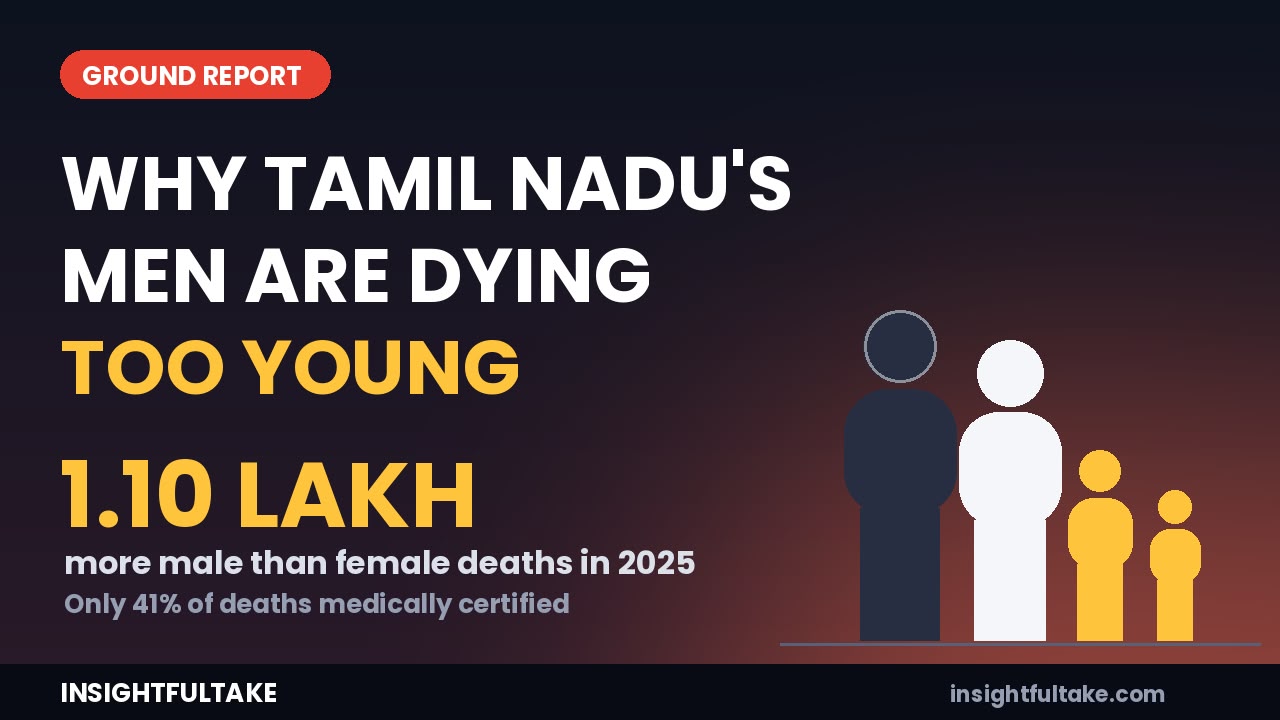
Tamil Nadu recorded 4.02 lakh male deaths in 2025 against 2.91 lakh female deaths. Nearly 95,000 of the additional male deaths were among people aged 15 to 64.
Tamil Nadu registered 693,207 deaths in 2025. Of these, 401,860 were men and 291,347 were women. It means 110,513 more men died than women during the year.
The difference is not new. The gap between male and female deaths has remained above one lakh for three consecutive years. It was about 1.10 lakh in 2023, 1.07 lakh in 2024 and 1.11 lakh in 2025.
The age data makes the difference more important.
Of the 110,513 additional male deaths in 2025, 94,792 were among people aged 15 to 64. That is about 86% of the entire gap. These are also the years when most people are working and many are supporting children and elderly parents.
The gap starts early
The difference is visible from young adulthood and becomes much larger through middle age.
In the 15–24 age group, Tamil Nadu recorded 9,167 male deaths and 4,461 female deaths in 2025.
Among people aged 25–34, there were 17,135 male deaths compared with 6,177 female deaths.
For the 35–44 age group, the figures were 31,585 male deaths and 11,406 female deaths.
The gap was even larger in the next two age groups. Between 45 and 54, there were 28,474 more male deaths than female deaths. Between 55 and 64, the difference was 30,475.
The picture changes after 70. In that age group, Tamil Nadu recorded 155,093 male deaths and 150,545 female deaths in 2025.
This means the difference is not simply about men having a higher death count. A large part of the difference occurs before old age.
Why are more men dying?
There is no single explanation.
Public health experts point to several major risks. Among younger men, road crashes and suicide are important causes. Among middle-aged men, doctors have raised concerns about heart disease, stroke, diabetes, kidney disease, chronic respiratory disease and illnesses linked to tobacco and alcohol use.
Road safety is a major issue in Tamil Nadu. At least 50 people die in road crashes every day in the state, and most of the victims are men, according to public health officials cited in the analysis. Suicide also accounts for a similar number of deaths each day, with men forming the majority of victims.
The health risks also appear to be affecting men at younger ages.
Dr T S Selvavinayagam, a former director of public health, said doctors are seeing strokes, heart attacks and kidney failure in younger people, with men affected more often than women. He also pointed to a basic difference in access to routine screening.
Women often come into contact with the health system during pregnancy and after childbirth. These visits can also help detect conditions such as high blood pressure and diabetes. Men do not have a similar routine reason to visit health facilities and may not get regular checks until much later.
Work can also keep men away from care
For many men, especially those dependent on daily wages, visiting a primary health centre during working hours can mean losing income.
Tamil Nadu has introduced evening clinics in an effort to address this problem. Health officials say these clinics can help working men get screening and treatment for conditions such as high blood pressure and high blood sugar without losing a day's work.
This is important because many of the conditions linked to premature death can be managed better when detected early.
But healthcare access is only part of the problem. Road safety, suicide prevention, tobacco and alcohol use, workplace risks and regular screening also need attention.
The biggest weakness is the data
There is another problem that makes the mortality figures difficult to interpret.
Tamil Nadu registered 693,207 deaths in 2025, but only 280,856 were medically certified. It means only about 41% of registered deaths had a medically certified cause of death. The certification rate was 42% for male deaths and 38% for female deaths.
This limits what the state can say about the exact causes behind the male-female mortality gap.
The state knows how many men and women died. It has much less reliable information on why many of those people died.
According to state officials, more than six in 10 deaths occur outside hospitals, where medical certification is weaker. Tamil Nadu is working on stronger guidelines, including verbal autopsies, to establish likely causes for deaths that occur outside medical institutions.
Better cause-of-death data would allow the state to identify which problems are driving premature deaths in different districts and age groups.
Tamil Nadu reflects a wider Indian pattern
The difference is not limited to Tamil Nadu.
India's Civil Registration System report for 2023 recorded 5.24 million male deaths and 3.42 million female deaths. Men accounted for 60.6% of all registered deaths, compared with 39.4% for women.
However, registered death totals cannot be compared directly across states without considering differences in population structure, sex ratio and the completeness of registration.
Tamil Nadu's data is useful because its registration system provides a relatively clear picture of the scale of the difference.
The real public health question
Tamil Nadu does not need a separate health system for men. It needs to make existing health services easier for men to use and strengthen prevention where the risks are highest.
That means better road safety, suicide prevention, screening for high blood pressure and diabetes, early treatment of heart and kidney disease, stronger action on tobacco and alcohol-related risks and easier access to healthcare outside normal working hours.
The numbers also show why this matters beyond men's health.
When a man dies at 35, 45 or 55, the effect can reach the entire family. Children may lose a parent. A spouse may lose an income source. Elderly parents may lose financial support.
Tamil Nadu's 2025 data does not provide one simple answer to why so many more men are dying. But it does provide a clear warning: too many men are dying during the years when they are expected to work, raise families and support others.
The first step towards changing that pattern is to find out exactly why.
Tamil Nadu registered 693,207 deaths in 2025. Of these, 401,860 were men and 291,347 were women. It means 110,513 more men died than women during the year.
The difference is not new. The gap between male and female deaths has remained above one lakh for three consecutive years. It was about 1.10 lakh in 2023, 1.07 lakh in 2024 and 1.11 lakh in 2025.
The age data makes the difference more important.
Of the 110,513 additional male deaths in 2025, 94,792 were among people aged 15 to 64. That is about 86% of the entire gap. These are also the years when most people are working and many are supporting children and elderly parents.
The gap starts early
The difference is visible from young adulthood and becomes much larger through middle age.
In the 15–24 age group, Tamil Nadu recorded 9,167 male deaths and 4,461 female deaths in 2025.
Among people aged 25–34, there were 17,135 male deaths compared with 6,177 female deaths.
For the 35–44 age group, the figures were 31,585 male deaths and 11,406 female deaths.
The gap was even larger in the next two age groups. Between 45 and 54, there were 28,474 more male deaths than female deaths. Between 55 and 64, the difference was 30,475.
The picture changes after 70. In that age group, Tamil Nadu recorded 155,093 male deaths and 150,545 female deaths in 2025.
This means the difference is not simply about men having a higher death count. A large part of the difference occurs before old age.
Why are more men dying?
There is no single explanation.
Public health experts point to several major risks. Among younger men, road crashes and suicide are important causes. Among middle-aged men, doctors have raised concerns about heart disease, stroke, diabetes, kidney disease, chronic respiratory disease and illnesses linked to tobacco and alcohol use.
Road safety is a major issue in Tamil Nadu. At least 50 people die in road crashes every day in the state, and most of the victims are men, according to public health officials cited in the analysis. Suicide also accounts for a similar number of deaths each day, with men forming the majority of victims.
The health risks also appear to be affecting men at younger ages.
Dr T S Selvavinayagam, a former director of public health, said doctors are seeing strokes, heart attacks and kidney failure in younger people, with men affected more often than women. He also pointed to a basic difference in access to routine screening.
Women often come into contact with the health system during pregnancy and after childbirth. These visits can also help detect conditions such as high blood pressure and diabetes. Men do not have a similar routine reason to visit health facilities and may not get regular checks until much later.
Work can also keep men away from care
For many men, especially those dependent on daily wages, visiting a primary health centre during working hours can mean losing income.
Tamil Nadu has introduced evening clinics in an effort to address this problem. Health officials say these clinics can help working men get screening and treatment for conditions such as high blood pressure and high blood sugar without losing a day's work.
This is important because many of the conditions linked to premature death can be managed better when detected early.
But healthcare access is only part of the problem. Road safety, suicide prevention, tobacco and alcohol use, workplace risks and regular screening also need attention.
The biggest weakness is the data
There is another problem that makes the mortality figures difficult to interpret.
Tamil Nadu registered 693,207 deaths in 2025, but only 280,856 were medically certified. It means only about 41% of registered deaths had a medically certified cause of death. The certification rate was 42% for male deaths and 38% for female deaths.
This limits what the state can say about the exact causes behind the male-female mortality gap.
The state knows how many men and women died. It has much less reliable information on why many of those people died.
According to state officials, more than six in 10 deaths occur outside hospitals, where medical certification is weaker. Tamil Nadu is working on stronger guidelines, including verbal autopsies, to establish likely causes for deaths that occur outside medical institutions.
Better cause-of-death data would allow the state to identify which problems are driving premature deaths in different districts and age groups.
Tamil Nadu reflects a wider Indian pattern
The difference is not limited to Tamil Nadu.
India's Civil Registration System report for 2023 recorded 5.24 million male deaths and 3.42 million female deaths. Men accounted for 60.6% of all registered deaths, compared with 39.4% for women.
However, registered death totals cannot be compared directly across states without considering differences in population structure, sex ratio and the completeness of registration.
Tamil Nadu's data is useful because its registration system provides a relatively clear picture of the scale of the difference.
The real public health question
Tamil Nadu does not need a separate health system for men. It needs to make existing health services easier for men to use and strengthen prevention where the risks are highest.
That means better road safety, suicide prevention, screening for high blood pressure and diabetes, early treatment of heart and kidney disease, stronger action on tobacco and alcohol-related risks and easier access to healthcare outside normal working hours.
The numbers also show why this matters beyond men's health.
When a man dies at 35, 45 or 55, the effect can reach the entire family. Children may lose a parent. A spouse may lose an income source. Elderly parents may lose financial support.
Tamil Nadu's 2025 data does not provide one simple answer to why so many more men are dying. But it does provide a clear warning: too many men are dying during the years when they are expected to work, raise families and support others.
The first step towards changing that pattern is to find out exactly why.

























Leave a Comment