
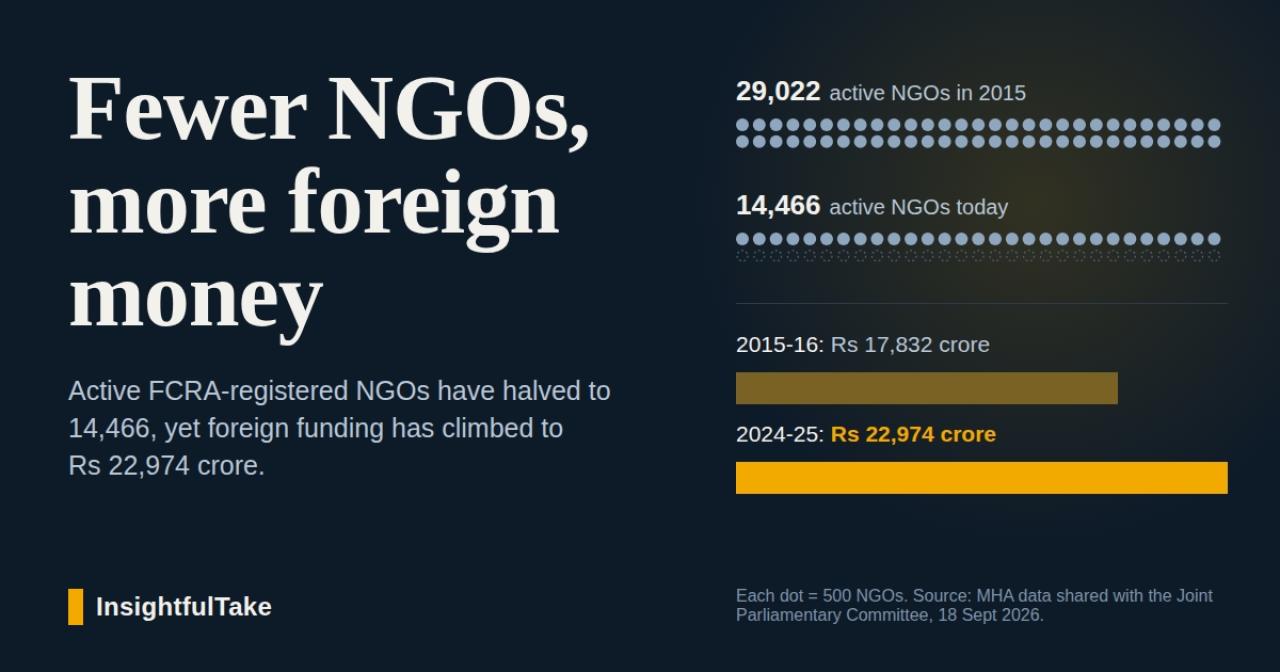
Active FCRA-registered NGOs have fallen by half in a decade, while foreign contributions have risen by nearly 29 per cent. The numbers raise questions about compliance, funding concentration and the future of NGO regulation in India.
The number of active NGOs registered under the Foreign Contribution (Regulation) Act, or FCRA, has fallen by more than half over the past decade. At the same time, the amount of foreign money received by registered organisations has increased.
The Ministry of Home Affairs (MHA) presented these figures before a Joint Parliamentary Committee (JPC) on September 18, during its first meeting to examine the FCRA Amendment Bill, 2026. The committee is headed by BJP MP Sanjay Jaiswal.
Union Home Secretary Govind Mohan and other MHA officials told the 31-member committee that 14,466 FCRA-registered NGOs are currently active. In 2015, the number was 29,022.
During roughly the same period, annual foreign contributions increased from ₹17,832 crore in 2015-16 to ₹22,974 crore in 2024-25.
That is an increase of ₹5,142 crore, or about 28.8 per cent.
A Smaller Group, A Larger Pool
The change becomes more striking when the two numbers are considered together.
In 2015-16, the foreign contribution worked out to roughly ₹61 lakh for every active FCRA-registered NGO, based on a simple division of the reported figures.
By 2024-25, the same calculation comes to about ₹1.59 crore per active NGO.
This does not mean every NGO received that amount. Many registered organisations may not receive foreign contributions in a particular year, while others may receive much larger sums.
The calculation is only a broad indicator. It nevertheless shows that a smaller number of active organisations are now operating within a larger overall pool of foreign contributions.
The distribution of funding also points towards concentration.
Between 2022 and 2024, one NGO received more than ₹500 crore. Fourteen organisations received between ₹100 crore and ₹500 crore, while 294 received between ₹10 crore and ₹50 crore.
At the other end of the scale, 4,508 organisations received between ₹5 lakh and ₹50 lakh.
The figures show a wide gap between the largest recipients and thousands of smaller organisations.
Why Has the NGO Count Fallen?
The government has cancelled the FCRA registrations of 21,983 NGOs, according to figures presented to the committee.
Of these cancellations, 91.3 per cent were linked to failure to file annual returns. Another 7.9 per cent were attributed to inactivity, while 0.4 per cent were linked to violations of the law.
This distinction matters.
The available figures do not suggest that all, or even most, cancelled registrations were linked to proven misuse of foreign funds. A large share was connected to compliance failures or inactivity.
The regulatory framework has also become stricter.
The 2020 FCRA amendment required foreign contributions to be received through a designated bank account, placed restrictions on administrative expenditure and tightened rules governing the transfer of foreign contributions to other organisations.
The 2026 rules have added further requirements relating to approved activities, state-wise operations, proof of activity and disclosures concerning key functionaries.
But the available data does not answer an important question: how many organisations stopped filing returns because they had effectively shut down, and how many were small or poorly resourced organisations that struggled with compliance?
That distinction is important when assessing what the fall in active registrations actually means.
Where Is the Foreign Money Coming From?
The United States remained the largest source of foreign contributions in 2024-25.
US-based sources contributed ₹12,113 crore, followed by the United Kingdom with ₹2,414 crore, Germany with ₹1,782 crore, Switzerland with ₹733 crore and Singapore with ₹669 crore.
Together, these five countries accounted for roughly 77 per cent of the total foreign contributions reported for the year.
Religious associations received ₹5,150 crore, according to the figures presented to the committee.
Within this category, Christian associations received ₹1,345 crore and Hindu NGOs received ₹328 crore. Other categories included Buddhist NGOs and Muslim organisations.
The figures show that religious organisations form one part of the wider FCRA funding system, which also covers organisations working in areas such as education, healthcare, social development, research and other approved activities.
Tamil Nadu Has the Most Active FCRA Associations
Tamil Nadu has the highest number of active FCRA associations, with 2,102.
It is followed by:
- Maharashtra: 1,578
- Karnataka: 1,355
- Delhi: 1,218
- Andhra Pradesh: 1,022
- Kerala: 1,013
The data presented to the committee therefore shows a substantial geographical concentration of active FCRA organisations in a relatively small number of states and regions.
The Bill Behind the Numbers
The MHA briefing came as Parliament examines the Foreign Contribution (Regulation) Amendment Bill, 2026.
The Bill was introduced in the Lok Sabha on March 25 and referred to a Joint Parliamentary Committee on August 12.
One of its central proposals is the creation of a Designated Authority to supervise, manage and dispose of foreign contributions and assets of an organisation whose FCRA certificate has ceased to exist.
This could apply when registration is cancelled, surrendered or not renewed.
The Bill provides for the vesting of such assets in the Designated Authority and lays down a framework for their management and disposal. The government has said that the underlying concept of vesting assets already exists under Section 15 of the existing FCRA, while the proposed amendment provides a more detailed mechanism for handling them.
The government has also clarified that the proposed mechanism concerns assets created from foreign contributions and applies after an organisation's FCRA registration has lawfully ended.
Opposition Raises Concerns
Opposition parties and some Christian organisations have raised concerns about the possible impact of the proposed provisions on institutions such as schools, hospitals and places of worship operated by NGOs.
Some Opposition leaders have also described the proposed framework as discriminatory against minorities.
The government has rejected those allegations and argued that the amendments are intended to improve accountability and provide a clear administrative mechanism for assets created from foreign contributions.
The Parliamentary Committee is examining the Bill and the competing claims around its possible effects. PRS Legislative Research notes that the Bill raises questions about the treatment of assets created through foreign contributions and the absence of an appeal mechanism in certain FCRA renewal situations.
What the Numbers Tell Us
The FCRA data presents two developments at the same time.
First, the number of active registered organisations has fallen sharply, from 29,022 in 2015 to 14,466 in 2026.
Second, annual foreign contributions have increased from ₹17,832 crore in 2015-16 to ₹22,974 crore in 2024-25.
The government can point to these figures as evidence of tighter compliance and a more closely regulated FCRA system.
Critics can focus on the decline in the number of registered organisations and the possibility that compliance requirements may have affected smaller groups more heavily.
The figures alone cannot establish how much of the decline is due to organisations becoming inactive, failing to meet compliance requirements, or leaving the sector for other reasons.
That is one of the questions the parliamentary process will need to examine.
What Comes Next?
The proposed changes raise several practical questions.
What safeguards will apply before foreign-funded assets are taken into government-supervised custody?
What process will an organisation have to challenge a decision affecting its registration or assets?
How will smaller community organisations manage increasingly detailed compliance requirements?
And how will the government balance financial transparency with the ability of legitimate organisations to carry out social, educational, religious and development work?
The JPC's examination is therefore not only about how much foreign money enters India.
It is also about who receives that money, how it is monitored, what happens when an organisation loses its FCRA status and how the rights of organisations are protected within the regulatory framework.
The committee's September 18 briefing provides a detailed snapshot of the sector. Its eventual recommendations will determine how these numbers translate into the next stage of India's foreign-funding regulation.
The number of active NGOs registered under the Foreign Contribution (Regulation) Act, or FCRA, has fallen by more than half over the past decade. At the same time, the amount of foreign money received by registered organisations has increased.
The Ministry of Home Affairs (MHA) presented these figures before a Joint Parliamentary Committee (JPC) on September 18, during its first meeting to examine the FCRA Amendment Bill, 2026. The committee is headed by BJP MP Sanjay Jaiswal.
Union Home Secretary Govind Mohan and other MHA officials told the 31-member committee that 14,466 FCRA-registered NGOs are currently active. In 2015, the number was 29,022.
During roughly the same period, annual foreign contributions increased from ₹17,832 crore in 2015-16 to ₹22,974 crore in 2024-25.
That is an increase of ₹5,142 crore, or about 28.8 per cent.
A Smaller Group, A Larger Pool
The change becomes more striking when the two numbers are considered together.
In 2015-16, the foreign contribution worked out to roughly ₹61 lakh for every active FCRA-registered NGO, based on a simple division of the reported figures.
By 2024-25, the same calculation comes to about ₹1.59 crore per active NGO.
This does not mean every NGO received that amount. Many registered organisations may not receive foreign contributions in a particular year, while others may receive much larger sums.
The calculation is only a broad indicator. It nevertheless shows that a smaller number of active organisations are now operating within a larger overall pool of foreign contributions.
The distribution of funding also points towards concentration.
Between 2022 and 2024, one NGO received more than ₹500 crore. Fourteen organisations received between ₹100 crore and ₹500 crore, while 294 received between ₹10 crore and ₹50 crore.
At the other end of the scale, 4,508 organisations received between ₹5 lakh and ₹50 lakh.
The figures show a wide gap between the largest recipients and thousands of smaller organisations.
Why Has the NGO Count Fallen?
The government has cancelled the FCRA registrations of 21,983 NGOs, according to figures presented to the committee.
Of these cancellations, 91.3 per cent were linked to failure to file annual returns. Another 7.9 per cent were attributed to inactivity, while 0.4 per cent were linked to violations of the law.
This distinction matters.
The available figures do not suggest that all, or even most, cancelled registrations were linked to proven misuse of foreign funds. A large share was connected to compliance failures or inactivity.
The regulatory framework has also become stricter.
The 2020 FCRA amendment required foreign contributions to be received through a designated bank account, placed restrictions on administrative expenditure and tightened rules governing the transfer of foreign contributions to other organisations.
The 2026 rules have added further requirements relating to approved activities, state-wise operations, proof of activity and disclosures concerning key functionaries.
But the available data does not answer an important question: how many organisations stopped filing returns because they had effectively shut down, and how many were small or poorly resourced organisations that struggled with compliance?
That distinction is important when assessing what the fall in active registrations actually means.
Where Is the Foreign Money Coming From?
The United States remained the largest source of foreign contributions in 2024-25.
US-based sources contributed ₹12,113 crore, followed by the United Kingdom with ₹2,414 crore, Germany with ₹1,782 crore, Switzerland with ₹733 crore and Singapore with ₹669 crore.
Together, these five countries accounted for roughly 77 per cent of the total foreign contributions reported for the year.
Religious associations received ₹5,150 crore, according to the figures presented to the committee.
Within this category, Christian associations received ₹1,345 crore and Hindu NGOs received ₹328 crore. Other categories included Buddhist NGOs and Muslim organisations.
The figures show that religious organisations form one part of the wider FCRA funding system, which also covers organisations working in areas such as education, healthcare, social development, research and other approved activities.
Tamil Nadu Has the Most Active FCRA Associations
Tamil Nadu has the highest number of active FCRA associations, with 2,102.
It is followed by:
- Maharashtra: 1,578
- Karnataka: 1,355
- Delhi: 1,218
- Andhra Pradesh: 1,022
- Kerala: 1,013
The data presented to the committee therefore shows a substantial geographical concentration of active FCRA organisations in a relatively small number of states and regions.
The Bill Behind the Numbers
The MHA briefing came as Parliament examines the Foreign Contribution (Regulation) Amendment Bill, 2026.
The Bill was introduced in the Lok Sabha on March 25 and referred to a Joint Parliamentary Committee on August 12.
One of its central proposals is the creation of a Designated Authority to supervise, manage and dispose of foreign contributions and assets of an organisation whose FCRA certificate has ceased to exist.
This could apply when registration is cancelled, surrendered or not renewed.
The Bill provides for the vesting of such assets in the Designated Authority and lays down a framework for their management and disposal. The government has said that the underlying concept of vesting assets already exists under Section 15 of the existing FCRA, while the proposed amendment provides a more detailed mechanism for handling them.
The government has also clarified that the proposed mechanism concerns assets created from foreign contributions and applies after an organisation's FCRA registration has lawfully ended.
Opposition Raises Concerns
Opposition parties and some Christian organisations have raised concerns about the possible impact of the proposed provisions on institutions such as schools, hospitals and places of worship operated by NGOs.
Some Opposition leaders have also described the proposed framework as discriminatory against minorities.
The government has rejected those allegations and argued that the amendments are intended to improve accountability and provide a clear administrative mechanism for assets created from foreign contributions.
The Parliamentary Committee is examining the Bill and the competing claims around its possible effects. PRS Legislative Research notes that the Bill raises questions about the treatment of assets created through foreign contributions and the absence of an appeal mechanism in certain FCRA renewal situations.
What the Numbers Tell Us
The FCRA data presents two developments at the same time.
First, the number of active registered organisations has fallen sharply, from 29,022 in 2015 to 14,466 in 2026.
Second, annual foreign contributions have increased from ₹17,832 crore in 2015-16 to ₹22,974 crore in 2024-25.
The government can point to these figures as evidence of tighter compliance and a more closely regulated FCRA system.
Critics can focus on the decline in the number of registered organisations and the possibility that compliance requirements may have affected smaller groups more heavily.
The figures alone cannot establish how much of the decline is due to organisations becoming inactive, failing to meet compliance requirements, or leaving the sector for other reasons.
That is one of the questions the parliamentary process will need to examine.
What Comes Next?
The proposed changes raise several practical questions.
What safeguards will apply before foreign-funded assets are taken into government-supervised custody?
What process will an organisation have to challenge a decision affecting its registration or assets?
How will smaller community organisations manage increasingly detailed compliance requirements?
And how will the government balance financial transparency with the ability of legitimate organisations to carry out social, educational, religious and development work?
The JPC's examination is therefore not only about how much foreign money enters India.
It is also about who receives that money, how it is monitored, what happens when an organisation loses its FCRA status and how the rights of organisations are protected within the regulatory framework.
The committee's September 18 briefing provides a detailed snapshot of the sector. Its eventual recommendations will determine how these numbers translate into the next stage of India's foreign-funding regulation.
























Leave a Comment