
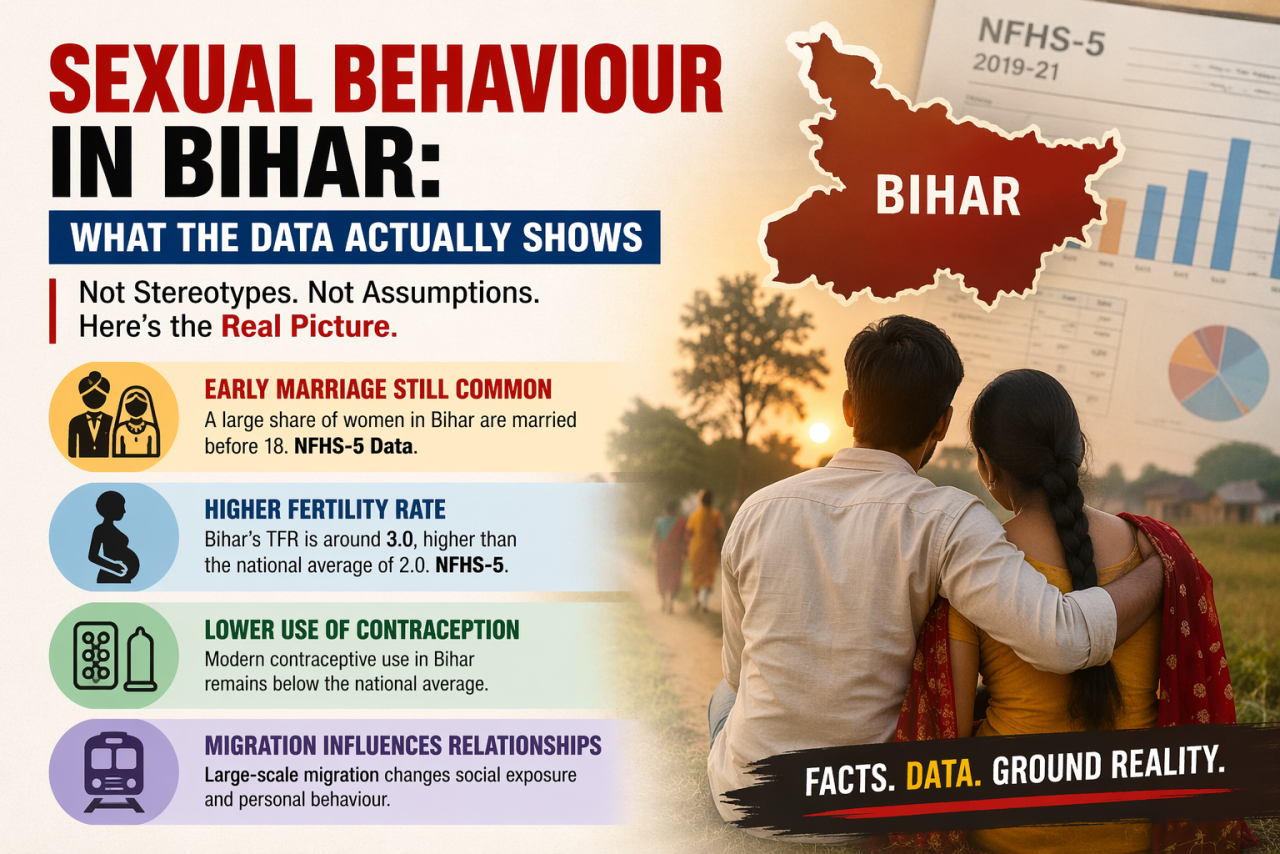
Sexual behaviour in Bihar is not defined by stereotypes, but by measurable realities such as early marriage, high fertility, and gaps in reproductive health access.
Sexual behaviour in Bihar is closely tied to marriage patterns, fertility trends, and access to health services, rather than informal labels or assumptions. Evidence from the National Family Health Survey (NFHS-5, 2019–21), Census data, and public health reports provides a clearer picture of how intimacy, relationships, and reproductive choices function within the state.
Marriage-Centred Intimacy
In Bihar, intimate relationships are overwhelmingly structured within marriage. NFHS-5 data shows that a significant proportion of women aged 20–24 were married before the legal age of 18. The median age at first marriage for women in the state remains lower than the national average.
This has two direct implications. First, sexual activity begins earlier within marriage compared to states where marriage occurs later. Second, the social legitimacy of intimacy is strongly tied to marital status, with limited acceptance of premarital relationships, particularly in rural areas.
Field studies in rural Bihar indicate that family and community norms play a decisive role in regulating relationships. Social surveillance, kinship structures, and caste networks influence partner choice and behaviour, keeping intimacy largely private and institutionally bound.
High Fertility and Reproductive Behaviour
Bihar’s Total Fertility Rate (TFR) is around 3.0, significantly higher than the national average of about 2.0. This is one of the most important indicators of sexual and reproductive behaviour in the state.
Higher fertility is not simply a reflection of higher sexual activity, but of three structural conditions:
- Early marriage extends the reproductive window
- Lower use of contraception increases the likelihood of pregnancies
- Preference for larger families in some communities
NFHS-5 data shows that spacing between children is often limited, particularly in rural households. This reflects gaps in family planning awareness and access rather than deliberate reproductive choices.
Contraception Gap and Unmet Need
One of the defining features of Bihar’s reproductive landscape is the low use of modern contraceptives. Compared to southern and western states, Bihar reports significantly lower adoption of methods such as condoms, oral pills, and intrauterine devices.
The concept of “unmet need for family planning”—women who want to delay or avoid pregnancy but are not using contraception—is relatively high. This gap points to structural barriers:
- Limited availability of services in rural areas
- Social hesitation in discussing contraception
- Male-dominated decision-making in households
As a result, sexual behaviour within marriage is less mediated by planning and more by circumstance.
Gender Inequality and Consent Dynamics
Research in gender studies highlights that women in Bihar often have limited autonomy in decisions related to sex and reproduction. Negotiating contraception or spacing of children can be difficult, especially in traditional households.
This affects the nature of intimate relationships. Consent, while present within marriage, may not always be explicitly negotiated in the way it is discussed in modern urban contexts. Instead, it operates within established social roles and expectations.
However, this is not static. Increased education among women and exposure to media are gradually shifting these dynamics. Younger couples, particularly in semi-urban areas, are showing greater participation in joint decision-making.
Male Migration and Its Effects
Bihar is one of India’s largest sources of migrant labour. A significant number of men spend long periods working in cities such as Delhi, Mumbai, and Surat.
This pattern has two contrasting effects on sexual behaviour:
- Within villages: Prolonged absence of husbands reduces frequency of marital intimacy and delays childbirth in some cases.
- In urban settings: Migrant workers, separated from family structures, may experience different social environments, including exposure to commercial sex or informal relationships.
Studies on migration suggest that such behavioural shifts are linked to mobility and isolation rather than regional identity. Similar patterns are observed among migrant populations globally.
Sexual Health and Risk Indicators
Despite structural challenges, Bihar does not report unusually high levels of sexually transmitted infections. Data from the National AIDS Control Organisation (NACO) indicates that HIV prevalence in Bihar remains lower than in several high-burden states.
This suggests that while awareness gaps exist, high-risk sexual networks are not widespread. Public health interventions, including HIV awareness campaigns and testing programmes, have contributed to maintaining relatively low prevalence.
Urbanisation and Emerging Change
Urban centres such as Patna, Gaya, and Muzaffarpur are witnessing gradual shifts in attitudes. With higher education levels and digital exposure, discussions around relationships, consent, and sexual health are becoming more open among younger populations.
There is also a slow but visible change in:
- Acceptance of family planning
- Delay in marriage among educated groups
- Increased awareness of sexual rights and health
However, these changes remain uneven and are more pronounced in urban and semi-urban areas than in rural regions.
A Grounded Perspective
The available evidence shows that sexual behaviour in Bihar is best understood through measurable indicators: early marriage, high fertility, low contraceptive use, gender norms, and migration patterns. These factors create a framework where intimacy is largely marital, reproduction is less regulated, and change is gradual.
There is no empirical basis for treating Bihar as having a distinct or separate category of sexual behaviour. Instead, the state reflects a combination of demographic pressures and developmental gaps that shape how relationships and reproductive choices are experienced.
A grounded, data-driven perspective moves beyond labels and focuses on lived realities—where policy, education, and healthcare access remain the key forces influencing intimate life.
Sexual behaviour in Bihar is closely tied to marriage patterns, fertility trends, and access to health services, rather than informal labels or assumptions. Evidence from the National Family Health Survey (NFHS-5, 2019–21), Census data, and public health reports provides a clearer picture of how intimacy, relationships, and reproductive choices function within the state.
Marriage-Centred Intimacy
In Bihar, intimate relationships are overwhelmingly structured within marriage. NFHS-5 data shows that a significant proportion of women aged 20–24 were married before the legal age of 18. The median age at first marriage for women in the state remains lower than the national average.
This has two direct implications. First, sexual activity begins earlier within marriage compared to states where marriage occurs later. Second, the social legitimacy of intimacy is strongly tied to marital status, with limited acceptance of premarital relationships, particularly in rural areas.
Field studies in rural Bihar indicate that family and community norms play a decisive role in regulating relationships. Social surveillance, kinship structures, and caste networks influence partner choice and behaviour, keeping intimacy largely private and institutionally bound.
High Fertility and Reproductive Behaviour
Bihar’s Total Fertility Rate (TFR) is around 3.0, significantly higher than the national average of about 2.0. This is one of the most important indicators of sexual and reproductive behaviour in the state.
Higher fertility is not simply a reflection of higher sexual activity, but of three structural conditions:
- Early marriage extends the reproductive window
- Lower use of contraception increases the likelihood of pregnancies
- Preference for larger families in some communities
NFHS-5 data shows that spacing between children is often limited, particularly in rural households. This reflects gaps in family planning awareness and access rather than deliberate reproductive choices.
Contraception Gap and Unmet Need
One of the defining features of Bihar’s reproductive landscape is the low use of modern contraceptives. Compared to southern and western states, Bihar reports significantly lower adoption of methods such as condoms, oral pills, and intrauterine devices.
The concept of “unmet need for family planning”—women who want to delay or avoid pregnancy but are not using contraception—is relatively high. This gap points to structural barriers:
- Limited availability of services in rural areas
- Social hesitation in discussing contraception
- Male-dominated decision-making in households
As a result, sexual behaviour within marriage is less mediated by planning and more by circumstance.
Gender Inequality and Consent Dynamics
Research in gender studies highlights that women in Bihar often have limited autonomy in decisions related to sex and reproduction. Negotiating contraception or spacing of children can be difficult, especially in traditional households.
This affects the nature of intimate relationships. Consent, while present within marriage, may not always be explicitly negotiated in the way it is discussed in modern urban contexts. Instead, it operates within established social roles and expectations.
However, this is not static. Increased education among women and exposure to media are gradually shifting these dynamics. Younger couples, particularly in semi-urban areas, are showing greater participation in joint decision-making.
Male Migration and Its Effects
Bihar is one of India’s largest sources of migrant labour. A significant number of men spend long periods working in cities such as Delhi, Mumbai, and Surat.
This pattern has two contrasting effects on sexual behaviour:
- Within villages: Prolonged absence of husbands reduces frequency of marital intimacy and delays childbirth in some cases.
- In urban settings: Migrant workers, separated from family structures, may experience different social environments, including exposure to commercial sex or informal relationships.
Studies on migration suggest that such behavioural shifts are linked to mobility and isolation rather than regional identity. Similar patterns are observed among migrant populations globally.
Sexual Health and Risk Indicators
Despite structural challenges, Bihar does not report unusually high levels of sexually transmitted infections. Data from the National AIDS Control Organisation (NACO) indicates that HIV prevalence in Bihar remains lower than in several high-burden states.
This suggests that while awareness gaps exist, high-risk sexual networks are not widespread. Public health interventions, including HIV awareness campaigns and testing programmes, have contributed to maintaining relatively low prevalence.
Urbanisation and Emerging Change
Urban centres such as Patna, Gaya, and Muzaffarpur are witnessing gradual shifts in attitudes. With higher education levels and digital exposure, discussions around relationships, consent, and sexual health are becoming more open among younger populations.
There is also a slow but visible change in:
- Acceptance of family planning
- Delay in marriage among educated groups
- Increased awareness of sexual rights and health
However, these changes remain uneven and are more pronounced in urban and semi-urban areas than in rural regions.
A Grounded Perspective
The available evidence shows that sexual behaviour in Bihar is best understood through measurable indicators: early marriage, high fertility, low contraceptive use, gender norms, and migration patterns. These factors create a framework where intimacy is largely marital, reproduction is less regulated, and change is gradual.
There is no empirical basis for treating Bihar as having a distinct or separate category of sexual behaviour. Instead, the state reflects a combination of demographic pressures and developmental gaps that shape how relationships and reproductive choices are experienced.
A grounded, data-driven perspective moves beyond labels and focuses on lived realities—where policy, education, and healthcare access remain the key forces influencing intimate life.























Leave a Comment