
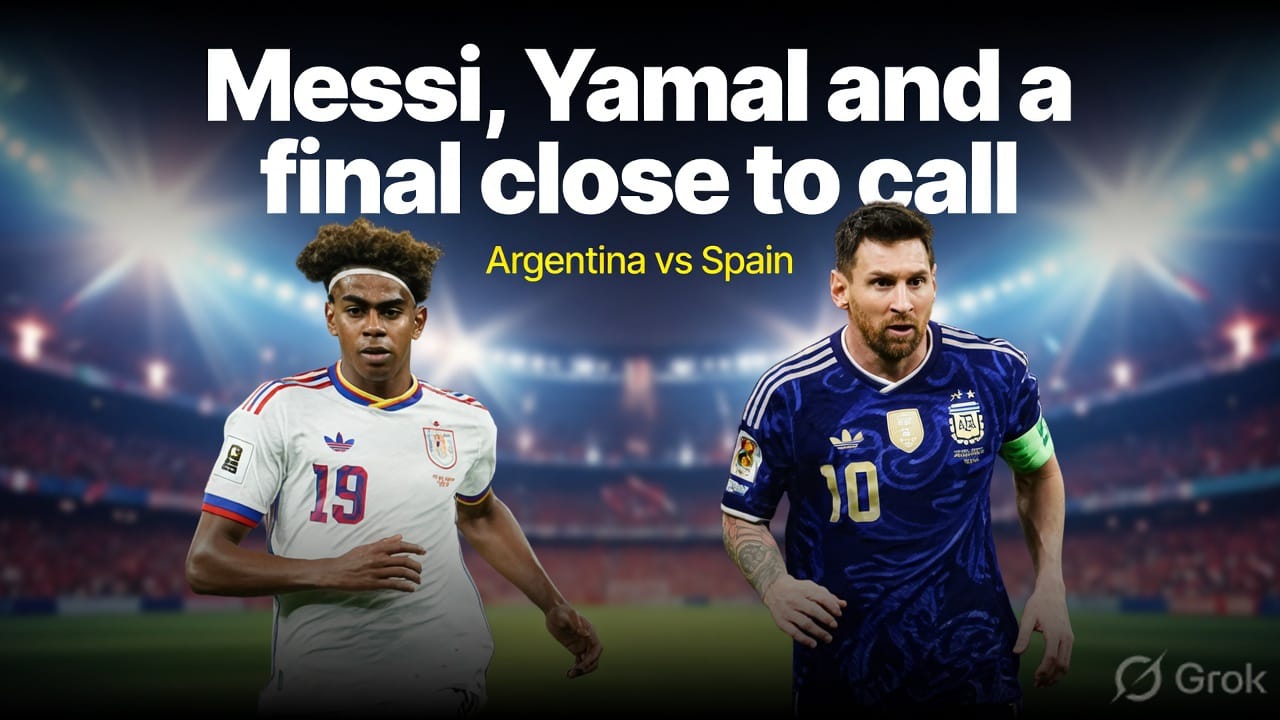
One final. Two generations. Will Lionel Messi script the perfect farewell, or will Lamine Yamal announce the arrival of football's next global superstar?
Lionel Messi will walk out at the New York/New Jersey Stadium on July 19 for what is almost certainly his last World Cup match, and standing on the other side will be Lamine Yamal, the 19-year-old who was still a toddler when Spain last won the trophy in 2010. The 2026 final brings together the game's most decorated modern great and its most exciting young talent, and it does so with the biggest prize in football on the line.
Argentina arrive at MetLife Stadium as defending champions chasing history. A win would make them only the second nation after Brazil to retain the World Cup, and only the fourth country ever to win it four times. Their path here has been anything but smooth. Argentina have needed late goals in three of their last four knockout matches, including a stunning come-from-behind 2-1 win over England in the semi-final, where Enzo Fernández equalised in the 85th minute before Lautaro Martínez headed in a stoppage-time winner off a Messi assist. That pattern, struggle and then finding a way, has defined coach Lionel Scaloni's side throughout the tournament.
Spain, by contrast, have looked the more complete team on paper. La Roja have conceded only one goal across the entire competition, a defensive record built on a settled back four of Pedro Porro, Aymeric Laporte, Robin Le Normand and Marc Cucurella, marshalled by midfield anchor Rodri. Their semi-final win over France was a statement performance. The 2-0 scoreline flattered a France side many had backed to go further. Manager Luis de la Fuente has built a team capable of controlling matches for long stretches, and Yamal, despite drawing heavy defensive attention all tournament, has been the player who unsettles opponents even when he is not directly involved in the scoring.
The Messi-Yamal contrast is central to how this final is being framed, but it may not be the most important individual battle on the pitch. Argentina's biggest question is how they contain Spain's control of possession without allowing their own midfield to be overrun. Rodri's ability to dictate the tempo, along with the passing triangle Spain build through Pedri, Fabián Ruiz and Dani Olmo, has troubled every opponent they have faced. If Argentina cannot disrupt that rhythm early, they risk spending long periods chasing the game, a position from which they have repeatedly had to recover during this tournament.
Spain's own vulnerability lies at the other end. For all their defensive solidity, they have not faced a front line quite like Argentina's, where Messi's vision combines with the pace of Julián Álvarez and the finishing of Lautaro Martínez. Argentina have scored five goals from outside the penalty area during this World Cup, the joint-highest tally by any team in a single edition since 1966. It reflects their willingness to shoot from distance when space inside the box is limited. Spain's discipline will be tested by exactly the kind of unpredictable, individual brilliance that has separated Argentina from opponents who otherwise matched them tactically.
There is also a deeper thread connecting the two camps. Messi's football education at Barcelona's famed La Masia academy, and the possession-based principles he absorbed there under coaches such as Pep Guardiola, helped shape the philosophy that Spain now play under de la Fuente. Yamal is a product of the same academy a generation later. In many ways, Sunday's final pits Messi's interpretation of the Barcelona school, now expressed through Argentina's more direct, transition-based style, against Spain's more faithful modern version of that philosophy.
For Messi personally, the stakes carry an emotional weight beyond trophies. At 39, this is widely expected to be his final World Cup appearance, bringing the curtain down on an international career that already delivered the one honour that eluded him for so long in Qatar in 2022. A second consecutive World Cup title would cement Argentina's era as one of the greatest in football history and give Messi an ending that very few athletes in any sport have been able to script for themselves.
Whatever the result, the final will conclude a tournament that expanded to 48 teams for the first time and produced its share of surprises and dramatic finishes. Sunday's match, preceded by a closing ceremony and the World Cup's first-ever halftime show, will determine whether football's new generation, led by Yamal, announces its arrival by defeating the game's greatest icon, or whether Messi signs off with one final, unforgettable triumph.
Lionel Messi will walk out at the New York/New Jersey Stadium on July 19 for what is almost certainly his last World Cup match, and standing on the other side will be Lamine Yamal, the 19-year-old who was still a toddler when Spain last won the trophy in 2010. The 2026 final brings together the game's most decorated modern great and its most exciting young talent, and it does so with the biggest prize in football on the line.
Argentina arrive at MetLife Stadium as defending champions chasing history. A win would make them only the second nation after Brazil to retain the World Cup, and only the fourth country ever to win it four times. Their path here has been anything but smooth. Argentina have needed late goals in three of their last four knockout matches, including a stunning come-from-behind 2-1 win over England in the semi-final, where Enzo Fernández equalised in the 85th minute before Lautaro Martínez headed in a stoppage-time winner off a Messi assist. That pattern, struggle and then finding a way, has defined coach Lionel Scaloni's side throughout the tournament.
Spain, by contrast, have looked the more complete team on paper. La Roja have conceded only one goal across the entire competition, a defensive record built on a settled back four of Pedro Porro, Aymeric Laporte, Robin Le Normand and Marc Cucurella, marshalled by midfield anchor Rodri. Their semi-final win over France was a statement performance. The 2-0 scoreline flattered a France side many had backed to go further. Manager Luis de la Fuente has built a team capable of controlling matches for long stretches, and Yamal, despite drawing heavy defensive attention all tournament, has been the player who unsettles opponents even when he is not directly involved in the scoring.
The Messi-Yamal contrast is central to how this final is being framed, but it may not be the most important individual battle on the pitch. Argentina's biggest question is how they contain Spain's control of possession without allowing their own midfield to be overrun. Rodri's ability to dictate the tempo, along with the passing triangle Spain build through Pedri, Fabián Ruiz and Dani Olmo, has troubled every opponent they have faced. If Argentina cannot disrupt that rhythm early, they risk spending long periods chasing the game, a position from which they have repeatedly had to recover during this tournament.
Spain's own vulnerability lies at the other end. For all their defensive solidity, they have not faced a front line quite like Argentina's, where Messi's vision combines with the pace of Julián Álvarez and the finishing of Lautaro Martínez. Argentina have scored five goals from outside the penalty area during this World Cup, the joint-highest tally by any team in a single edition since 1966. It reflects their willingness to shoot from distance when space inside the box is limited. Spain's discipline will be tested by exactly the kind of unpredictable, individual brilliance that has separated Argentina from opponents who otherwise matched them tactically.
There is also a deeper thread connecting the two camps. Messi's football education at Barcelona's famed La Masia academy, and the possession-based principles he absorbed there under coaches such as Pep Guardiola, helped shape the philosophy that Spain now play under de la Fuente. Yamal is a product of the same academy a generation later. In many ways, Sunday's final pits Messi's interpretation of the Barcelona school, now expressed through Argentina's more direct, transition-based style, against Spain's more faithful modern version of that philosophy.
For Messi personally, the stakes carry an emotional weight beyond trophies. At 39, this is widely expected to be his final World Cup appearance, bringing the curtain down on an international career that already delivered the one honour that eluded him for so long in Qatar in 2022. A second consecutive World Cup title would cement Argentina's era as one of the greatest in football history and give Messi an ending that very few athletes in any sport have been able to script for themselves.
Whatever the result, the final will conclude a tournament that expanded to 48 teams for the first time and produced its share of surprises and dramatic finishes. Sunday's match, preceded by a closing ceremony and the World Cup's first-ever halftime show, will determine whether football's new generation, led by Yamal, announces its arrival by defeating the game's greatest icon, or whether Messi signs off with one final, unforgettable triumph.





















Leave a Comment