
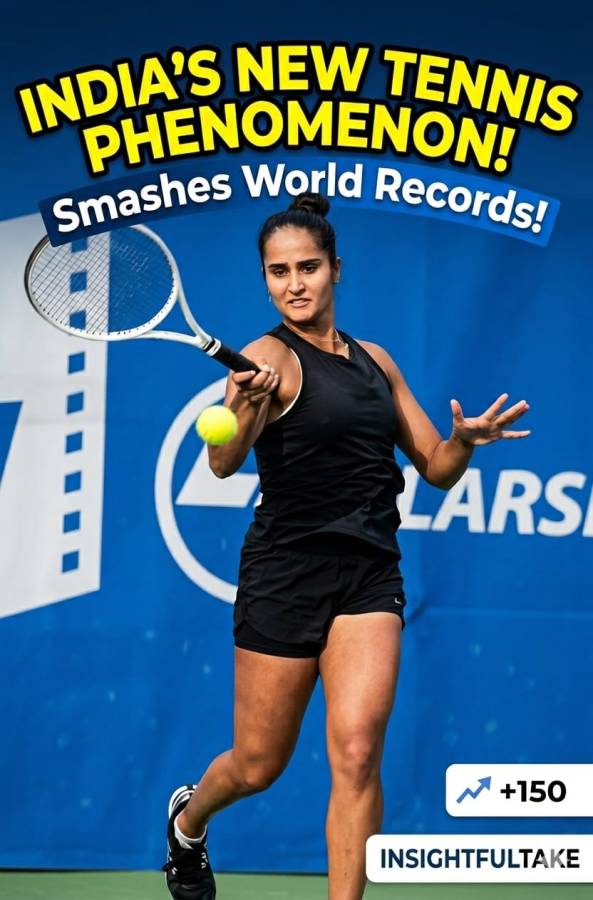
While India watches sixes and wickets, a 21-year-old with a racket is quietly breaking a 17-year-old barrier—Vaishnavi Adkar’s rise is the story we’re missing.
While the nation’s collective gaze is firmly fixed on the flashing lights and franchise rivalries of the IPL, a quiet revolution is taking place on the 78-foot rectangle of the tennis court. In a country where sporting success is often measured only in wickets and sixes, Vaishnavi Adkar is serving notice that there is life—and immense talent—beyond the cricket boundary.
A Historic Leap in Bengaluru
In February, while the cricket world was busy with auctions and pre-season hype, Adkar was making history at the W100 ITF event in Bengaluru. At just 21 years old, she became the first Indian woman to reach the singles final of a tournament at that level since Sania Mirza in 2009.
Entering as a wildcard ranked World No. 690, she didn't just participate; she dominated. She dismantled higher-ranked opponents, including world-class talent like Lanlana Tararudee, to prove that her game belongs on the global stage. Her performance didn't just earn her a runner-up trophy; it catapulted her ranking by over 200 places, firmly breaking into the WTA Top 400.
The Road Through Germany and Beyond
Adkar’s rise isn't a flash in the pan. In July 2025, she ended India’s 46-year wait for a tennis medal at the World University Games in Germany, clinching a bronze. She followed that momentum by securing the Fenesta National title in October. These aren't just statistics; they are milestones of a player who has learned to thrive under pressure when the cameras aren't watching.
Behind this success lies a calculated move. Adkar recently shifted her training base from her hometown of Pune to the Rohan Bopanna Tennis Academy (RBTA) in Bengaluru. Under the guidance of veteran coach M Balachandran and the mentorship of Grand Slam champion Rohan Bopanna, her game has found a new edge.
"Shifting my base to Bengaluru has helped because I am getting guidance from experienced people like Balu sir and Rohan," Adkar says. "The change in perspective has been making a huge difference."
The "Grind" and the Financial Reality
However, the path of a non-cricketer in India is paved with more than just sweat; it is paved with significant financial hurdles. While IPL players secure life-changing contracts, tennis players like Adkar face a "punishing grind" that drains the pocket as much as the body.
Her father, Nihar Adkar, a businessman, notes the meticulous budgeting required to keep two daughters (Vaishnavi and her younger sister Asmi) in the sport. At the senior level, travel, equipment, and coaching expenses far outweigh the prize money available at lower-tier tournaments.
- The Struggle: Lack of a robust domestic structure to identify talent early.
- The Burnout: Many players quit because the financial struggle doesn't feel worth the effort.
- The Hope: A slow but steady increase in corporate sponsorship and support.
Why We Must Look Away from the Pitch
It is easy to get lost in the "cricket-only" narrative, especially during the summer. But the story of Vaishnavi Adkar is a reminder of what Indian sports can be if we widen our lens. She represents a generation of athletes fighting for recognition in an ecosystem that often ignores them.
As she prepares for the Billie Jean King Cup, Vaishnavi Adkar isn't just playing for herself; she’s playing to prove that an Indian woman can once again conquer the international tennis circuit. In the middle of IPL fever, let’s make sure we save some applause for the girl with the racket who is breaking a 17-year-old ceiling.
Tennis may not have a "strategic timeout," but it’s time we took one from cricket to appreciate a star in the making.
























Leave a Comment