
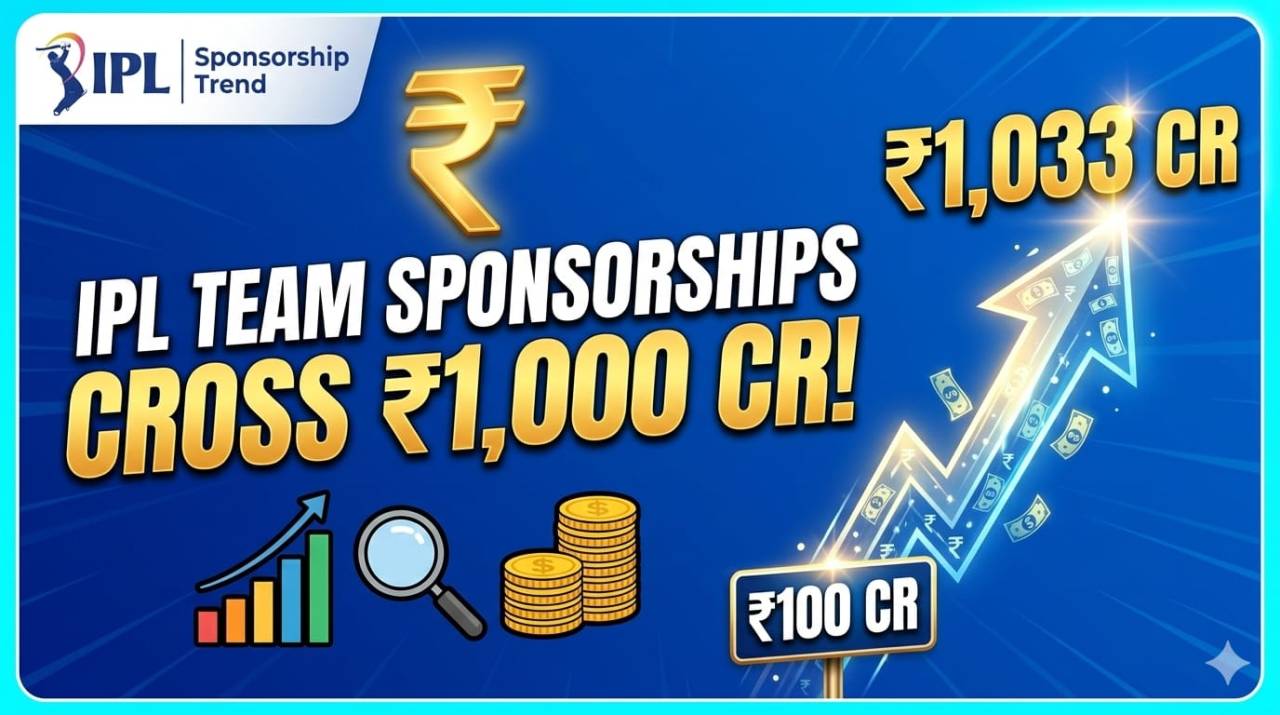
The IPL doesn’t just draw crowds—it draws cash, turning every boundary into business.
The Indian Premier League has long been more than just a cricket tournament; it has become the engine room of the Indian sports economy. According to the latest "Sporting Nation" report for 2025 by WPP Media, the league has reached a massive financial milestone. For the first time in its history, the money collected from team sponsorships alone has crossed the ₹1,000 crore mark, settling at an impressive ₹1,033 crore. This growth is a clear indicator of how deeply rooted the IPL has become in the Indian commercial landscape.
To understand why this is a big deal, we have to look at the challenges the industry faced recently. For a long time, "Real Money Gaming" (RMG) companies—the apps where people play fantasy sports for cash—were the biggest spenders in cricket. However, new government regulations and bans on these platforms created a sudden vacuum. Many feared that sports funding would collapse without these big-spending tech companies. Instead, the opposite happened. Traditional brands from sectors like automobiles, cement, and electronics stepped in to fill the gap. This shift shows that the IPL is no longer an "emerging" market that relies on a single trend; it is a mature, stable industry that other businesses are eager to join.
The Growth of the Sports Economy
The overall sports industry in India is now valued at ₹18,864 crore (roughly $2.13 billion). To put that in perspective, this value has nearly doubled in just the last four years. While India is home to many sports, cricket is the undisputed king, accounting for 89% of this entire growth. Within this "cricket-first" economy, the IPL acts as the central pillar.
The report highlights that sponsorship is only one part of the story. Media spending—the money brands pay to show ads on TV and digital streaming—is even larger, contributing ₹9,571 crore. Interestingly, digital advertising is now growing faster than traditional television. This means more people are watching matches on their phones and laptops, and companies are following them there with their marketing budgets.
Why Teams are More Valuable Than Ever
In the early days of the IPL, teams relied almost entirely on the central pool of money from the Board of Control for Cricket in India. Today, the teams themselves have become powerful individual brands. The fact that team-specific sponsorships crossed ₹1,000 crore means that companies are not just buying an association with the league; they are buying an association with specific teams like Mumbai Indians (MI), Royal Challengers Bengaluru (RCB), and Chennai Super Kings (CSK).
These three teams are the heavyweights of the league. According to the report, each of these franchises is earning in the range of ₹150 crore annually just from sponsorships. Other teams like Kolkata Knight Riders (KKR) and Gujarat Titans (GT) are following closely behind. When a brand puts its logo on an RCB or CSK jersey, they aren't just reaching sports fans; they are tapping into a massive, loyal community that stays engaged throughout the year.
New Players in the Market
The nature of the companies sponsoring the IPL is changing. We are seeing global giants like Google enter the fray. Google’s involvement is particularly interesting because it isn't just about search engines anymore; it is driven by the "AI wars." By sponsoring the IPL and major world cups, tech giants are trying to ensure their brand is the first thing people think of when they use new technology.
Other traditional brands have also increased their presence. For example, Apollo Tyres recently replaced Dream11 as a major sponsor for the Indian national team, and similar shifts are happening within the IPL franchises. These "old world" companies provide a level of financial stability that the volatile tech startup sector couldn't always guarantee.
Beyond the Men’s Game
The IPL’s success is also spilling over into other areas of cricket. The Women’s Premier League (WPL) and the success of the Indian women's team in global tournaments have created new avenues for brands. Companies are realizing that the female audience for cricket is growing rapidly, making it a very attractive demographic for advertisers.
What Does the Future Look Like?
The simple truth is that the IPL has reached a point where it’s almost impossible to shake. Even when new rules pushed out an entire category of sponsors, fresh brands stepped in without much delay. That’s because nothing else in India offers what the IPL does—a massive, guaranteed audience of hundreds of millions tuning in consistently for two straight months.
What the “Sporting Nation” report really hints at is that crossing ₹1,000 crore isn’t the peak—it’s just the starting line for what comes next. With more people watching matches on their phones and teams building stronger connections with fans beyond the stadium, sponsorship money is only expected to grow. The IPL is no longer just about cricket; it has quietly become the financial backbone of Indian sports.
Put simply, if you notice more logos on jerseys or more ads during matches in the coming seasons, it’s not just about teams trying to earn more. It’s because the world’s biggest companies now see the IPL as one of the smartest and most reliable places to invest their money.






















Leave a Comment