
Development has long been presented as the path to prosperity. Dams, highways, industrial corridors, mines and river-linking projects are often celebrated as symbols of national progress. They promise irrigation, electricity, employment and economic growth. Yet every such project carries a cost that rarely appears in official announcements. That cost is often borne by communities living closest to the land chosen for development.
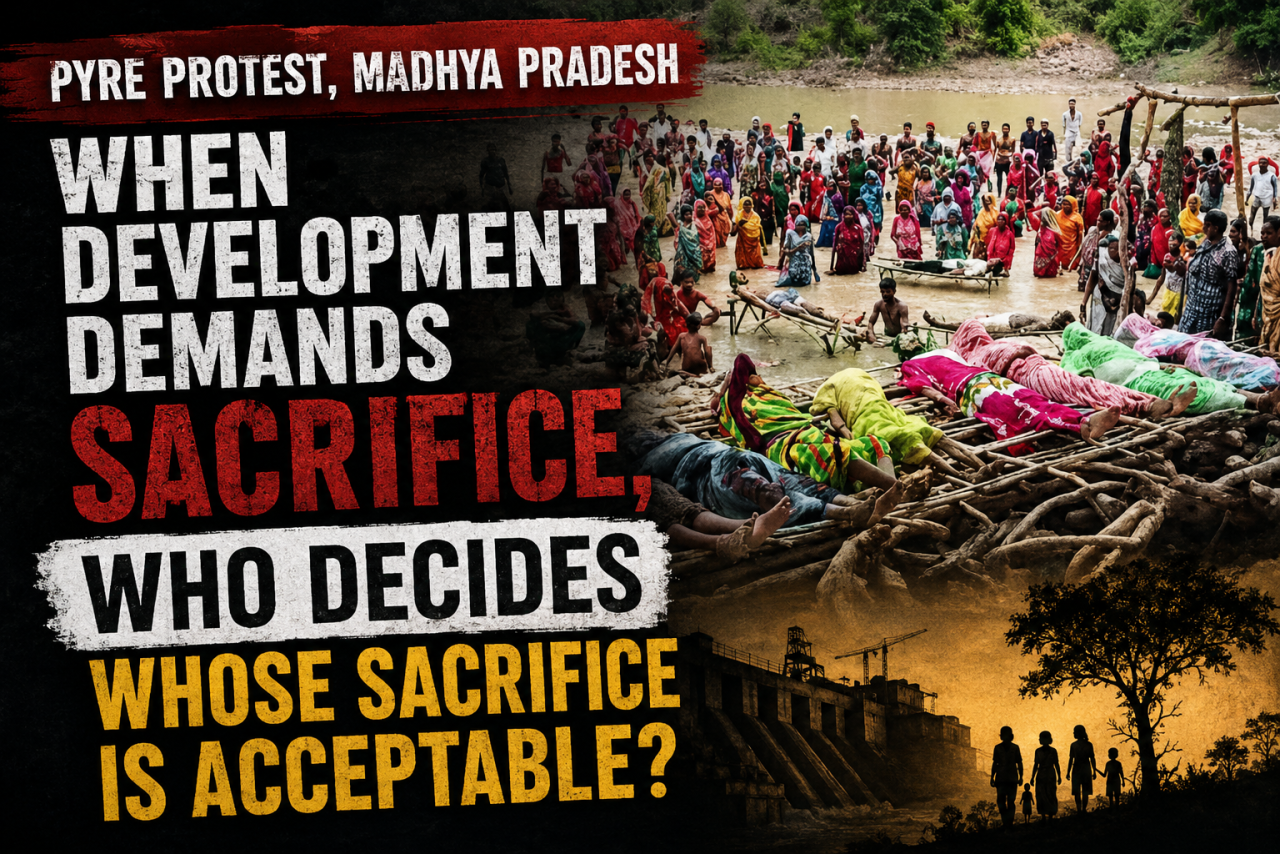
The recent Pyre Protest in Madhya Pradesh has once again brought this uncomfortable reality into public view. Hundreds of tribal women lay down on symbolic funeral pyres to oppose displacement linked to the Ken-Betwa River Linking Project. Their message was not merely emotional. It was deeply political. They were asking a question that every democracy must confront: When development demands sacrifice, who decides whose sacrifice is acceptable?
The answer cannot be found in project reports alone. It lies in how a society defines justice.
India undoubtedly needs development. A country aspiring to become a global economic power cannot ignore the need for better infrastructure, water security and energy generation. Large public projects have transformed regions, created opportunities and improved the quality of life for millions. Rejecting development altogether is neither practical nor desirable.
However, the debate becomes difficult when the benefits of development are widely shared while its burdens fall on a small and vulnerable population. This imbalance raises questions that cannot be dismissed as anti-development rhetoric.
Communities facing displacement often lose much more than physical property. A village is not simply a collection of houses. It is a network of relationships, memories, customs and livelihoods built over generations. For tribal communities, forests are not merely economic resources. They are places of worship, identity and cultural continuity. Compensation can replace land in monetary terms, but it cannot recreate an ecosystem of belonging.
This is where conventional discussions on rehabilitation often fall short. Governments typically calculate the value of land, crops and structures. What remains difficult to quantify is the loss of social fabric, traditional knowledge and emotional attachment to ancestral homes. These intangible losses rarely feature in cost-benefit analyses despite their profound impact on people's lives.
The symbolism of the Pyre Protest deserves careful attention. Choosing funeral pyres was not simply a dramatic act to attract media coverage. It reflected the protesters' belief that displacement would amount to the death of their way of life. Whether one agrees with their position or not, dismissing such symbolism as mere theatrics would be a mistake. Democracies must learn to hear messages expressed through peaceful protest, especially when conventional channels fail to convince decision-makers.
At the same time, public policy cannot be guided solely by emotion. Governments are entrusted with balancing competing interests. If every infrastructure project were halted due to local opposition, many regions would continue to suffer from inadequate irrigation, poor connectivity and limited economic opportunities. Development inevitably involves difficult choices.
The real issue, therefore, is not whether sacrifice should ever occur. The real issue is whether sacrifice is distributed fairly.
History shows that the same groups often bear the greatest burden. Tribal communities, small farmers, forest dwellers and economically weaker sections are disproportionately affected by land acquisition and displacement. They rarely possess the political influence, legal resources or media visibility available to more powerful groups. As a result, they are frequently asked to surrender their homes in the name of national interest while receiving limited participation in decisions that reshape their future.
This raises an ethical concern. National development cannot become a process in which the weakest citizens repeatedly subsidise the prosperity of everyone else.
A democratic state derives its legitimacy not merely from elections but from consent. Genuine public consultation should not be reduced to procedural formalities. Communities likely to be affected deserve access to complete information, independent environmental assessments and meaningful opportunities to influence project design. Consent becomes meaningful only when people are informed, heard and treated as equal stakeholders rather than administrative obstacles.
Equally important is the quality of rehabilitation. Successful resettlement is not achieved by issuing compensation cheques alone. It requires ensuring secure housing, sustainable livelihoods, functioning schools, healthcare, transport, community spaces and legal protection in the new location. Rehabilitation should aim to improve living standards rather than merely restore them. If displaced families become poorer after relocation, development has failed one of its most basic moral tests.
Environmental considerations also deserve equal weight. Forests, rivers and biodiversity are not barriers to development; they are foundations of long-term prosperity. Projects that permanently damage ecological systems may deliver immediate economic gains while imposing far greater costs on future generations. Sustainable development requires recognising that environmental conservation and economic growth are complementary rather than contradictory goals.
The Pyre Protest also reminds us that language matters. Protesters are often labelled as either champions of the environment or obstacles to progress. Both descriptions are overly simplistic. Citizens opposing a project are not necessarily rejecting development. Many are demanding a different model of development, one that values participation, fairness and ecological responsibility alongside economic growth.
Similarly, governments should not automatically be viewed as adversaries. Public infrastructure remains essential for national advancement. The challenge lies in designing policies that minimise displacement, maximise transparency and ensure that those who sacrifice receive justice rather than sympathy.
Ultimately, the question is not whether development should proceed. It must. The question is whether progress can be achieved without treating certain communities as expendable.
A mature democracy is judged not only by the roads it builds or the dams it inaugurates, but also by how it treats those who stand in the path of those ambitions. Development becomes meaningful when it expands dignity alongside prosperity. It loses its moral authority when it asks the powerless to make sacrifices that the powerful would never accept for themselves.
The Pyre Protest may eventually fade from the headlines, but the question it has raised will remain relevant for every future infrastructure project. Development should unite a nation, not divide it into beneficiaries and bearers of sacrifice.
If the price of progress is to be paid, justice demands that those who bear the greatest burden must also have the strongest voice in deciding whether that price is worth paying.



















Leave a Comment