
Nearly four lakh trees could disappear for three coal projects. Can India balance energy security with its climate promises and forest conservation?
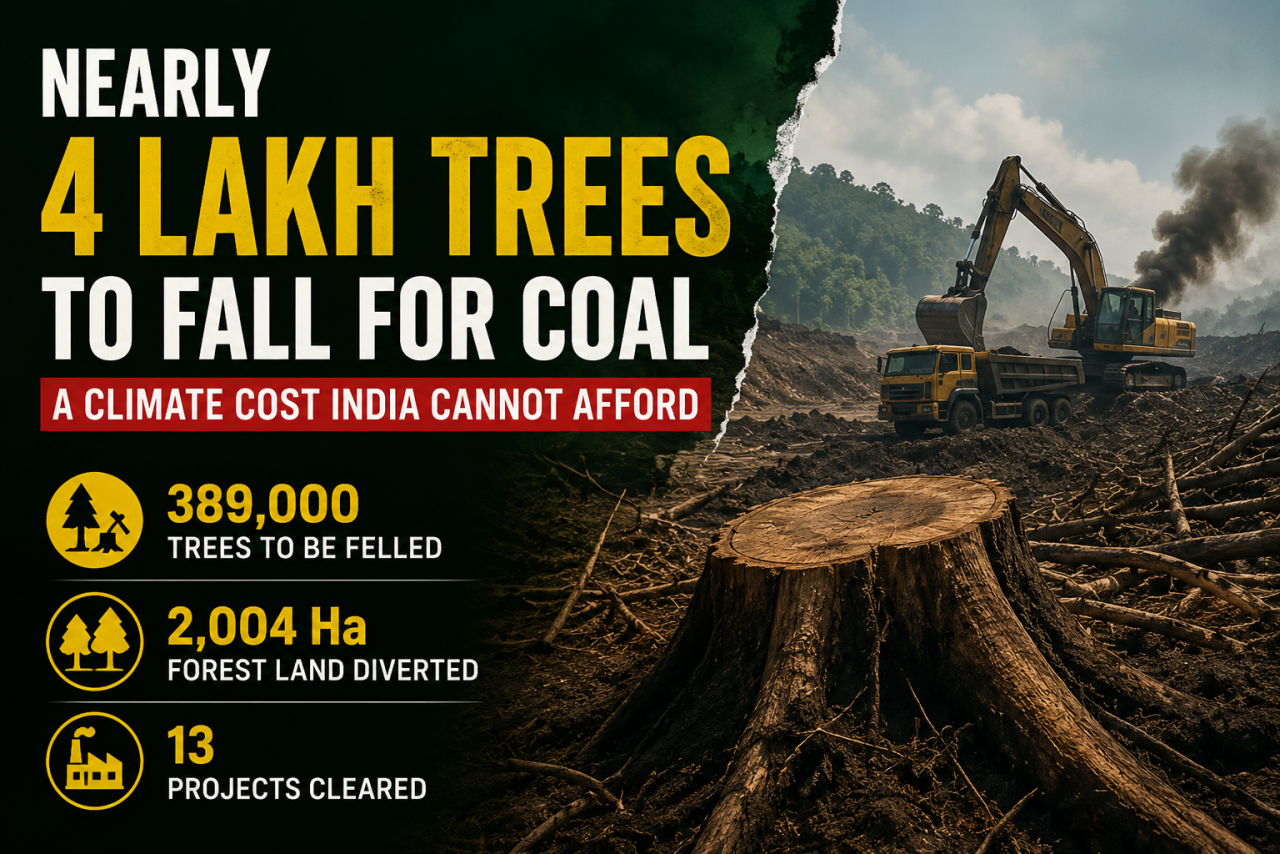
The Union government's latest forest clearance decisions have reignited concerns over the balance between development and environmental protection. The Forest Advisory Committee (FAC), in its meeting on July 6, granted Stage-I approval to three major coal mining projects that will require the felling of nearly 3.89 lakh trees and the diversion of more than 1,700 hectares of forest land.
The approvals cover the Alaknanda Coal Mine in Odisha, the Purunga Underground Coal Block, and the Pelma Open Cast Mine in Chhattisgarh. Overall, the committee recommended diverting more than 2,000 hectares of forest land across 13 projects considered during the meeting.
The decision comes at a time when India has pledged to reduce the emissions intensity of its economy and expand forest cover under its climate commitments. Against this backdrop, the scale of the proposed forest diversion raises important questions about the country's environmental priorities.
Alaknanda Mine Accounts for the Biggest Tree Loss
Among the approved projects, the Alaknanda Coal Mine in Odisha accounts for the largest environmental impact. The project alone is expected to lead to the felling of more than 3.3 lakh trees.
The Pelma Open Cast Mine in Chhattisgarh will require the removal of 52,570 trees, while the Purunga Underground Coal Block will involve cutting 4,368 trees.
These are mature forest ecosystems that have developed over decades. Environmental experts argue that such forests cannot simply be replaced through compensatory afforestation, as newly planted trees take decades to perform the ecological functions of natural forests.
What Stage-I Forest Clearance Means
Forest diversion proposals under the Forest Conservation Act follow a three-stage approval process.
Stage-I provides an in-principle approval subject to certain conditions. Stage-II clearance is granted after those conditions are fulfilled, following which a final diversion order is issued.
Although the latest approvals are only at the first stage, Stage-I clearances are rarely reversed. In practice, they are often treated as a strong indication that projects will eventually proceed.
Concerns Over Tribal Rights and Forest Communities
The Alaknanda project has also drawn attention because of its location on Scheduled Tribe land.
Prakriti Srivastava, a retired Indian Forest Service officer and former official in the Ministry of Environment, has compared the project with the controversial Sijimali bauxite mining project in Odisha, where concerns were raised over the rights of indigenous communities.
She argues that the Alaknanda project could affect both forest ecosystems and communities that depend on these forests for their livelihoods. Similar concerns have emerged repeatedly in India's mineral-rich forest regions, where mining projects often intersect with tribal lands.
Climate Commitments Versus Coal Expansion
Coal remains central to India's energy security and economic growth strategy. However, the expansion of coal mining comes with significant environmental costs.
Natural forests act as major carbon sinks while supporting biodiversity, protecting water resources, and regulating local climates. Once cleared for open-cast mining, these ecological services are difficult, and often impossible, to restore fully.
Compensatory afforestation remains the government's primary mechanism to offset forest diversion. However, several studies have questioned its effectiveness due to low survival rates, delayed implementation, and the inability of plantation forests to replicate the biodiversity and ecological value of natural forests.
Other Projects Also Receive Forest Clearance
The FAC meeting also granted approvals to several non-coal projects, including:
- Tata Steel's Gandhalpada Iron Ore Block in Odisha.
- The Surajkund Tourism Complex in Haryana.
- Three hydrocarbon exploration projects by Oil India in Tripura.
- A Jal Jeevan Mission water supply scheme in Karnataka.
Taken together, these approvals reflect a continuing emphasis on industrial and infrastructure development, even as climate change intensifies through rising temperatures, erratic monsoons, and increasingly frequent extreme weather events.
A Decision With Long-Term Consequences
Forest clearances should not be viewed as routine administrative exercises. The Forest Advisory Committee exists to carefully balance development needs with ecological sustainability.
As these projects move towards Stage-II approval, project developers and state governments will face growing scrutiny over whether they have adequately protected community rights, assessed environmental impacts, and accounted for the long-term climate costs.
India's development ambitions and climate commitments need not be mutually exclusive. But decisions involving the loss of nearly four lakh trees demand greater public transparency, rigorous environmental assessment, and a clearer demonstration that ecological costs have been fully considered before irreversible changes are made.
The Union government's latest forest clearance decisions have reignited concerns over the balance between development and environmental protection. The Forest Advisory Committee (FAC), in its meeting on July 6, granted Stage-I approval to three major coal mining projects that will require the felling of nearly 3.89 lakh trees and the diversion of more than 1,700 hectares of forest land.
The approvals cover the Alaknanda Coal Mine in Odisha, the Purunga Underground Coal Block, and the Pelma Open Cast Mine in Chhattisgarh. Overall, the committee recommended diverting more than 2,000 hectares of forest land across 13 projects considered during the meeting.
The decision comes at a time when India has pledged to reduce the emissions intensity of its economy and expand forest cover under its climate commitments. Against this backdrop, the scale of the proposed forest diversion raises important questions about the country's environmental priorities.
Alaknanda Mine Accounts for the Biggest Tree Loss
Among the approved projects, the Alaknanda Coal Mine in Odisha accounts for the largest environmental impact. The project alone is expected to lead to the felling of more than 3.3 lakh trees.
The Pelma Open Cast Mine in Chhattisgarh will require the removal of 52,570 trees, while the Purunga Underground Coal Block will involve cutting 4,368 trees.
These are mature forest ecosystems that have developed over decades. Environmental experts argue that such forests cannot simply be replaced through compensatory afforestation, as newly planted trees take decades to perform the ecological functions of natural forests.
What Stage-I Forest Clearance Means
Forest diversion proposals under the Forest Conservation Act follow a three-stage approval process.
Stage-I provides an in-principle approval subject to certain conditions. Stage-II clearance is granted after those conditions are fulfilled, following which a final diversion order is issued.
Although the latest approvals are only at the first stage, Stage-I clearances are rarely reversed. In practice, they are often treated as a strong indication that projects will eventually proceed.
Concerns Over Tribal Rights and Forest Communities
The Alaknanda project has also drawn attention because of its location on Scheduled Tribe land.
Prakriti Srivastava, a retired Indian Forest Service officer and former official in the Ministry of Environment, has compared the project with the controversial Sijimali bauxite mining project in Odisha, where concerns were raised over the rights of indigenous communities.
She argues that the Alaknanda project could affect both forest ecosystems and communities that depend on these forests for their livelihoods. Similar concerns have emerged repeatedly in India's mineral-rich forest regions, where mining projects often intersect with tribal lands.
Climate Commitments Versus Coal Expansion
Coal remains central to India's energy security and economic growth strategy. However, the expansion of coal mining comes with significant environmental costs.
Natural forests act as major carbon sinks while supporting biodiversity, protecting water resources, and regulating local climates. Once cleared for open-cast mining, these ecological services are difficult, and often impossible, to restore fully.
Compensatory afforestation remains the government's primary mechanism to offset forest diversion. However, several studies have questioned its effectiveness due to low survival rates, delayed implementation, and the inability of plantation forests to replicate the biodiversity and ecological value of natural forests.
Other Projects Also Receive Forest Clearance
The FAC meeting also granted approvals to several non-coal projects, including:
- Tata Steel's Gandhalpada Iron Ore Block in Odisha.
- The Surajkund Tourism Complex in Haryana.
- Three hydrocarbon exploration projects by Oil India in Tripura.
- A Jal Jeevan Mission water supply scheme in Karnataka.
Taken together, these approvals reflect a continuing emphasis on industrial and infrastructure development, even as climate change intensifies through rising temperatures, erratic monsoons, and increasingly frequent extreme weather events.
A Decision With Long-Term Consequences
Forest clearances should not be viewed as routine administrative exercises. The Forest Advisory Committee exists to carefully balance development needs with ecological sustainability.
As these projects move towards Stage-II approval, project developers and state governments will face growing scrutiny over whether they have adequately protected community rights, assessed environmental impacts, and accounted for the long-term climate costs.
India's development ambitions and climate commitments need not be mutually exclusive. But decisions involving the loss of nearly four lakh trees demand greater public transparency, rigorous environmental assessment, and a clearer demonstration that ecological costs have been fully considered before irreversible changes are made.


























Leave a Comment