
Delhi's latest sewage assessment has uncovered a shocking reality: one drain alone now releases more wastewater than the city's entire treatment capacity, raising fresh questions about the future of the Yamuna cleanup.
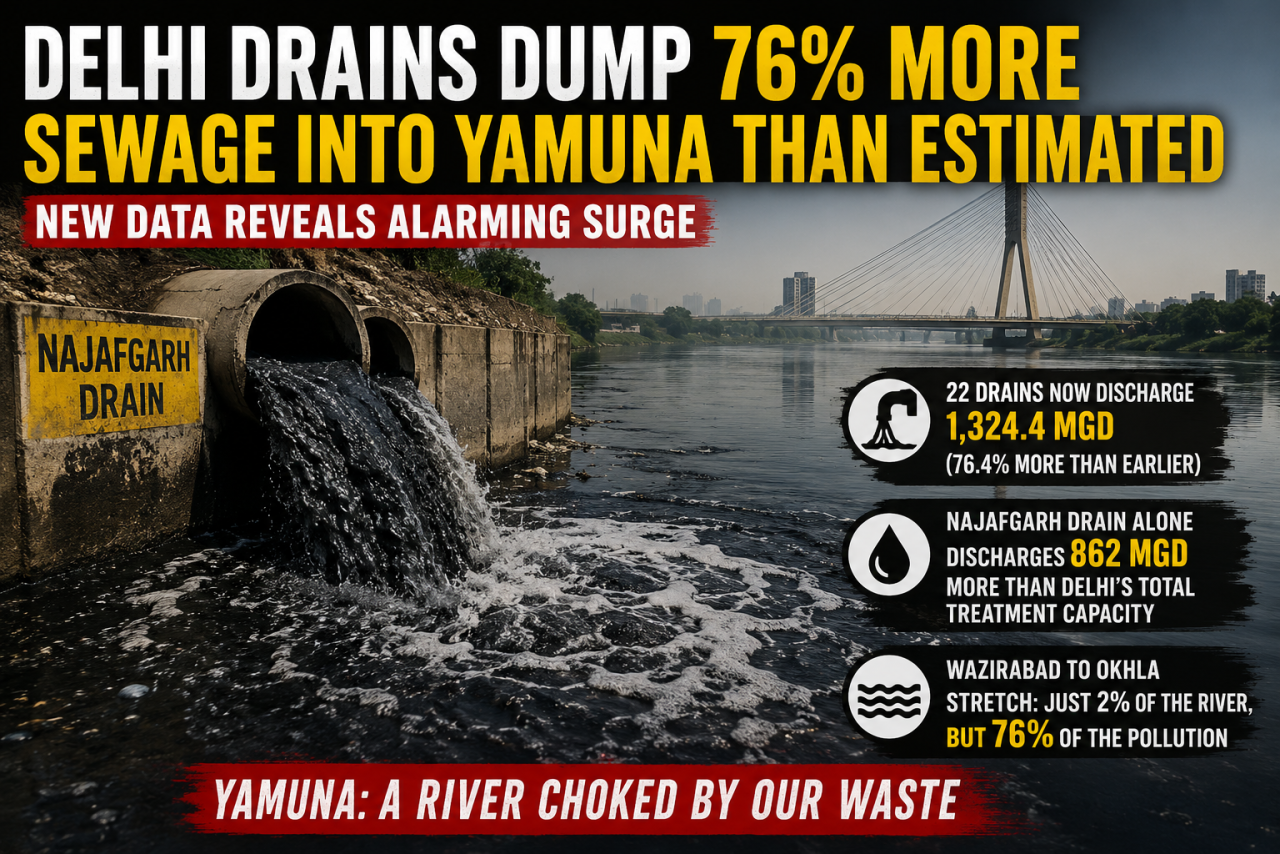
Delhi's main drains are releasing far more untreated wastewater into the Yamuna than previously estimated, according to a fresh assessment by the Delhi Jal Board. The 22 drains that discharge into the river across the capital now carry an estimated 1,324.4 million gallons per day (MGD) of wastewater, a 76.4 percent increase from the 750.4 MGD estimated in May 2025.
The revised figures are based on reassessment surveys and volumetric studies conducted over the past year. The findings have forced city authorities to revisit the baseline data used for Yamuna rejuvenation projects.
Najafgarh Drain Alone Exceeds Delhi's Treatment Capacity
The Najafgarh drain, the largest contributor to Yamuna pollution, showed the biggest increase. Earlier estimated to carry 452.34 MGD, it is now found to be discharging around 862 MGD, an increase of nearly 90 percent.
The figure is significant because it exceeds the combined treatment capacity of all 37 sewage treatment plants (STPs) in Delhi, which together can process 814.226 MGD. Even if every STP operated at full capacity, it would still fall short of treating the wastewater flowing through this single drain.
Several Other Drains Show Sharp Increase
The reassessment also recorded substantial increases across several major drains.
- Abul Fazal drain: Up 433 percent to 6.61 MGD
- Barapullah drain: Up 374 percent to 151.6 MGD
- Delhi Gate drain: Up 221.51 percent to 86.68 MGD
- Sen Nursing Home drain: Up 177.36 percent to 26.35 MGD
- Shahdara drain: Up 53.65 percent to 160.82 MGD
Officials attribute these revisions to years of unaccounted urban growth and sewage generation that had not been accurately measured before the latest survey.
A Small Stretch Carries Most of the Pollution
The Yamuna stretch between Wazirabad and Okhla is only 22 kilometres, roughly 2 percent of the river's total length. Yet, according to the 2018 Yamuna Monitoring Committee report, this section accounts for 76 percent of the river's total pollution load.
With nearly one major drain discharging into the river every kilometre, this short stretch has effectively become an open sewage channel before the water reaches the Okhla barrage.
Pollution Visible Along the River
The impact is visible near Signature Bridge, where the Najafgarh drain, also known as the Sahibi River, joins the Yamuna. The river's water changes almost immediately from brown to thick black sludge after the confluence.
These drains carry not only Delhi's sewage but also untreated wastewater from parts of Haryana and Uttar Pradesh, further increasing the pollution entering the river.
Cleanup Plans Face a Bigger Challenge
The revised estimates have major implications for the government's Yamuna cleanup programme. Existing rejuvenation plans, sewage treatment projects and pollution-control targets were based on much lower wastewater estimates.
With the actual sewage load now nearly double earlier assumptions, future infrastructure will need to be significantly expanded to match reality. Until treatment capacity catches up with the revised figures, the drains will continue to dominate the Yamuna's condition despite ongoing restoration efforts.
For a river that once sustained thriving ecosystems and communities along its banks, the new data underscores the enormous challenge that still lies ahead in restoring the Yamuna.
Delhi's main drains are releasing far more untreated wastewater into the Yamuna than previously estimated, according to a fresh assessment by the Delhi Jal Board. The 22 drains that discharge into the river across the capital now carry an estimated 1,324.4 million gallons per day (MGD) of wastewater, a 76.4 percent increase from the 750.4 MGD estimated in May 2025.
The revised figures are based on reassessment surveys and volumetric studies conducted over the past year. The findings have forced city authorities to revisit the baseline data used for Yamuna rejuvenation projects.
Najafgarh Drain Alone Exceeds Delhi's Treatment Capacity
The Najafgarh drain, the largest contributor to Yamuna pollution, showed the biggest increase. Earlier estimated to carry 452.34 MGD, it is now found to be discharging around 862 MGD, an increase of nearly 90 percent.
The figure is significant because it exceeds the combined treatment capacity of all 37 sewage treatment plants (STPs) in Delhi, which together can process 814.226 MGD. Even if every STP operated at full capacity, it would still fall short of treating the wastewater flowing through this single drain.
Several Other Drains Show Sharp Increase
The reassessment also recorded substantial increases across several major drains.
- Abul Fazal drain: Up 433 percent to 6.61 MGD
- Barapullah drain: Up 374 percent to 151.6 MGD
- Delhi Gate drain: Up 221.51 percent to 86.68 MGD
- Sen Nursing Home drain: Up 177.36 percent to 26.35 MGD
- Shahdara drain: Up 53.65 percent to 160.82 MGD
Officials attribute these revisions to years of unaccounted urban growth and sewage generation that had not been accurately measured before the latest survey.
A Small Stretch Carries Most of the Pollution
The Yamuna stretch between Wazirabad and Okhla is only 22 kilometres, roughly 2 percent of the river's total length. Yet, according to the 2018 Yamuna Monitoring Committee report, this section accounts for 76 percent of the river's total pollution load.
With nearly one major drain discharging into the river every kilometre, this short stretch has effectively become an open sewage channel before the water reaches the Okhla barrage.
Pollution Visible Along the River
The impact is visible near Signature Bridge, where the Najafgarh drain, also known as the Sahibi River, joins the Yamuna. The river's water changes almost immediately from brown to thick black sludge after the confluence.
These drains carry not only Delhi's sewage but also untreated wastewater from parts of Haryana and Uttar Pradesh, further increasing the pollution entering the river.
Cleanup Plans Face a Bigger Challenge
The revised estimates have major implications for the government's Yamuna cleanup programme. Existing rejuvenation plans, sewage treatment projects and pollution-control targets were based on much lower wastewater estimates.
With the actual sewage load now nearly double earlier assumptions, future infrastructure will need to be significantly expanded to match reality. Until treatment capacity catches up with the revised figures, the drains will continue to dominate the Yamuna's condition despite ongoing restoration efforts.
For a river that once sustained thriving ecosystems and communities along its banks, the new data underscores the enormous challenge that still lies ahead in restoring the Yamuna.
























Leave a Comment