
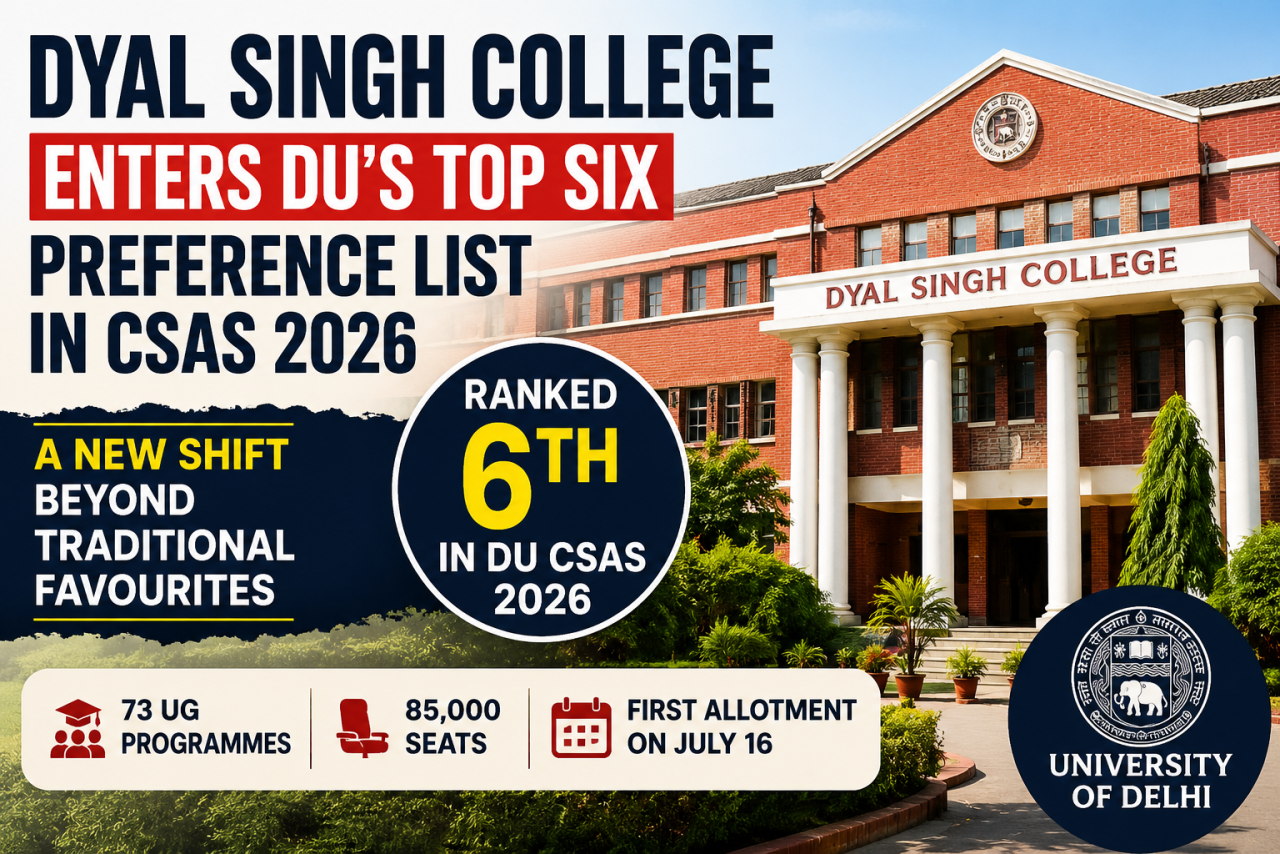
Dyal Singh College's rise into DU's top six preferences signals a changing admission landscape where students increasingly value academic quality, campus facilities and career outcomes over legacy reputation.
Dyal Singh College has entered the top six most preferred colleges in Delhi University's Common Seat Allocation System (CSAS) for 2026, marking the first time the institution has featured in this bracket. The simulated rank data released by Delhi University on July 12 places Dyal Singh College at the sixth position, behind Kirori Mal College, Hansraj College, Hindu College, Sri Venkateswara College and Ramjas College. Notably, Shri Ram College of Commerce (SRCC), long considered the default first choice for commerce aspirants, has slipped out of the top five preferences this year.
The CSAS UG 2026 admission cycle began on June 27, with preference filling opening on July 3 and closing on July 11. Delhi University offered a brief window between July 12 and July 13 for candidates to review and revise their choices based on the simulated ranks. The first seat allotment list is scheduled for release on July 16, after which document verification will take place between July 16 and July 20. This year's cycle covers 73 undergraduate programmes and around 85,000 seats across the university's constituent colleges.
A Shift in Student Priorities
Dyal Singh College Principal VK Paliwal attributes the shift to a change in how students and parents evaluate colleges. He notes that the earlier challenge for the college was limited public recognition rather than a shortfall in academic or infrastructural quality. That perception, he says, has changed as students and their families have begun paying closer attention to campus facilities and educational standards rather than relying solely on legacy reputation.
Paliwal also credits the sustained effort of the college faculty for this turnaround, describing the growing preference for Dyal Singh as recognition of work that had been building quietly over previous years.
The principal frames the college's underlying approach as one that goes beyond academics, with a deliberate focus on the overall personality development of students alongside classroom learning. This includes strengthening extracurricular activities and administrative support systems, an approach he says has guided the college's growth strategy consistently rather than emerging as a response to this year's admission trends.
College Profile and Performance
Established in 1959, Dyal Singh College is a constituent college of the University of Delhi, located on Lodhi Road in central Delhi. The college holds an NAAC A-grade accreditation and was ranked 36th in the overall category of the NIRF 2025 rankings.
Its placement outcomes have also shown improvement, with NIRF data indicating a rise in median UG placement packages, alongside consistent numbers of students placed through the college's placement cell each year. The college offers undergraduate and postgraduate programmes across the arts, commerce and science streams, with its BCom (Hons) and BCom programmes recording some of the highest CUET-based cutoffs on campus.
Beyond Legacy Reputation
The broader pattern emerging from this year's CSAS simulated data suggests aspirants are no longer concentrating their top preferences around a fixed set of institutions such as SRCC, St Stephen's College and Miranda House, which have historically dominated the first few preference slots.
Instead, colleges such as Dyal Singh appear to be benefiting from a more distributed pattern of preferences, with students weighing facilities, faculty strength and extracurricular ecosystems alongside a college's traditional standing. This diversification is consistent with a wider trend across CSAS cycles in recent years, where students are submitting a larger number of preferences overall and factoring in course-specific strengths of individual colleges rather than college prestige alone.
For a system as competitive as DU admissions, where lakhs of aspirants compete for a limited number of seats each year, this kind of shift carries weight beyond a single college's admission numbers. It reflects a gradual recalibration in how the university's ecosystem is perceived, with mid-tier and rising colleges gaining ground as students look more closely at outcomes rather than legacy alone.
Whether this trend continues in subsequent seat allotment rounds, or moderates once actual allotments and cutoffs are finalised, will become clearer once Delhi University releases the Phase 1 allotment list on July 16. For colleges such as Dyal Singh, though, the current preference data already marks a notable shift in how they are viewed within one of India's most closely watched admission cycles.
Dyal Singh College has entered the top six most preferred colleges in Delhi University's Common Seat Allocation System (CSAS) for 2026, marking the first time the institution has featured in this bracket. The simulated rank data released by Delhi University on July 12 places Dyal Singh College at the sixth position, behind Kirori Mal College, Hansraj College, Hindu College, Sri Venkateswara College and Ramjas College. Notably, Shri Ram College of Commerce (SRCC), long considered the default first choice for commerce aspirants, has slipped out of the top five preferences this year.
The CSAS UG 2026 admission cycle began on June 27, with preference filling opening on July 3 and closing on July 11. Delhi University offered a brief window between July 12 and July 13 for candidates to review and revise their choices based on the simulated ranks. The first seat allotment list is scheduled for release on July 16, after which document verification will take place between July 16 and July 20. This year's cycle covers 73 undergraduate programmes and around 85,000 seats across the university's constituent colleges.
A Shift in Student Priorities
Dyal Singh College Principal VK Paliwal attributes the shift to a change in how students and parents evaluate colleges. He notes that the earlier challenge for the college was limited public recognition rather than a shortfall in academic or infrastructural quality. That perception, he says, has changed as students and their families have begun paying closer attention to campus facilities and educational standards rather than relying solely on legacy reputation.
Paliwal also credits the sustained effort of the college faculty for this turnaround, describing the growing preference for Dyal Singh as recognition of work that had been building quietly over previous years.
The principal frames the college's underlying approach as one that goes beyond academics, with a deliberate focus on the overall personality development of students alongside classroom learning. This includes strengthening extracurricular activities and administrative support systems, an approach he says has guided the college's growth strategy consistently rather than emerging as a response to this year's admission trends.
College Profile and Performance
Established in 1959, Dyal Singh College is a constituent college of the University of Delhi, located on Lodhi Road in central Delhi. The college holds an NAAC A-grade accreditation and was ranked 36th in the overall category of the NIRF 2025 rankings.
Its placement outcomes have also shown improvement, with NIRF data indicating a rise in median UG placement packages, alongside consistent numbers of students placed through the college's placement cell each year. The college offers undergraduate and postgraduate programmes across the arts, commerce and science streams, with its BCom (Hons) and BCom programmes recording some of the highest CUET-based cutoffs on campus.
Beyond Legacy Reputation
The broader pattern emerging from this year's CSAS simulated data suggests aspirants are no longer concentrating their top preferences around a fixed set of institutions such as SRCC, St Stephen's College and Miranda House, which have historically dominated the first few preference slots.
Instead, colleges such as Dyal Singh appear to be benefiting from a more distributed pattern of preferences, with students weighing facilities, faculty strength and extracurricular ecosystems alongside a college's traditional standing. This diversification is consistent with a wider trend across CSAS cycles in recent years, where students are submitting a larger number of preferences overall and factoring in course-specific strengths of individual colleges rather than college prestige alone.
For a system as competitive as DU admissions, where lakhs of aspirants compete for a limited number of seats each year, this kind of shift carries weight beyond a single college's admission numbers. It reflects a gradual recalibration in how the university's ecosystem is perceived, with mid-tier and rising colleges gaining ground as students look more closely at outcomes rather than legacy alone.
Whether this trend continues in subsequent seat allotment rounds, or moderates once actual allotments and cutoffs are finalised, will become clearer once Delhi University releases the Phase 1 allotment list on July 16. For colleges such as Dyal Singh, though, the current preference data already marks a notable shift in how they are viewed within one of India's most closely watched admission cycles.























Leave a Comment