
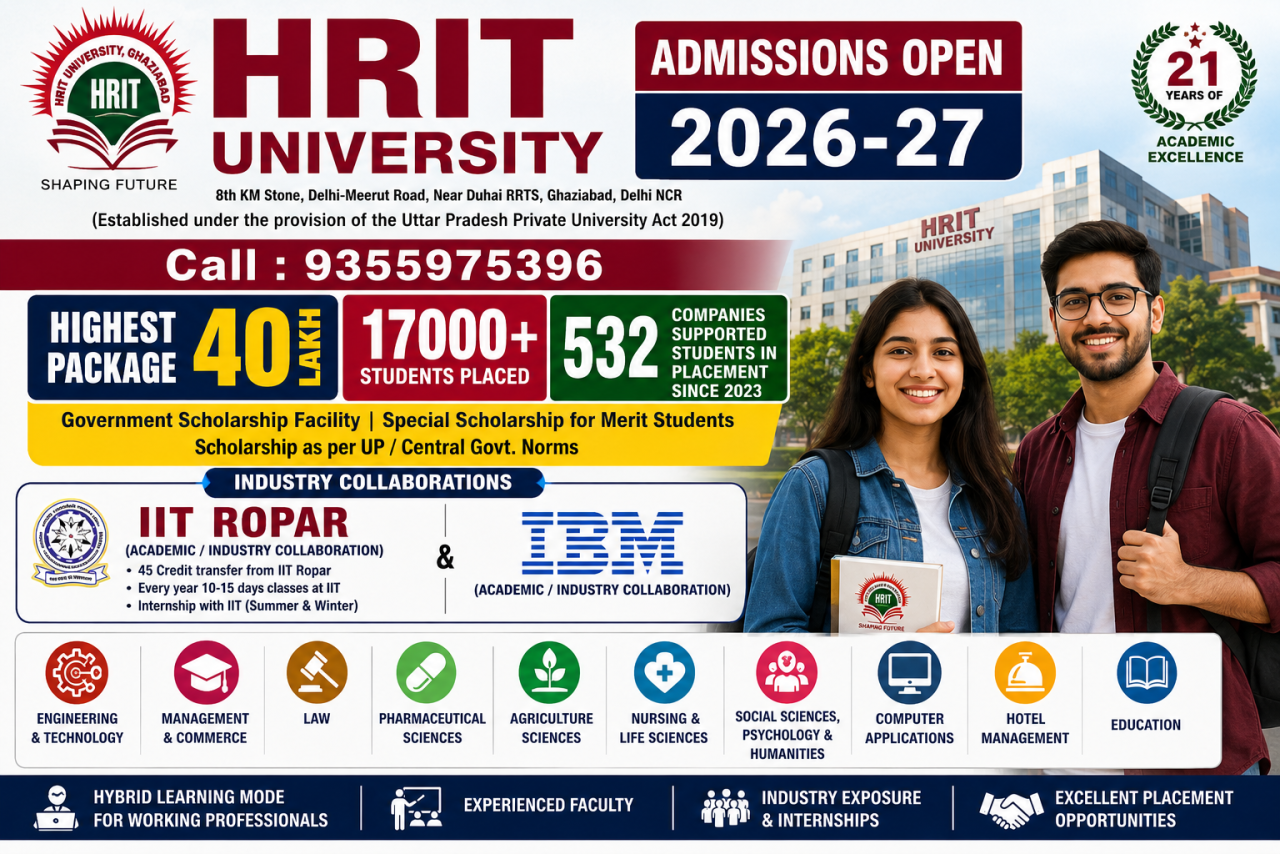
Can industry collaborations and skill-based education improve graduate employability? HRIT University believes the answer lies in combining academic learning with partnerships, scholarships, and career-oriented programs.
As India's higher education sector becomes increasingly competitive, universities are under pressure to offer more than just academic degrees. Students and parents today seek institutions that can provide industry exposure, skill development, internships, and meaningful employment opportunities. Against this backdrop, HRIT University in Ghaziabad has launched its admissions campaign for the 2026–27 academic session, highlighting a combination of industry collaborations, scholarship support, and a wide range of professional courses.
Located on Delhi-Meerut Road near the Duhai RRTS station in the National Capital Region (NCR), HRIT University has positioned itself as a multidisciplinary institution catering to students from diverse academic backgrounds. Established under the Uttar Pradesh Private University Act, 2019, the university is promoting a model that combines classroom learning with practical industry engagement.
Focus on Employability
One of the key highlights of the university's admission announcement is its emphasis on placements and career readiness. According to the information released by the institution, HRIT reports a highest package of ₹40 lakh and claims to have facilitated placements for more than 17,000 students. The university also states that over 532 companies have supported its students in placements since 2023.
In an era where employability remains a major concern among graduates, such figures are likely to attract attention from prospective students. Universities across India are increasingly being evaluated not only on academic standards but also on their ability to connect students with employment opportunities.
The institution has also introduced special provisions for working professionals through a hybrid learning mode, reflecting the growing demand for flexible education options among employed individuals seeking higher qualifications or career advancement.
Industry Collaborations Take Center Stage
Perhaps the most notable aspect of the university's promotional campaign is its emphasis on industry-academia partnerships. HRIT highlights collaborations with IIT Ropar and IBM, aiming to bridge the gap between theoretical learning and practical industry requirements.
The IIT Ropar collaboration reportedly offers students access to academic and industrial training opportunities. The university states that eligible students can earn up to 45 credits through IIT Ropar, attend periodic classes conducted by IIT faculty, and participate in internship programs.
Similarly, the association with IBM is presented as a means to expose students to industry-relevant technologies and professional practices. Such collaborations have become increasingly important as employers seek graduates with practical skills in emerging fields such as artificial intelligence, cloud computing, and data science.
Strong Presence in Engineering and Technology
Engineering remains one of the university's flagship offerings. The Faculty of Engineering and Technology provides B.Tech, M.Tech, and Diploma programs across multiple disciplines.
Courses include Computer Science and Engineering (CSE), Data Science and Cloud Computing, Artificial Intelligence and Machine Learning, Civil Engineering, Mechanical Engineering, Electronics and Communication Engineering, and Electrical Engineering. These programs reflect current industry trends, particularly the growing demand for expertise in digital technologies and automation.
The inclusion of diploma programs also provides alternative pathways for students seeking technical education and skill-based careers.
Expanding Beyond Traditional Disciplines
While engineering often dominates admission campaigns, HRIT University has adopted a broader multidisciplinary approach. The institution offers programs through several specialized faculties, including:
Legal Studies
Students can pursue BA-LL.B, BBA-LL.B, LL.B, and LL.M programs, catering to those interested in legal education and judicial careers.
Management and Commerce
The university offers BBA, BBA (Aviation), MBA, B.Com (Hons.), and M.Com (Hons.), targeting students interested in business, entrepreneurship, finance, and management.
Pharmaceutical Sciences
Courses such as D.Pharm, B.Pharm, and M.Pharm are available, with specialization areas including Pharmaceutical Chemistry, Pharmaceutics, Pharmacology, and Pharmacognosy.
Computer Applications
Programs like BCA, B.Sc. (Computer Science), and MCA address the growing demand for software and IT professionals.
Agriculture Sciences
Agriculture remains a significant employment sector in India. HRIT offers B.Sc. (Hons.) Agriculture and Diploma in Agriculture programs aimed at combining scientific knowledge with modern farming practices.
Growing Emphasis on Healthcare and Life Sciences
The healthcare sector continues to expand rapidly, creating opportunities for skilled professionals. HRIT University's Life Sciences and Nursing faculties provide programs in Nursing, Microbiology, Biotechnology, Forensic Science, Nutrition and Dietetics, Hospital Administration, and Health Information Management.
The availability of both undergraduate and postgraduate options reflects the increasing demand for trained healthcare professionals and researchers.
Social Sciences, Psychology, and Education
Another notable feature of the university's academic portfolio is its investment in social sciences and psychology. Programs are available in English, Economics, Psychology, Political Science, Sociology, Hindi, and History.
Specialized psychology courses focus on Clinical Psychology, Industrial and Organizational Psychology, and Guidance and Counselling. The university also offers postgraduate diplomas in counselling, a field gaining importance amid growing awareness of mental health and emotional well-being.
Teacher training programs such as BA-B.Ed and B.Sc-B.Ed further strengthen the institution's presence in the education sector.
Scholarships and Accessibility
To attract talented students from different backgrounds, the university has announced government scholarship support in accordance with Uttar Pradesh and Central Government norms. Additionally, Chancellor, Merit, and Special Scholarships are expected to be awarded to eligible candidates.
Scholarships have become a critical factor in higher education decisions, especially as rising educational costs continue to challenge many families.
A Comprehensive Academic Ecosystem
The breadth of courses offered by HRIT University reflects a larger trend within Indian higher education: the shift toward multidisciplinary learning. From engineering and law to agriculture, nursing, psychology, and hotel management, the institution is seeking to create an academic ecosystem capable of serving diverse career aspirations.
As admissions for the 2026–27 academic session begin, HRIT University is presenting itself as a career-oriented institution that combines academic learning with industry engagement. Whether these initiatives translate into long-term success for students will ultimately depend on the quality of implementation, industry relevance, and sustained academic excellence. However, the university's focus on collaboration, employability, and multidisciplinary education reflects the evolving expectations of today's higher education landscape.
As India's higher education sector becomes increasingly competitive, universities are under pressure to offer more than just academic degrees. Students and parents today seek institutions that can provide industry exposure, skill development, internships, and meaningful employment opportunities. Against this backdrop, HRIT University in Ghaziabad has launched its admissions campaign for the 2026–27 academic session, highlighting a combination of industry collaborations, scholarship support, and a wide range of professional courses.
Located on Delhi-Meerut Road near the Duhai RRTS station in the National Capital Region (NCR), HRIT University has positioned itself as a multidisciplinary institution catering to students from diverse academic backgrounds. Established under the Uttar Pradesh Private University Act, 2019, the university is promoting a model that combines classroom learning with practical industry engagement.
Focus on Employability
One of the key highlights of the university's admission announcement is its emphasis on placements and career readiness. According to the information released by the institution, HRIT reports a highest package of ₹40 lakh and claims to have facilitated placements for more than 17,000 students. The university also states that over 532 companies have supported its students in placements since 2023.
In an era where employability remains a major concern among graduates, such figures are likely to attract attention from prospective students. Universities across India are increasingly being evaluated not only on academic standards but also on their ability to connect students with employment opportunities.
The institution has also introduced special provisions for working professionals through a hybrid learning mode, reflecting the growing demand for flexible education options among employed individuals seeking higher qualifications or career advancement.
Industry Collaborations Take Center Stage
Perhaps the most notable aspect of the university's promotional campaign is its emphasis on industry-academia partnerships. HRIT highlights collaborations with IIT Ropar and IBM, aiming to bridge the gap between theoretical learning and practical industry requirements.
The IIT Ropar collaboration reportedly offers students access to academic and industrial training opportunities. The university states that eligible students can earn up to 45 credits through IIT Ropar, attend periodic classes conducted by IIT faculty, and participate in internship programs.
Similarly, the association with IBM is presented as a means to expose students to industry-relevant technologies and professional practices. Such collaborations have become increasingly important as employers seek graduates with practical skills in emerging fields such as artificial intelligence, cloud computing, and data science.
Strong Presence in Engineering and Technology
Engineering remains one of the university's flagship offerings. The Faculty of Engineering and Technology provides B.Tech, M.Tech, and Diploma programs across multiple disciplines.
Courses include Computer Science and Engineering (CSE), Data Science and Cloud Computing, Artificial Intelligence and Machine Learning, Civil Engineering, Mechanical Engineering, Electronics and Communication Engineering, and Electrical Engineering. These programs reflect current industry trends, particularly the growing demand for expertise in digital technologies and automation.
The inclusion of diploma programs also provides alternative pathways for students seeking technical education and skill-based careers.
Expanding Beyond Traditional Disciplines
While engineering often dominates admission campaigns, HRIT University has adopted a broader multidisciplinary approach. The institution offers programs through several specialized faculties, including:
Legal Studies
Students can pursue BA-LL.B, BBA-LL.B, LL.B, and LL.M programs, catering to those interested in legal education and judicial careers.
Management and Commerce
The university offers BBA, BBA (Aviation), MBA, B.Com (Hons.), and M.Com (Hons.), targeting students interested in business, entrepreneurship, finance, and management.
Pharmaceutical Sciences
Courses such as D.Pharm, B.Pharm, and M.Pharm are available, with specialization areas including Pharmaceutical Chemistry, Pharmaceutics, Pharmacology, and Pharmacognosy.
Computer Applications
Programs like BCA, B.Sc. (Computer Science), and MCA address the growing demand for software and IT professionals.
Agriculture Sciences
Agriculture remains a significant employment sector in India. HRIT offers B.Sc. (Hons.) Agriculture and Diploma in Agriculture programs aimed at combining scientific knowledge with modern farming practices.
Growing Emphasis on Healthcare and Life Sciences
The healthcare sector continues to expand rapidly, creating opportunities for skilled professionals. HRIT University's Life Sciences and Nursing faculties provide programs in Nursing, Microbiology, Biotechnology, Forensic Science, Nutrition and Dietetics, Hospital Administration, and Health Information Management.
The availability of both undergraduate and postgraduate options reflects the increasing demand for trained healthcare professionals and researchers.
Social Sciences, Psychology, and Education
Another notable feature of the university's academic portfolio is its investment in social sciences and psychology. Programs are available in English, Economics, Psychology, Political Science, Sociology, Hindi, and History.
Specialized psychology courses focus on Clinical Psychology, Industrial and Organizational Psychology, and Guidance and Counselling. The university also offers postgraduate diplomas in counselling, a field gaining importance amid growing awareness of mental health and emotional well-being.
Teacher training programs such as BA-B.Ed and B.Sc-B.Ed further strengthen the institution's presence in the education sector.
Scholarships and Accessibility
To attract talented students from different backgrounds, the university has announced government scholarship support in accordance with Uttar Pradesh and Central Government norms. Additionally, Chancellor, Merit, and Special Scholarships are expected to be awarded to eligible candidates.
Scholarships have become a critical factor in higher education decisions, especially as rising educational costs continue to challenge many families.
A Comprehensive Academic Ecosystem
The breadth of courses offered by HRIT University reflects a larger trend within Indian higher education: the shift toward multidisciplinary learning. From engineering and law to agriculture, nursing, psychology, and hotel management, the institution is seeking to create an academic ecosystem capable of serving diverse career aspirations.
As admissions for the 2026–27 academic session begin, HRIT University is presenting itself as a career-oriented institution that combines academic learning with industry engagement. Whether these initiatives translate into long-term success for students will ultimately depend on the quality of implementation, industry relevance, and sustained academic excellence. However, the university's focus on collaboration, employability, and multidisciplinary education reflects the evolving expectations of today's higher education landscape.






















Leave a Comment