

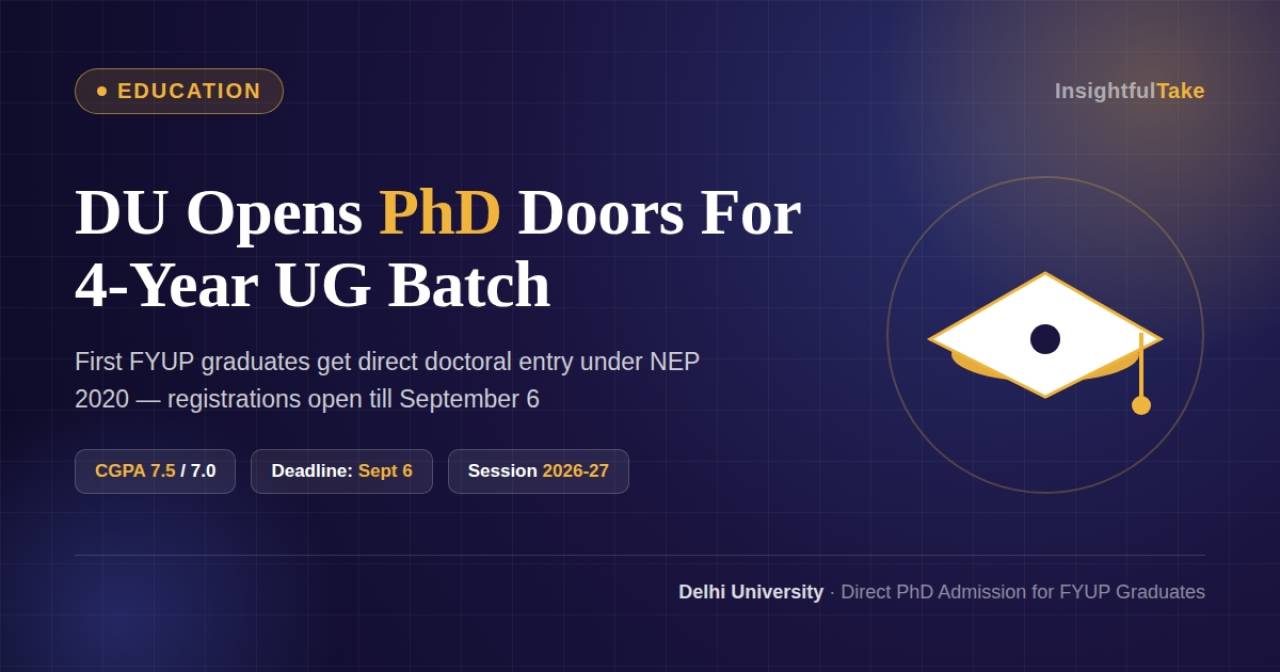
No master's degree? No problem. Delhi University now allows eligible four-year undergraduate students to apply directly for PhD programmes, marking a major shift in India's higher education system.
The University of Delhi (DU) has approved direct admission to its PhD programmes for students who complete a four-year undergraduate degree with a research component. The move brings the university's admission rules in line with the University Grants Commission (UGC) regulations introduced under the National Education Policy (NEP) 2020 and marks a significant shift in India's higher education landscape.
The decision allows eligible students to move straight from an undergraduate programme into doctoral research, eliminating the need for a master's degree in certain cases.
A Faster Route to Doctoral Research
Until now, students generally had to complete a three-year bachelor's degree followed by a two-year master's programme, or in some cases an MPhil, before becoming eligible for a PhD.
Under the revised framework, students who complete the Four-Year Undergraduate Programme (FYUP) with a research component can apply directly for doctoral studies, provided they meet the prescribed academic and admission requirements.
The change is expected to reduce the time required to begin research careers by one to two years. It also gives academically strong students an opportunity to enter research, higher education, and specialised sectors much earlier than under the previous system.
Eligibility Criteria for Direct PhD Admission
Students seeking direct admission to a PhD programme must satisfy the eligibility conditions laid down by the UGC and adopted by Delhi University.
- Academic Performance: Candidates must complete a four-year, eight-semester bachelor's degree with at least 75 percent aggregate marks or an equivalent 7.5 CGPA.
- Relaxation for Reserved Categories: A 5 percent relaxation in the minimum marks requirement is available for candidates belonging to SC, ST, OBC (Non-Creamy Layer), EWS, and Persons with Disabilities categories.
- National-Level Entrance Test: Applicants must qualify in a recognised national eligibility examination such as UGC-NET or CSIR-NET.
- Interview and Research Proposal: Shortlisted candidates will have to appear before the Departmental Research Committee for an interview and present a research proposal.
Some Questions Still Remain
Although the policy has received formal approval, a few important aspects are yet to be clarified.
The university has not specified whether the revised admission norms will come into effect from the 2026-27 academic session or be implemented in a later admission cycle.
Members of the Academic Council have also raised concerns about how reservation policies will be applied when candidates with four-year undergraduate degrees are considered alongside applicants holding master's degrees.
Another issue awaiting clarification is the allocation of research fellowships, particularly for students who enter PhD programmes directly after graduation without qualifying for a Junior Research Fellowship (JRF).
A Major Shift in India's Higher Education System
The Four-Year Undergraduate Programme introduced under the Undergraduate Curriculum Framework (UGCF) 2022 was designed to embed research training, dissertations, internships, and skill-based learning into undergraduate education. The objective is to prepare students for advanced research much earlier in their academic journey.
The new admission pathway gives students greater flexibility. They can graduate after three years with a bachelor's degree, continue into the fourth year to earn an honours degree with research, or use that qualification as a gateway to doctoral studies.
As Delhi University updates its PhD admission framework, the move is likely to influence other central and state universities that are implementing NEP 2020 reforms.
The University of Delhi (DU) has approved direct admission to its PhD programmes for students who complete a four-year undergraduate degree with a research component. The move brings the university's admission rules in line with the University Grants Commission (UGC) regulations introduced under the National Education Policy (NEP) 2020 and marks a significant shift in India's higher education landscape.
The decision allows eligible students to move straight from an undergraduate programme into doctoral research, eliminating the need for a master's degree in certain cases.
A Faster Route to Doctoral Research
Until now, students generally had to complete a three-year bachelor's degree followed by a two-year master's programme, or in some cases an MPhil, before becoming eligible for a PhD.
Under the revised framework, students who complete the Four-Year Undergraduate Programme (FYUP) with a research component can apply directly for doctoral studies, provided they meet the prescribed academic and admission requirements.
The change is expected to reduce the time required to begin research careers by one to two years. It also gives academically strong students an opportunity to enter research, higher education, and specialised sectors much earlier than under the previous system.
Eligibility Criteria for Direct PhD Admission
Students seeking direct admission to a PhD programme must satisfy the eligibility conditions laid down by the UGC and adopted by Delhi University.
- Academic Performance: Candidates must complete a four-year, eight-semester bachelor's degree with at least 75 percent aggregate marks or an equivalent 7.5 CGPA.
- Relaxation for Reserved Categories: A 5 percent relaxation in the minimum marks requirement is available for candidates belonging to SC, ST, OBC (Non-Creamy Layer), EWS, and Persons with Disabilities categories.
- National-Level Entrance Test: Applicants must qualify in a recognised national eligibility examination such as UGC-NET or CSIR-NET.
- Interview and Research Proposal: Shortlisted candidates will have to appear before the Departmental Research Committee for an interview and present a research proposal.
Some Questions Still Remain
Although the policy has received formal approval, a few important aspects are yet to be clarified.
The university has not specified whether the revised admission norms will come into effect from the 2026-27 academic session or be implemented in a later admission cycle.
Members of the Academic Council have also raised concerns about how reservation policies will be applied when candidates with four-year undergraduate degrees are considered alongside applicants holding master's degrees.
Another issue awaiting clarification is the allocation of research fellowships, particularly for students who enter PhD programmes directly after graduation without qualifying for a Junior Research Fellowship (JRF).
A Major Shift in India's Higher Education System
The Four-Year Undergraduate Programme introduced under the Undergraduate Curriculum Framework (UGCF) 2022 was designed to embed research training, dissertations, internships, and skill-based learning into undergraduate education. The objective is to prepare students for advanced research much earlier in their academic journey.
The new admission pathway gives students greater flexibility. They can graduate after three years with a bachelor's degree, continue into the fourth year to earn an honours degree with research, or use that qualification as a gateway to doctoral studies.
As Delhi University updates its PhD admission framework, the move is likely to influence other central and state universities that are implementing NEP 2020 reforms.























Leave a Comment