
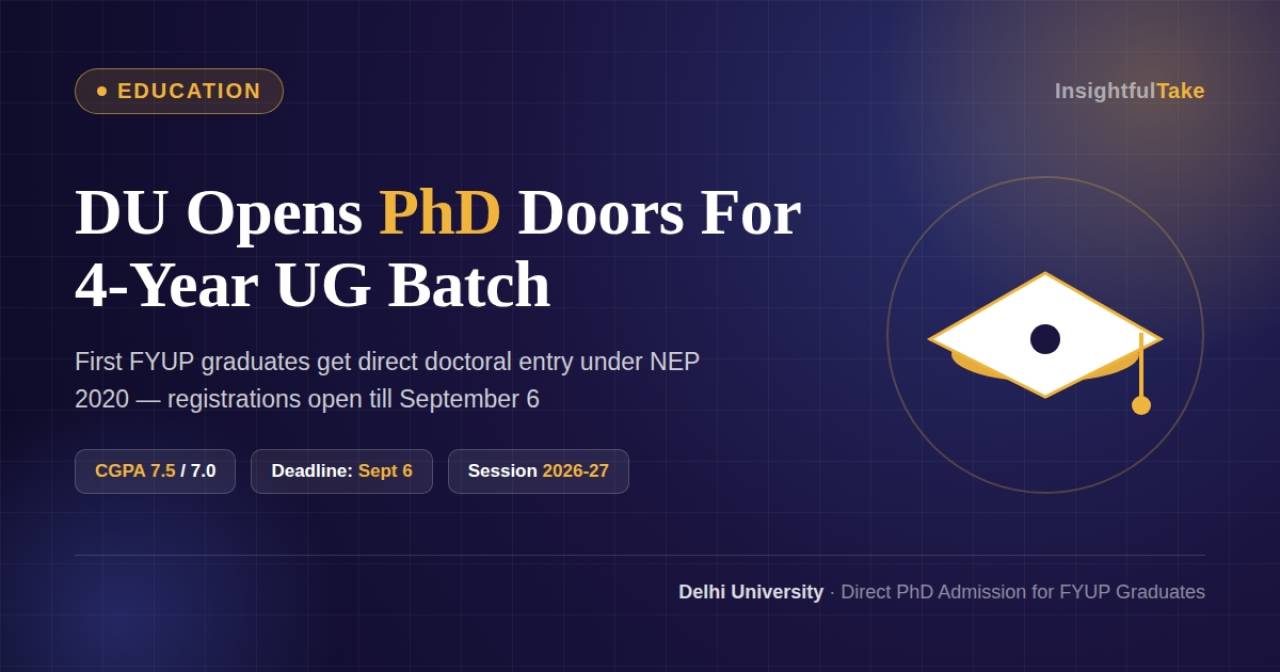
Four years of undergraduate study could now take DU students straight to a PhD.
Delhi University has opened a new academic pathway for its students. For the first time, graduates from its four-year undergraduate programme can apply directly for PhD admission without completing a conventional postgraduate degree.
The University of Delhi has opened a new route into doctoral education, and for thousands of students, the change could prove significant.
For the first time, students who completed the university's four-year undergraduate programme (FYUP) can apply directly for PhD admission, bypassing the traditional postgraduate stage. The move marks a notable shift in the way doctoral education is structured at one of India's largest and most closely watched universities.
For students interested in research and academia, it could mean reaching doctoral study as much as two years earlier than under the conventional academic route.
What Has Changed
Delhi University released the admission schedule for the special PhD admission window on Thursday. Registration is open from August 27 to September 6, 2026.
The opportunity is currently limited to students from DU's first FYUP batch, who were admitted in 2022 and are graduating in 2026. The provision applies only to the 2026-27 academic session.
The change is rooted in the National Education Policy (NEP) 2020, which introduced a four-year undergraduate structure with greater emphasis on research and multidisciplinary learning.
Under the traditional system, students generally completed a three-year bachelor's degree followed by a two-year master's degree before becoming eligible to pursue a PhD. The four-year undergraduate structure changes that sequence by adding an additional year of academic and research training at the undergraduate level.
That makes eligible four-year degree holders candidates for direct entry into doctoral programmes.
Who Can Apply?
The new route is not open to every FYUP graduate.
Delhi University has prescribed a minimum cumulative grade point average of 7.5 for students in the unreserved category and 7.0 for students belonging to reserved categories.
Eligible students have until September 6, 2026, to submit their applications.
The decision was cleared at an Executive Council meeting held last month. The proposal, however, was not without discussion. Some council members reportedly raised objections during deliberations before the university ultimately approved direct PhD admission for the first FYUP batch.
Why This Matters for Students
The significance of the decision becomes clearer when compared with the traditional academic route.
Under the older structure, a student aspiring to pursue a PhD would typically spend three years completing a bachelor's degree and another two years earning a master's degree before reaching the doctoral stage.
The FYUP route can shorten that journey.
For students who meet the required academic criteria, the four-year undergraduate degree can now become the gateway directly into doctoral research. In practical terms, that could allow eligible students to begin PhD-level work up to two years earlier than students following the conventional three-year undergraduate plus two-year postgraduate pathway.
This is more than a change in admission procedure. It could alter the way students approach their undergraduate years.
A student entering a four-year programme now has an additional incentive to maintain strong academic performance throughout the degree. Instead of viewing the fourth year simply as an extension of undergraduate study, students interested in research may see it as preparation for doctoral work.
For those planning careers in research, academia, science, social sciences or the humanities, the possibility of moving directly into a PhD could make the four-year degree considerably more attractive.
NEP 2020 Moves From Policy to Practice
The decision also offers a glimpse into how NEP 2020 is changing India's higher education system.
The four-year undergraduate structure was designed to give students greater academic flexibility while strengthening research exposure. One of its broader objectives is to bring Indian higher education closer to international models in which students with strong undergraduate research backgrounds can move directly into doctoral programmes.
Delhi University's decision to open this route for its pioneering FYUP batch therefore represents an important test of how that policy works in practice.
For the students involved, however, the issue is less about policy language and more about what happens next.
What Students Should Do Now
Students from DU's first FYUP batch who believe they meet the eligibility criteria should carefully check the university's official admission notification, verify the requirements applicable to their category and complete their applications before the September 6 deadline.
The limited nature of this admission window makes timing particularly important. The provision currently applies to the 2026-27 academic session, so students should not assume that the opportunity will automatically remain open indefinitely.
For younger students still pursuing their four-year degrees, the development offers an early indication of what their own academic journey could look like.
It also carries a simple lesson: consistent academic performance matters.
If direct PhD admission becomes a more established feature of the four-year undergraduate system, students may need to think about research and academic performance much earlier in their university careers rather than waiting until graduation.
A Quiet Change With Bigger Implications
Delhi University has often been an important indicator of how changes in India's higher education policies translate into actual academic practice.
Its decision to allow eligible graduates from the first FYUP batch to move directly into PhD programmes may appear, on the surface, to be a specialised admission decision.
But its implications could be much broader.
If the model works, it could influence how students evaluate four-year undergraduate degrees, how universities structure research training and how India's academic pipeline moves students from undergraduate study into advanced research.
For the first batch of FYUP students, the door has now opened.
What remains to be seen is how many choose to walk through it.
Delhi University has opened a new academic pathway for its students. For the first time, graduates from its four-year undergraduate programme can apply directly for PhD admission without completing a conventional postgraduate degree.
The University of Delhi has opened a new route into doctoral education, and for thousands of students, the change could prove significant.
For the first time, students who completed the university's four-year undergraduate programme (FYUP) can apply directly for PhD admission, bypassing the traditional postgraduate stage. The move marks a notable shift in the way doctoral education is structured at one of India's largest and most closely watched universities.
For students interested in research and academia, it could mean reaching doctoral study as much as two years earlier than under the conventional academic route.
What Has Changed
Delhi University released the admission schedule for the special PhD admission window on Thursday. Registration is open from August 27 to September 6, 2026.
The opportunity is currently limited to students from DU's first FYUP batch, who were admitted in 2022 and are graduating in 2026. The provision applies only to the 2026-27 academic session.
The change is rooted in the National Education Policy (NEP) 2020, which introduced a four-year undergraduate structure with greater emphasis on research and multidisciplinary learning.
Under the traditional system, students generally completed a three-year bachelor's degree followed by a two-year master's degree before becoming eligible to pursue a PhD. The four-year undergraduate structure changes that sequence by adding an additional year of academic and research training at the undergraduate level.
That makes eligible four-year degree holders candidates for direct entry into doctoral programmes.
Who Can Apply?
The new route is not open to every FYUP graduate.
Delhi University has prescribed a minimum cumulative grade point average of 7.5 for students in the unreserved category and 7.0 for students belonging to reserved categories.
Eligible students have until September 6, 2026, to submit their applications.
The decision was cleared at an Executive Council meeting held last month. The proposal, however, was not without discussion. Some council members reportedly raised objections during deliberations before the university ultimately approved direct PhD admission for the first FYUP batch.
Why This Matters for Students
The significance of the decision becomes clearer when compared with the traditional academic route.
Under the older structure, a student aspiring to pursue a PhD would typically spend three years completing a bachelor's degree and another two years earning a master's degree before reaching the doctoral stage.
The FYUP route can shorten that journey.
For students who meet the required academic criteria, the four-year undergraduate degree can now become the gateway directly into doctoral research. In practical terms, that could allow eligible students to begin PhD-level work up to two years earlier than students following the conventional three-year undergraduate plus two-year postgraduate pathway.
This is more than a change in admission procedure. It could alter the way students approach their undergraduate years.
A student entering a four-year programme now has an additional incentive to maintain strong academic performance throughout the degree. Instead of viewing the fourth year simply as an extension of undergraduate study, students interested in research may see it as preparation for doctoral work.
For those planning careers in research, academia, science, social sciences or the humanities, the possibility of moving directly into a PhD could make the four-year degree considerably more attractive.
NEP 2020 Moves From Policy to Practice
The decision also offers a glimpse into how NEP 2020 is changing India's higher education system.
The four-year undergraduate structure was designed to give students greater academic flexibility while strengthening research exposure. One of its broader objectives is to bring Indian higher education closer to international models in which students with strong undergraduate research backgrounds can move directly into doctoral programmes.
Delhi University's decision to open this route for its pioneering FYUP batch therefore represents an important test of how that policy works in practice.
For the students involved, however, the issue is less about policy language and more about what happens next.
What Students Should Do Now
Students from DU's first FYUP batch who believe they meet the eligibility criteria should carefully check the university's official admission notification, verify the requirements applicable to their category and complete their applications before the September 6 deadline.
The limited nature of this admission window makes timing particularly important. The provision currently applies to the 2026-27 academic session, so students should not assume that the opportunity will automatically remain open indefinitely.
For younger students still pursuing their four-year degrees, the development offers an early indication of what their own academic journey could look like.
It also carries a simple lesson: consistent academic performance matters.
If direct PhD admission becomes a more established feature of the four-year undergraduate system, students may need to think about research and academic performance much earlier in their university careers rather than waiting until graduation.
A Quiet Change With Bigger Implications
Delhi University has often been an important indicator of how changes in India's higher education policies translate into actual academic practice.
Its decision to allow eligible graduates from the first FYUP batch to move directly into PhD programmes may appear, on the surface, to be a specialised admission decision.
But its implications could be much broader.
If the model works, it could influence how students evaluate four-year undergraduate degrees, how universities structure research training and how India's academic pipeline moves students from undergraduate study into advanced research.
For the first batch of FYUP students, the door has now opened.
What remains to be seen is how many choose to walk through it.






















Leave a Comment