
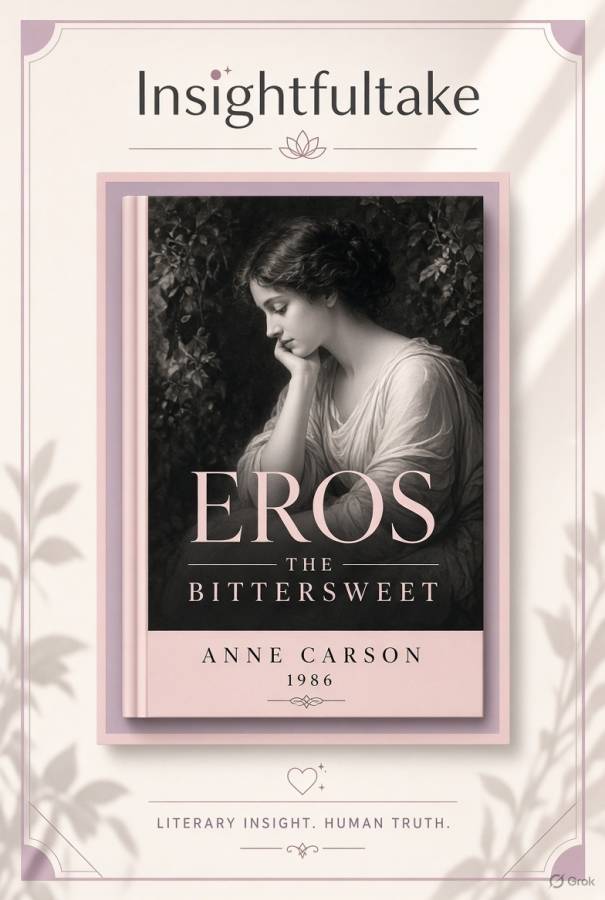
Why does desire grow stronger when something remains out of reach? Anne Carson explores the complex relationship between love, longing and distance in Eros the Bittersweet.
Desire is not simply a line between two people. It is a triangle shaped by longing, distance and the presence of what remains out of reach.
In Eros the Bittersweet, published in 1986, Canadian poet and essayist Anne Carson explores this complicated nature of love through ancient Greek literature, philosophy and language. For Carson, love is not just about two people coming together. It also depends on the distance between them, the uncertainty of desire and the awareness of something that cannot be fully possessed.
This is the central idea of her book. We do not desire only the person before us. We also desire the possibility of reaching them. The gap between two people becomes part of the attraction itself.
The Bittersweet Nature of Love
Carson begins with the Greek poet Sappho, whose word glukupikron combines two apparently opposing sensations: sweetness and bitterness. The expression captures the contradictions of desire. Love can bring pleasure and pain, hope and frustration, closeness and separation.
Carson examines these contradictions through the language and literature of ancient Greece. Her approach is both scholarly and personal. She draws on Greek poetry, Plato's Phaedrus and other intellectual traditions to explore why desire often grows stronger when fulfilment remains uncertain.
Her argument is not that love is simply an attraction to something missing. Rather, desire is shaped by the distance between the person who longs and the person or object they long for. Without that distance, the experience of wanting would change.
This idea gives the book its distinctive structure. Carson moves between ancient texts and modern thought, showing how questions about love, language and human behaviour continue to cross the boundaries of time.
The act of reading also becomes part of this exploration. A reader encounters words on a page but must use imagination, memory and interpretation to reach beyond them. Meaning does not always arrive completely formed. Sometimes, it emerges in the space between what a writer says and what a reader understands.
Anne Carson's Distinctive Literary Style
Reading Anne Carson means entering a world where classical scholarship meets contemporary life. Her writing is intellectually demanding, but it rarely follows the conventional boundaries of academic criticism or creative literature.
Several features distinguish her work.
1. Ancient literature in conversation with the present
Carson treats the ancient world as a living source of ideas rather than a collection of historical artefacts. Greek poets and philosophers remain relevant because their concerns, including desire, grief, violence and loss, are still part of human experience.
She brings old texts into conversation with modern literature and contemporary ways of thinking. The result is not simply a retelling of classical works but a fresh examination of what they can mean today.
2. A refusal to follow conventional genres
Carson moves freely between poetry, essays, translation, criticism and narrative. Her work often resists easy classification.
Autobiography of Red, for example, reimagines the Greek myth of Geryon through an unusual blend of poetry, fiction and coming-of-age narrative. Nox, her book about the death of her brother, combines fragments of writing, photographs, translations and personal recollection.
These works show how the form of a book can become part of its meaning. Carson does not always ask a story to fit an established structure. She allows the structure to develop from the subject itself.
3. The power of silence and omission
Carson understands that meaning does not depend entirely on what is written. Gaps, fragments and unfinished thoughts can carry their own emotional force.
Her writing often leaves room for readers to make connections rather than explaining every idea. This approach demands attention, but it also makes reading an active experience. The reader must participate in the creation of meaning.
4. Scholarship with a sharp sense of humour
Carson's academic background gives her a deep understanding of Greek language and literature. Yet her work is not limited to formal scholarship.
She combines close textual analysis with irony, unexpected comparisons and dry humour. This mixture allows her to examine complex ideas without losing sight of the absurdities and contradictions of human life.
Why Anne Carson Matters to Contemporary Literature
Carson's importance lies in her ability to bring intellectual inquiry and emotional experience together without reducing one to the other.
Her engagement with classical literature challenges the idea that ancient texts belong only in universities or specialist discussions. She shows how Greek poetry and mythology can illuminate experiences that remain familiar today.
Her experiments with form have also expanded the possibilities of contemporary writing. A book can move between poetry and prose, combine personal memory with scholarship or use its physical design to express the difficulty of remembering and mourning.
At the same time, Carson's work resists easy conclusions. She does not offer a simple formula for understanding love or loss. Instead, she examines the tensions within these experiences and allows their contradictions to remain visible.
That balance between intellectual rigour and emotional depth is central to her achievement. Her writing asks readers to think carefully, but it also reminds them that ideas matter because they help us understand the lives we lead.
The Space Between Two People
The enduring appeal of Eros the Bittersweet lies in its examination of a familiar but difficult question: why does desire so often become more intense when something remains beyond our reach?
Carson's answer begins with distance. Two people do not become one simply because they love each other. They remain separate individuals, and that separation shapes their longing, their imagination and their understanding of one another.
The space between them is not merely an obstacle. It is also where anticipation, uncertainty and possibility take shape.
The same tension runs through Carson's writing. Her work occupies the space between ancient and modern literature, scholarship and art, language and silence. She brings these worlds together without erasing their differences.
In Eros the Bittersweet, desire becomes a way of thinking about the limits of human connection. We reach towards others, knowing that complete understanding or possession may remain impossible.
Perhaps that is why the book continues to resonate. Love is not only about what we find. It is also about what we seek, what we imagine and what remains just beyond our grasp.
Desire is not simply a line between two people. It is a triangle shaped by longing, distance and the presence of what remains out of reach.
In Eros the Bittersweet, published in 1986, Canadian poet and essayist Anne Carson explores this complicated nature of love through ancient Greek literature, philosophy and language. For Carson, love is not just about two people coming together. It also depends on the distance between them, the uncertainty of desire and the awareness of something that cannot be fully possessed.
This is the central idea of her book. We do not desire only the person before us. We also desire the possibility of reaching them. The gap between two people becomes part of the attraction itself.
The Bittersweet Nature of Love
Carson begins with the Greek poet Sappho, whose word glukupikron combines two apparently opposing sensations: sweetness and bitterness. The expression captures the contradictions of desire. Love can bring pleasure and pain, hope and frustration, closeness and separation.
Carson examines these contradictions through the language and literature of ancient Greece. Her approach is both scholarly and personal. She draws on Greek poetry, Plato's Phaedrus and other intellectual traditions to explore why desire often grows stronger when fulfilment remains uncertain.
Her argument is not that love is simply an attraction to something missing. Rather, desire is shaped by the distance between the person who longs and the person or object they long for. Without that distance, the experience of wanting would change.
This idea gives the book its distinctive structure. Carson moves between ancient texts and modern thought, showing how questions about love, language and human behaviour continue to cross the boundaries of time.
The act of reading also becomes part of this exploration. A reader encounters words on a page but must use imagination, memory and interpretation to reach beyond them. Meaning does not always arrive completely formed. Sometimes, it emerges in the space between what a writer says and what a reader understands.
Anne Carson's Distinctive Literary Style
Reading Anne Carson means entering a world where classical scholarship meets contemporary life. Her writing is intellectually demanding, but it rarely follows the conventional boundaries of academic criticism or creative literature.
Several features distinguish her work.
1. Ancient literature in conversation with the present
Carson treats the ancient world as a living source of ideas rather than a collection of historical artefacts. Greek poets and philosophers remain relevant because their concerns, including desire, grief, violence and loss, are still part of human experience.
She brings old texts into conversation with modern literature and contemporary ways of thinking. The result is not simply a retelling of classical works but a fresh examination of what they can mean today.
2. A refusal to follow conventional genres
Carson moves freely between poetry, essays, translation, criticism and narrative. Her work often resists easy classification.
Autobiography of Red, for example, reimagines the Greek myth of Geryon through an unusual blend of poetry, fiction and coming-of-age narrative. Nox, her book about the death of her brother, combines fragments of writing, photographs, translations and personal recollection.
These works show how the form of a book can become part of its meaning. Carson does not always ask a story to fit an established structure. She allows the structure to develop from the subject itself.
3. The power of silence and omission
Carson understands that meaning does not depend entirely on what is written. Gaps, fragments and unfinished thoughts can carry their own emotional force.
Her writing often leaves room for readers to make connections rather than explaining every idea. This approach demands attention, but it also makes reading an active experience. The reader must participate in the creation of meaning.
4. Scholarship with a sharp sense of humour
Carson's academic background gives her a deep understanding of Greek language and literature. Yet her work is not limited to formal scholarship.
She combines close textual analysis with irony, unexpected comparisons and dry humour. This mixture allows her to examine complex ideas without losing sight of the absurdities and contradictions of human life.
Why Anne Carson Matters to Contemporary Literature
Carson's importance lies in her ability to bring intellectual inquiry and emotional experience together without reducing one to the other.
Her engagement with classical literature challenges the idea that ancient texts belong only in universities or specialist discussions. She shows how Greek poetry and mythology can illuminate experiences that remain familiar today.
Her experiments with form have also expanded the possibilities of contemporary writing. A book can move between poetry and prose, combine personal memory with scholarship or use its physical design to express the difficulty of remembering and mourning.
At the same time, Carson's work resists easy conclusions. She does not offer a simple formula for understanding love or loss. Instead, she examines the tensions within these experiences and allows their contradictions to remain visible.
That balance between intellectual rigour and emotional depth is central to her achievement. Her writing asks readers to think carefully, but it also reminds them that ideas matter because they help us understand the lives we lead.
The Space Between Two People
The enduring appeal of Eros the Bittersweet lies in its examination of a familiar but difficult question: why does desire so often become more intense when something remains beyond our reach?
Carson's answer begins with distance. Two people do not become one simply because they love each other. They remain separate individuals, and that separation shapes their longing, their imagination and their understanding of one another.
The space between them is not merely an obstacle. It is also where anticipation, uncertainty and possibility take shape.
The same tension runs through Carson's writing. Her work occupies the space between ancient and modern literature, scholarship and art, language and silence. She brings these worlds together without erasing their differences.
In Eros the Bittersweet, desire becomes a way of thinking about the limits of human connection. We reach towards others, knowing that complete understanding or possession may remain impossible.
Perhaps that is why the book continues to resonate. Love is not only about what we find. It is also about what we seek, what we imagine and what remains just beyond our grasp.























Leave a Comment