
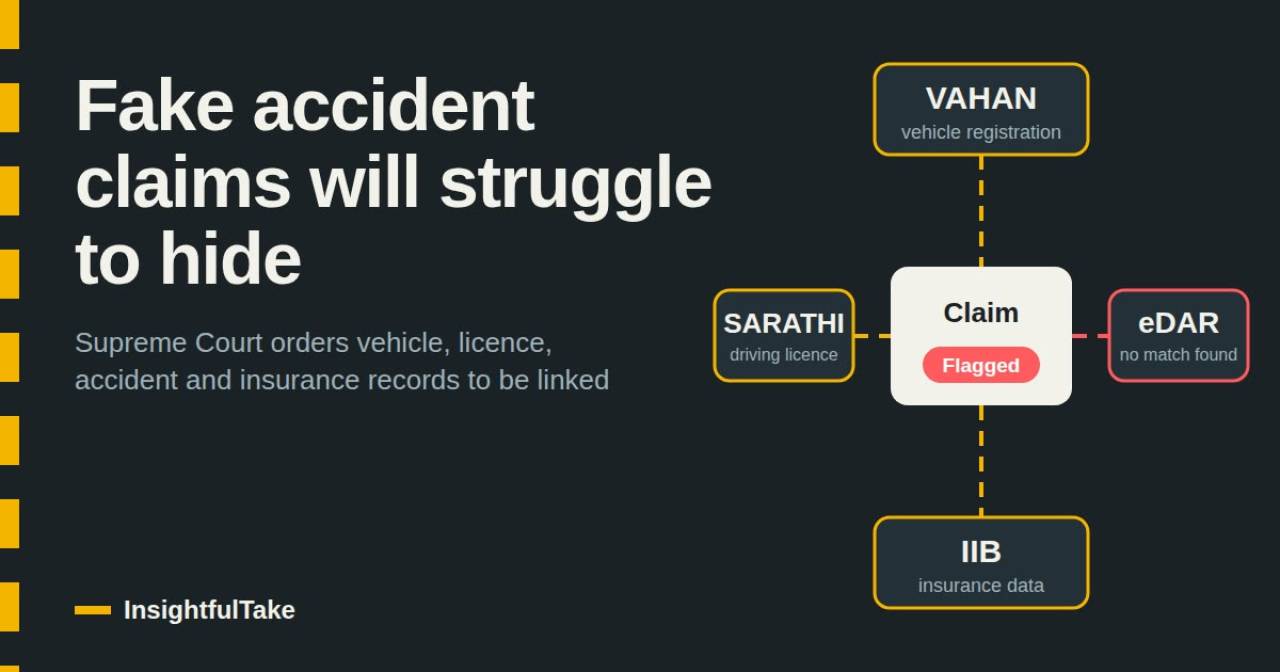
Four databases could soon work as one to expose suspicious accident claims, hold insurers accountable and help genuine victims receive compensation faster.
Every road accident leaves a trail of records, from police reports and vehicle registrations to driving licences and insurance policies. But these records often sit in separate systems and are not routinely checked against one another. The Supreme Court now wants that to change, directing the Centre and states to connect these databases to help detect fraudulent motor accident claims and speed up compensation for genuine victims.
What the Court Has Ordered
A bench of Justices Ahsanuddin Amanullah and PB Varale has directed all states to upload road accident data to the Electronic Detailed Accident Report (eDAR) portal without delay. Managed by the National Informatics Centre, the portal is used in motor accident compensation proceedings.
The court observed that only a few states had begun uploading the required data.
The proposed system will link four databases: VAHAN, which maintains vehicle registration records; SARATHI, which holds driving licence details; eDAR, which stores digital accident reports; and the Insurance Information Bureau, which maintains insurance-related data.
The portals of the concerned ministries must also be connected. The integrated system is expected to cover hit-and-run cases and the PM-RAHAT cashless treatment scheme, allowing insurers to receive early alerts about accidents.
The Centre, states and other authorities have been given four weeks to file compliance reports.
How Linked Records Could Expose Fake Claims
Motor accident claims rely on documents and records that must establish the circumstances of an accident and the basis for compensation. When information remains scattered across separate databases, inconsistencies may be harder to detect.
Linking the four systems would allow authorities to compare accident reports with vehicle registration details, driving licences, insurance policies and other relevant records.
For example, repeated claims involving the same vehicle in unrelated accidents could raise a warning. A claim that lacks a corresponding accident report in eDAR could also require closer examination.
Such discrepancies would not automatically prove fraud, but they could help investigators identify suspicious cases for further scrutiny.
Insurers Face Greater Accountability
The court's directions extend beyond technology. Insurers have been asked to refer every claim that raises suspicion of fraud to the state special investigation teams (SITs). The bench cautioned against a "pick and choose" approach, making it clear that insurers cannot selectively report cases.
Insurance companies must also examine whether their own employees were involved in or assisted fraudulent claims. States that have not constituted SITs have been given a final four-week deadline to do so.
The bench also expressed concern over delays in complying with earlier directions. It issued contempt show-cause notices to several insurance companies.
One notice was issued to Vaibhav Goyal, managing director and chief executive of Navi General Insurance. The company told the court that a Supreme Court notice received on April 18 had not reached its officers and that those responsible had been suspended.
The court described the apology as "cosmetic and not heartfelt" and directed Goyal to file a personal affidavit explaining why contempt proceedings should not be initiated.
Notices were also issued to New India Assurance, Zuno General Insurance and GIC Re.
Zuno's chief executive, Shubhdarshini Ghosh, was given a final opportunity to submit a fresh affidavit after the court rejected her explanation that pre-scheduled commitments in Mumbai had prevented her from appearing. She must appear in person at the next hearing on November 27.
Why This Matters to Accident Victims
For a family dealing with a death, serious injury or mounting hospital bills after a road accident, compensation can be essential to meeting immediate expenses and rebuilding their lives.
Fraudulent claims can place an additional burden on the verification process. When investigators and insurers have to examine more doubtful cases, genuine claimants may face further delays.
A connected database could help authorities verify essential details more quickly, making it easier to identify claims that have consistent supporting records. Early accident alerts could also help insurers initiate the process for cashless treatment sooner.
However, faster verification will depend on accurate records, timely data entry and effective coordination between police departments, state authorities and insurers. Linking databases alone cannot guarantee quicker compensation.
Data Protection and Implementation Remain Key Concerns
The proposed system faces two important challenges.
The first is implementation. Since the system depends on participation by states and other authorities, incomplete data could leave gaps in verification. If records are missing or outdated, suspicious claims may escape detection while genuine claims could face unnecessary scrutiny.
The second concern is data protection. Linking databases will allow information about vehicles, drivers, accidents and insurance policies to be accessed across a wider network of systems. Clear safeguards will be needed to define who can access the information, how it can be used and how unauthorised access will be prevented.
These questions will require attention as the system develops.
Final Take
The Supreme Court's directions treat fraudulent motor accident claims as a problem that requires coordination across institutions rather than isolated action against individual claimants. They also put pressure on insurers and state authorities to demonstrate that they are complying with the court's earlier directions.
The next steps will depend on the compliance reports due within four weeks and the proceedings scheduled for November 27.
For accident victims, the real test will be whether the connected system can detect fraud without creating fresh hurdles for genuine claimants. Better coordination between police, transport authorities and insurers could make verification more reliable, but timely compensation will ultimately depend on how effectively the directions are implemented.
Every road accident leaves a trail of records, from police reports and vehicle registrations to driving licences and insurance policies. But these records often sit in separate systems and are not routinely checked against one another. The Supreme Court now wants that to change, directing the Centre and states to connect these databases to help detect fraudulent motor accident claims and speed up compensation for genuine victims.
What the Court Has Ordered
A bench of Justices Ahsanuddin Amanullah and PB Varale has directed all states to upload road accident data to the Electronic Detailed Accident Report (eDAR) portal without delay. Managed by the National Informatics Centre, the portal is used in motor accident compensation proceedings.
The court observed that only a few states had begun uploading the required data.
The proposed system will link four databases: VAHAN, which maintains vehicle registration records; SARATHI, which holds driving licence details; eDAR, which stores digital accident reports; and the Insurance Information Bureau, which maintains insurance-related data.
The portals of the concerned ministries must also be connected. The integrated system is expected to cover hit-and-run cases and the PM-RAHAT cashless treatment scheme, allowing insurers to receive early alerts about accidents.
The Centre, states and other authorities have been given four weeks to file compliance reports.
How Linked Records Could Expose Fake Claims
Motor accident claims rely on documents and records that must establish the circumstances of an accident and the basis for compensation. When information remains scattered across separate databases, inconsistencies may be harder to detect.
Linking the four systems would allow authorities to compare accident reports with vehicle registration details, driving licences, insurance policies and other relevant records.
For example, repeated claims involving the same vehicle in unrelated accidents could raise a warning. A claim that lacks a corresponding accident report in eDAR could also require closer examination.
Such discrepancies would not automatically prove fraud, but they could help investigators identify suspicious cases for further scrutiny.
Insurers Face Greater Accountability
The court's directions extend beyond technology. Insurers have been asked to refer every claim that raises suspicion of fraud to the state special investigation teams (SITs). The bench cautioned against a "pick and choose" approach, making it clear that insurers cannot selectively report cases.
Insurance companies must also examine whether their own employees were involved in or assisted fraudulent claims. States that have not constituted SITs have been given a final four-week deadline to do so.
The bench also expressed concern over delays in complying with earlier directions. It issued contempt show-cause notices to several insurance companies.
One notice was issued to Vaibhav Goyal, managing director and chief executive of Navi General Insurance. The company told the court that a Supreme Court notice received on April 18 had not reached its officers and that those responsible had been suspended.
The court described the apology as "cosmetic and not heartfelt" and directed Goyal to file a personal affidavit explaining why contempt proceedings should not be initiated.
Notices were also issued to New India Assurance, Zuno General Insurance and GIC Re.
Zuno's chief executive, Shubhdarshini Ghosh, was given a final opportunity to submit a fresh affidavit after the court rejected her explanation that pre-scheduled commitments in Mumbai had prevented her from appearing. She must appear in person at the next hearing on November 27.
Why This Matters to Accident Victims
For a family dealing with a death, serious injury or mounting hospital bills after a road accident, compensation can be essential to meeting immediate expenses and rebuilding their lives.
Fraudulent claims can place an additional burden on the verification process. When investigators and insurers have to examine more doubtful cases, genuine claimants may face further delays.
A connected database could help authorities verify essential details more quickly, making it easier to identify claims that have consistent supporting records. Early accident alerts could also help insurers initiate the process for cashless treatment sooner.
However, faster verification will depend on accurate records, timely data entry and effective coordination between police departments, state authorities and insurers. Linking databases alone cannot guarantee quicker compensation.
Data Protection and Implementation Remain Key Concerns
The proposed system faces two important challenges.
The first is implementation. Since the system depends on participation by states and other authorities, incomplete data could leave gaps in verification. If records are missing or outdated, suspicious claims may escape detection while genuine claims could face unnecessary scrutiny.
The second concern is data protection. Linking databases will allow information about vehicles, drivers, accidents and insurance policies to be accessed across a wider network of systems. Clear safeguards will be needed to define who can access the information, how it can be used and how unauthorised access will be prevented.
These questions will require attention as the system develops.
Final Take
The Supreme Court's directions treat fraudulent motor accident claims as a problem that requires coordination across institutions rather than isolated action against individual claimants. They also put pressure on insurers and state authorities to demonstrate that they are complying with the court's earlier directions.
The next steps will depend on the compliance reports due within four weeks and the proceedings scheduled for November 27.
For accident victims, the real test will be whether the connected system can detect fraud without creating fresh hurdles for genuine claimants. Better coordination between police, transport authorities and insurers could make verification more reliable, but timely compensation will ultimately depend on how effectively the directions are implemented.














Leave a Comment