
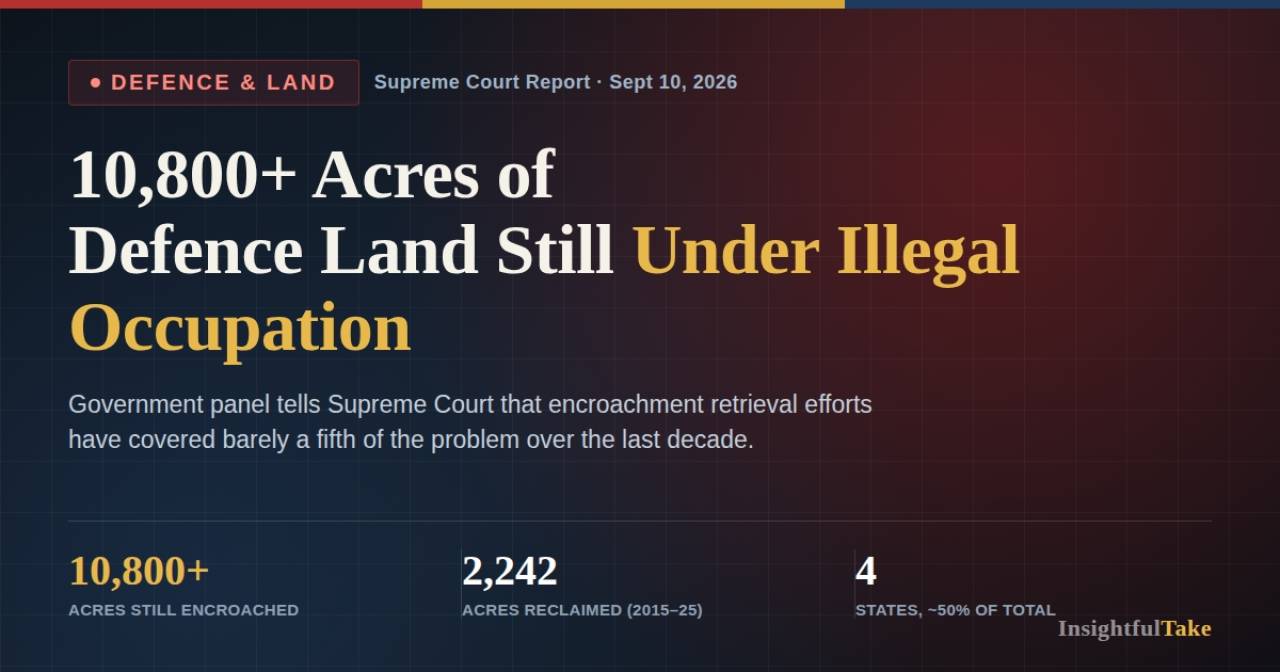
More than 10,800 acres of defence land remain under illegal occupation. A Supreme Court case now puts the focus on how and when the government will reclaim it.
More than 10,800 acres of defence land across India remain under illegal occupation, even after authorities reclaimed over 2,200 acres during the past decade, according to a report submitted to the Supreme Court.
The findings have brought renewed attention to a long-running problem involving defence land management, encroachment and coordination between central and state authorities.
Where the Report Came From
The report was prepared by the Independent Committee on Issues of Defence Land Management, a four-member panel constituted by the Ministry of Defence on July 14, 2025.
The committee was tasked with examining the problem of encroachment on defence land and recommending measures for its recovery and better management.
The issue has been flagged in earlier reports of the Comptroller and Auditor General of India (CAG) as well. The latest proceedings followed a Public Interest Litigation (PIL) filed by the non-profit organisation Common Cause, which sought stronger action against illegal occupation of defence land.
The committee submitted its report to the Supreme Court on September 10. A bench headed by Chief Justice of India Surya Kant was scheduled to consider the matter on September 15.
More Than 10,800 Acres Under Encroachment
According to the committee, defence authorities reclaimed 2,242 acres of encroached land between January 1, 2015 and July 2025.
However, more than 10,800 acres remain under illegal occupation.
The encroached land is distributed across different defence establishments:
- Directorate General Defence Estates (DGDE): 4,299 acres
- Indian Army: 4,153 acres
- Indian Air Force: 1,739 acres
- Indian Navy: 546 acres
The figures show that the problem extends well beyond individual cantonments and involves large areas administered through different defence authorities.
Four States Account for Nearly Half
The problem is particularly concentrated in Madhya Pradesh, Uttar Pradesh, West Bengal and Maharashtra.
Together, these four states account for nearly 5,800 acres of encroached defence land, or roughly half of the total identified by the committee.
The Centre had also shared similar figures with Parliament in December 2025, underlining that the problem has remained substantial despite years of efforts to recover defence property.
Why Recovery Has Been Difficult
One of the major difficulties identified by the committee is the location of much of the encroached land.
Several parcels lie outside cantonment areas, limiting the ability of Defence Estates Officers (DEOs) to act independently. Recovering such land often requires coordination with state governments, municipal authorities and the police.
The committee referred to the “operational impediments” faced by Defence Estates Officers while dealing with encroachments. The level of assistance from local authorities also differs from one location to another.
This makes land recovery more than a question of issuing eviction notices. It often involves multiple government agencies, local administration and law-enforcement machinery.
What the Committee Has Recommended
The panel has called for a “comprehensive and effective mechanism” to recover encroached defence land.
Its recommendations include stronger coordination between the Centre and state governments, along with clearly defined timelines for recovering occupied land.
The committee has also called for a broader, coordinated and time-bound strategy to address the underlying causes of encroachment instead of handling individual cases in isolation.
Two senior officials associated with the committee, Jay Prakash Dubey and Sarvadanand Baranwal, Director in the Department of Land Resources, reportedly highlighted gaps in the existing approach to removing encroachments.
Why Defence Land Matters
Defence land is used for purposes ranging from military training and storage to accommodation, infrastructure and other facilities connected with national security.
Large-scale encroachment can therefore create problems beyond property management. It can restrict the availability of land for future requirements, complicate planning and potentially affect the functioning of defence establishments.
The Supreme Court's examination of the committee's report could now bring greater scrutiny to how quickly and effectively the government acts on the recommendations.
The central question is not simply how much defence land has been encroached upon. It is whether the government can establish a clear, coordinated and enforceable process to recover it.
With more than 10,800 acres still identified as illegally occupied, the challenge is substantial. The next phase will depend on how the Centre, state governments and local authorities respond to the committee's recommendations.
More than 10,800 acres of defence land across India remain under illegal occupation, even after authorities reclaimed over 2,200 acres during the past decade, according to a report submitted to the Supreme Court.
The findings have brought renewed attention to a long-running problem involving defence land management, encroachment and coordination between central and state authorities.
Where the Report Came From
The report was prepared by the Independent Committee on Issues of Defence Land Management, a four-member panel constituted by the Ministry of Defence on July 14, 2025.
The committee was tasked with examining the problem of encroachment on defence land and recommending measures for its recovery and better management.
The issue has been flagged in earlier reports of the Comptroller and Auditor General of India (CAG) as well. The latest proceedings followed a Public Interest Litigation (PIL) filed by the non-profit organisation Common Cause, which sought stronger action against illegal occupation of defence land.
The committee submitted its report to the Supreme Court on September 10. A bench headed by Chief Justice of India Surya Kant was scheduled to consider the matter on September 15.
More Than 10,800 Acres Under Encroachment
According to the committee, defence authorities reclaimed 2,242 acres of encroached land between January 1, 2015 and July 2025.
However, more than 10,800 acres remain under illegal occupation.
The encroached land is distributed across different defence establishments:
- Directorate General Defence Estates (DGDE): 4,299 acres
- Indian Army: 4,153 acres
- Indian Air Force: 1,739 acres
- Indian Navy: 546 acres
The figures show that the problem extends well beyond individual cantonments and involves large areas administered through different defence authorities.
Four States Account for Nearly Half
The problem is particularly concentrated in Madhya Pradesh, Uttar Pradesh, West Bengal and Maharashtra.
Together, these four states account for nearly 5,800 acres of encroached defence land, or roughly half of the total identified by the committee.
The Centre had also shared similar figures with Parliament in December 2025, underlining that the problem has remained substantial despite years of efforts to recover defence property.
Why Recovery Has Been Difficult
One of the major difficulties identified by the committee is the location of much of the encroached land.
Several parcels lie outside cantonment areas, limiting the ability of Defence Estates Officers (DEOs) to act independently. Recovering such land often requires coordination with state governments, municipal authorities and the police.
The committee referred to the “operational impediments” faced by Defence Estates Officers while dealing with encroachments. The level of assistance from local authorities also differs from one location to another.
This makes land recovery more than a question of issuing eviction notices. It often involves multiple government agencies, local administration and law-enforcement machinery.
What the Committee Has Recommended
The panel has called for a “comprehensive and effective mechanism” to recover encroached defence land.
Its recommendations include stronger coordination between the Centre and state governments, along with clearly defined timelines for recovering occupied land.
The committee has also called for a broader, coordinated and time-bound strategy to address the underlying causes of encroachment instead of handling individual cases in isolation.
Two senior officials associated with the committee, Jay Prakash Dubey and Sarvadanand Baranwal, Director in the Department of Land Resources, reportedly highlighted gaps in the existing approach to removing encroachments.
Why Defence Land Matters
Defence land is used for purposes ranging from military training and storage to accommodation, infrastructure and other facilities connected with national security.
Large-scale encroachment can therefore create problems beyond property management. It can restrict the availability of land for future requirements, complicate planning and potentially affect the functioning of defence establishments.
The Supreme Court's examination of the committee's report could now bring greater scrutiny to how quickly and effectively the government acts on the recommendations.
The central question is not simply how much defence land has been encroached upon. It is whether the government can establish a clear, coordinated and enforceable process to recover it.
With more than 10,800 acres still identified as illegally occupied, the challenge is substantial. The next phase will depend on how the Centre, state governments and local authorities respond to the committee's recommendations.

























Leave a Comment