
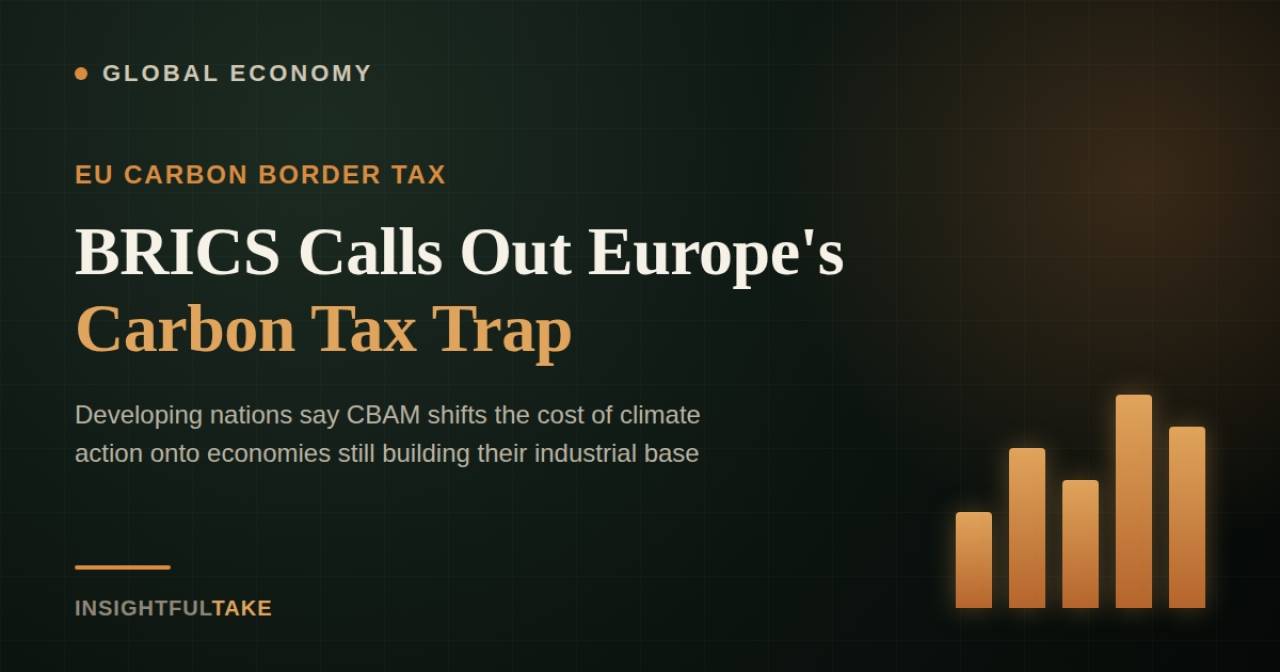
Europe calls it climate protection. BRICS countries see a trade rule that could make the Global South pay more for a crisis it did not create alone.
BRICS countries have formally opposed the European Union's Carbon Border Adjustment Mechanism (CBAM), arguing that the policy shifts the cost of climate action onto nations that have contributed comparatively less to the historical accumulation of greenhouse-gas emissions.
The declaration, issued in New Delhi under India's 2026 chairship of the grouping, marks a strong collective objection from emerging economies to a climate policy designed in Brussels.
How the EU's Carbon Border Tax Works
At the centre of the dispute is a relatively simple but consequential mechanism.
Since January 1, 2026, EU importers of carbon-intensive products such as iron and steel, aluminium, cement, fertilisers, hydrogen and electricity have been required to account for the emissions embedded in those goods through CBAM certificates.
If a comparable carbon price has already been paid in the country of origin, that amount can be taken into account. Where it has not, the importer faces the corresponding CBAM cost.
The European Union presents the system as a way to prevent "carbon leakage", where production could shift to countries with weaker emissions rules simply to avoid the higher costs associated with climate policies in Europe.
BRICS countries, however, argue that the mechanism places an additional burden on developing economies.
Why Developing Economies Object
The BRICS declaration described unilateral measures of this kind as discriminatory and inconsistent with international law. It also warned that such policies could weaken the ability of developing countries to adapt to climate change and build resilience against its effects.
The grouping includes India, China, Brazil, Russia, South Africa, Egypt, Ethiopia, Indonesia, Iran, Saudi Arabia and the UAE.
Alongside its criticism of trade-related climate measures, the declaration reaffirmed cooperation on disaster risk reduction and welcomed new guidelines for early-warning data sharing among member and partner countries.
The broader message is that climate adaptation cannot be separated from questions of trade, finance and development.
The Development Gap Behind the Carbon Dispute
The economic argument behind the BRICS position is closely linked to the different stages of industrial development across countries.
India and China, for example, are major producers and exporters of steel, aluminium and other industrial goods covered by CBAM. Their manufacturing systems also remain more dependent on coal-intensive power than those of many European economies.
European industries have had a much longer period to invest in cleaner energy systems and industrial technologies. Developing economies argue that imposing an emissions-based cost on their exports without sufficiently accounting for these different starting points can turn the climate transition into a trade disadvantage.
The dispute, therefore, is not only about the price attached to a tonne of carbon.
It is also about whether countries should face similar climate-related trade costs when their levels of development, historical emissions and access to finance are markedly different.
Who Should Pay for the Climate Transition?
This is where the BRICS objection becomes part of a much larger climate debate.
Developing countries have long argued for the principle of differentiated responsibilities. The argument is that countries that industrialised earlier and contributed more to the historical accumulation of greenhouse-gas emissions should shoulder a greater share of the cost of the global transition.
CBAM applies a carbon-related cost when goods enter the European market. Critics in the developing world argue that this approach does not adequately reflect differences in historical responsibility or development needs.
For them, the concern is that climate policy could increasingly operate through trade rules designed by wealthy economies, leaving exporters in developing countries to absorb costs over which they had limited influence.
Climate Finance Is Part of the Same Argument
The BRICS declaration also highlighted the financial imbalance surrounding climate adaptation.
Developing economies face substantial costs from floods, droughts, extreme heat, storms and other climate-related risks, while their access to affordable long-term climate finance remains more limited than that of wealthier economies.
BRICS members called for stronger multilateral platforms and greater support for risk-informed planning.
The declaration also referred to work on optimising sustainable and green finance through central banks, with the broader objective of improving access to financing for climate adaptation and the green transition.
The argument is straightforward: if developing countries are expected to decarbonise while also adapting to climate impacts, the financing architecture must account for their different economic capacities.
Fossil Fuels and the Pace of Transition
There is another important dimension to the BRICS position.
Member countries reaffirmed their commitments under the Paris Agreement while continuing to emphasise national circumstances and different pathways towards the energy transition.
For many developing economies, fossil fuels remain an important part of the energy mix because of rising electricity demand, industrialisation and the need for affordable and reliable power.
That position does not necessarily amount to rejecting climate goals. Instead, it reflects a disagreement over the pace and sequencing of the transition.
The BRICS argument is that countries should have greater control over how quickly they move away from fossil fuels, particularly when their energy systems and development needs differ significantly from those of advanced economies.
Why CBAM Matters to India
For India, the issue has direct economic consequences.
Indian exporters of CBAM-covered products face additional compliance requirements and potential costs when selling into the European market. New Delhi has opposed the mechanism since its development, arguing that it can add pressure on industries operating within a carbon-intensive energy system.
The BRICS declaration gives India's position a broader diplomatic platform by placing the issue within a collective developing-country argument about trade, climate responsibility and access to finance.
But the declaration does not resolve the dispute with Brussels.
The EU has continued with CBAM, while other economies are also considering or developing carbon-related trade measures. The United Kingdom and Australia, for instance, have been moving towards their own approaches to addressing the carbon content of imports.
That points to a wider question for global trade.
If more economies begin using carbon-related border measures, exporters in developing countries could face an increasingly complicated patchwork of climate-linked trade rules.
Final Take
The CBAM dispute ultimately goes beyond one European policy.
It raises a fundamental question about who sets the rules for the global climate transition and who pays when those rules reshape international trade.
Europe sees carbon border measures as a tool to prevent carbon leakage and protect the integrity of its climate policy. BRICS countries see a risk that such measures could transfer part of the cost of the transition onto developing economies.
Both positions are rooted in different understandings of fairness.
The emerging debate will therefore not be settled simply by determining whether carbon should have a price. It will also depend on how historical responsibility, development needs, climate finance and the realities of energy transitions are reflected in the rules governing global trade.
BRICS countries have formally opposed the European Union's Carbon Border Adjustment Mechanism (CBAM), arguing that the policy shifts the cost of climate action onto nations that have contributed comparatively less to the historical accumulation of greenhouse-gas emissions.
The declaration, issued in New Delhi under India's 2026 chairship of the grouping, marks a strong collective objection from emerging economies to a climate policy designed in Brussels.
How the EU's Carbon Border Tax Works
At the centre of the dispute is a relatively simple but consequential mechanism.
Since January 1, 2026, EU importers of carbon-intensive products such as iron and steel, aluminium, cement, fertilisers, hydrogen and electricity have been required to account for the emissions embedded in those goods through CBAM certificates.
If a comparable carbon price has already been paid in the country of origin, that amount can be taken into account. Where it has not, the importer faces the corresponding CBAM cost.
The European Union presents the system as a way to prevent "carbon leakage", where production could shift to countries with weaker emissions rules simply to avoid the higher costs associated with climate policies in Europe.
BRICS countries, however, argue that the mechanism places an additional burden on developing economies.
Why Developing Economies Object
The BRICS declaration described unilateral measures of this kind as discriminatory and inconsistent with international law. It also warned that such policies could weaken the ability of developing countries to adapt to climate change and build resilience against its effects.
The grouping includes India, China, Brazil, Russia, South Africa, Egypt, Ethiopia, Indonesia, Iran, Saudi Arabia and the UAE.
Alongside its criticism of trade-related climate measures, the declaration reaffirmed cooperation on disaster risk reduction and welcomed new guidelines for early-warning data sharing among member and partner countries.
The broader message is that climate adaptation cannot be separated from questions of trade, finance and development.
The Development Gap Behind the Carbon Dispute
The economic argument behind the BRICS position is closely linked to the different stages of industrial development across countries.
India and China, for example, are major producers and exporters of steel, aluminium and other industrial goods covered by CBAM. Their manufacturing systems also remain more dependent on coal-intensive power than those of many European economies.
European industries have had a much longer period to invest in cleaner energy systems and industrial technologies. Developing economies argue that imposing an emissions-based cost on their exports without sufficiently accounting for these different starting points can turn the climate transition into a trade disadvantage.
The dispute, therefore, is not only about the price attached to a tonne of carbon.
It is also about whether countries should face similar climate-related trade costs when their levels of development, historical emissions and access to finance are markedly different.
Who Should Pay for the Climate Transition?
This is where the BRICS objection becomes part of a much larger climate debate.
Developing countries have long argued for the principle of differentiated responsibilities. The argument is that countries that industrialised earlier and contributed more to the historical accumulation of greenhouse-gas emissions should shoulder a greater share of the cost of the global transition.
CBAM applies a carbon-related cost when goods enter the European market. Critics in the developing world argue that this approach does not adequately reflect differences in historical responsibility or development needs.
For them, the concern is that climate policy could increasingly operate through trade rules designed by wealthy economies, leaving exporters in developing countries to absorb costs over which they had limited influence.
Climate Finance Is Part of the Same Argument
The BRICS declaration also highlighted the financial imbalance surrounding climate adaptation.
Developing economies face substantial costs from floods, droughts, extreme heat, storms and other climate-related risks, while their access to affordable long-term climate finance remains more limited than that of wealthier economies.
BRICS members called for stronger multilateral platforms and greater support for risk-informed planning.
The declaration also referred to work on optimising sustainable and green finance through central banks, with the broader objective of improving access to financing for climate adaptation and the green transition.
The argument is straightforward: if developing countries are expected to decarbonise while also adapting to climate impacts, the financing architecture must account for their different economic capacities.
Fossil Fuels and the Pace of Transition
There is another important dimension to the BRICS position.
Member countries reaffirmed their commitments under the Paris Agreement while continuing to emphasise national circumstances and different pathways towards the energy transition.
For many developing economies, fossil fuels remain an important part of the energy mix because of rising electricity demand, industrialisation and the need for affordable and reliable power.
That position does not necessarily amount to rejecting climate goals. Instead, it reflects a disagreement over the pace and sequencing of the transition.
The BRICS argument is that countries should have greater control over how quickly they move away from fossil fuels, particularly when their energy systems and development needs differ significantly from those of advanced economies.
Why CBAM Matters to India
For India, the issue has direct economic consequences.
Indian exporters of CBAM-covered products face additional compliance requirements and potential costs when selling into the European market. New Delhi has opposed the mechanism since its development, arguing that it can add pressure on industries operating within a carbon-intensive energy system.
The BRICS declaration gives India's position a broader diplomatic platform by placing the issue within a collective developing-country argument about trade, climate responsibility and access to finance.
But the declaration does not resolve the dispute with Brussels.
The EU has continued with CBAM, while other economies are also considering or developing carbon-related trade measures. The United Kingdom and Australia, for instance, have been moving towards their own approaches to addressing the carbon content of imports.
That points to a wider question for global trade.
If more economies begin using carbon-related border measures, exporters in developing countries could face an increasingly complicated patchwork of climate-linked trade rules.
Final Take
The CBAM dispute ultimately goes beyond one European policy.
It raises a fundamental question about who sets the rules for the global climate transition and who pays when those rules reshape international trade.
Europe sees carbon border measures as a tool to prevent carbon leakage and protect the integrity of its climate policy. BRICS countries see a risk that such measures could transfer part of the cost of the transition onto developing economies.
Both positions are rooted in different understandings of fairness.
The emerging debate will therefore not be settled simply by determining whether carbon should have a price. It will also depend on how historical responsibility, development needs, climate finance and the realities of energy transitions are reflected in the rules governing global trade.


















Leave a Comment