
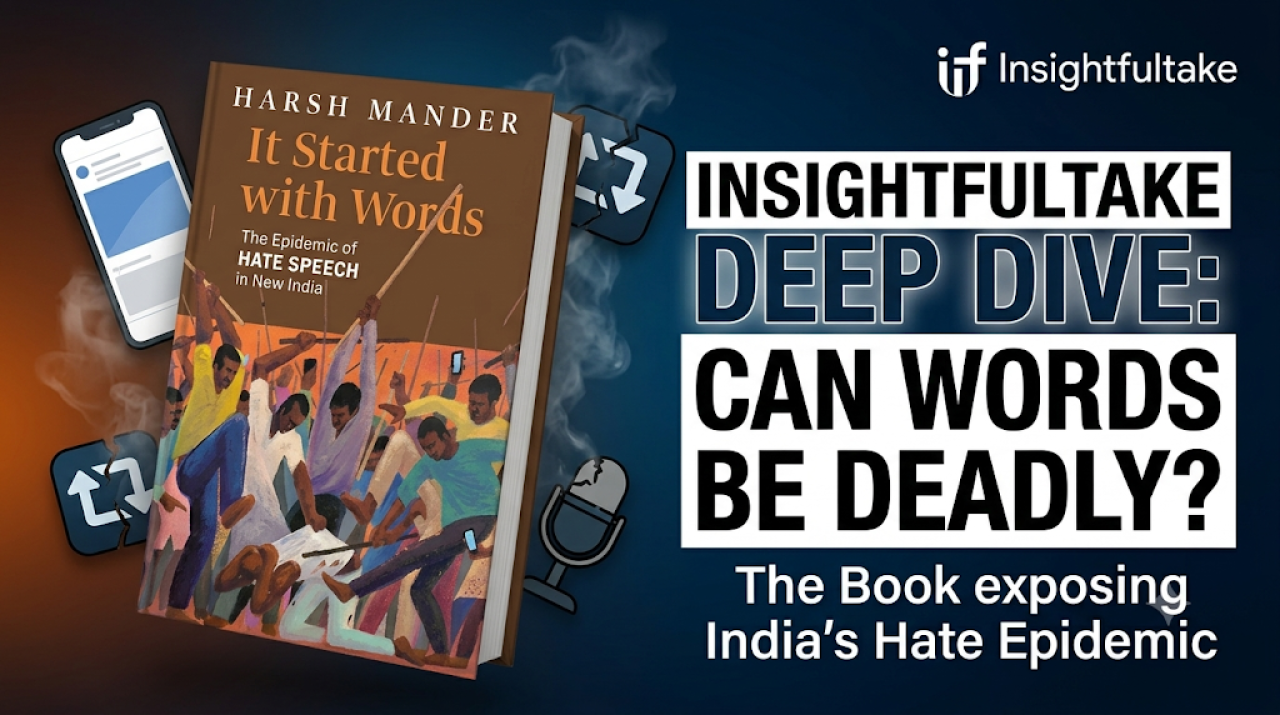
Hate does not always begin with violence. Sometimes, it begins with words repeated so often that society stops noticing them.
Hate speech rarely begins with violence. It often begins with words.
A post is shared, a video goes viral, a community is described as a threat, and a familiar prejudice is repeated often enough to start sounding like fact. In It Started with Words: The Epidemic of Hate Speech in New India, human rights activist Harsh Mander examines how such language can move from social media and public discourse into everyday discrimination, intimidation and, eventually, physical violence.
The book is not simply about abusive posts or offensive speeches. Its larger concern is what happens when hate becomes normal.
Mander looks at the changing nature of public discourse in India and asks how language that once remained at the margins can enter mainstream political and social conversation. He examines the role of political rhetoric, digital platforms, sections of the media and the wider institutional response to hate speech.
His central argument is difficult to ignore: words can prepare society for violence.
How Hate Becomes Normal
One of the strengths of the book is that Mander does not treat every hateful statement as an isolated incident. He looks at the environment in which such statements are produced and circulated.
A community is first portrayed as different. It is then presented as a threat. Repeated claims, rumours and provocative messages reinforce the image. Social media allows these messages to travel quickly, often reaching thousands or millions of people before facts can catch up.
WhatsApp groups, videos and other digital platforms have changed the speed and scale at which such narratives can spread. A false claim repeated across multiple channels can acquire the appearance of truth simply because people encounter it everywhere.
Mander is particularly concerned about what happens when this language enters political speech and public institutions. When hateful rhetoric is ignored, selectively challenged or left without consequences, it can create a sense that some forms of hostility are acceptable.
That is where the book's argument becomes more troubling. The problem is not only the person who creates a hateful message. It is also the wider environment that allows such messages to survive, spread and become part of ordinary political conversation.
From Words to Real Lives
Mander's account becomes more powerful when it moves away from the digital world and looks at people affected by communal hostility.
Behind every statistic or headline are families facing fear, economic pressure, social isolation or displacement. Hate can affect where people live, which businesses they can enter, whom they can employ and whether they feel safe in their own neighbourhoods.
The book connects these experiences with some of the major episodes of communal violence and intimidation in recent India. Mander draws upon his own work as a civil society activist and his involvement in legal and public interventions, including those connected with the 2020 Delhi violence.
This gives the book a perspective that is different from a conventional study of social media. Mander is interested not merely in how hate spreads but in what it does to people.
The Question of Accountability
The book also raises uncomfortable questions about the institutions expected to deal with hate speech.
India already has laws dealing with incitement, threats and communal hostility. Yet enforcement can be uneven. The difficulty becomes greater when hateful material is produced anonymously, shared repeatedly and distributed across networks that have no obvious centre.
Who should be held responsible when a false or inflammatory message reaches thousands of people? The original creator? The person who forwards it? The platform? A political organisation that uses the narrative? Or institutions that fail to act despite repeated warnings?
Mander does not offer easy answers. Instead, he places these questions within the larger debate over constitutional rights, free speech and the responsibility of the state to protect citizens from violence.
Why the Book Matters
It Started with Words is ultimately a book about the consequences of allowing hatred to become ordinary.
Its warning is not that every angry post will lead to violence. Rather, Mander shows how repeated dehumanisation can change the social atmosphere in which violence becomes easier to justify.
That makes the book relevant not only to lawyers, researchers and journalists but also to anyone concerned about the quality of public debate in India.
The most important question raised by the book is also the simplest: What happens to a society when people become accustomed to hearing hatred every day?
Mander's answer is unsettling. Violence may not begin with a blow. Sometimes, it begins with words that people stop noticing.
Book: It Started with Words: The Epidemic of Hate Speech in New India
Author: Harsh Mander
Hate speech rarely begins with violence. It often begins with words.
A post is shared, a video goes viral, a community is described as a threat, and a familiar prejudice is repeated often enough to start sounding like fact. In It Started with Words: The Epidemic of Hate Speech in New India, human rights activist Harsh Mander examines how such language can move from social media and public discourse into everyday discrimination, intimidation and, eventually, physical violence.
The book is not simply about abusive posts or offensive speeches. Its larger concern is what happens when hate becomes normal.
Mander looks at the changing nature of public discourse in India and asks how language that once remained at the margins can enter mainstream political and social conversation. He examines the role of political rhetoric, digital platforms, sections of the media and the wider institutional response to hate speech.
His central argument is difficult to ignore: words can prepare society for violence.
How Hate Becomes Normal
One of the strengths of the book is that Mander does not treat every hateful statement as an isolated incident. He looks at the environment in which such statements are produced and circulated.
A community is first portrayed as different. It is then presented as a threat. Repeated claims, rumours and provocative messages reinforce the image. Social media allows these messages to travel quickly, often reaching thousands or millions of people before facts can catch up.
WhatsApp groups, videos and other digital platforms have changed the speed and scale at which such narratives can spread. A false claim repeated across multiple channels can acquire the appearance of truth simply because people encounter it everywhere.
Mander is particularly concerned about what happens when this language enters political speech and public institutions. When hateful rhetoric is ignored, selectively challenged or left without consequences, it can create a sense that some forms of hostility are acceptable.
That is where the book's argument becomes more troubling. The problem is not only the person who creates a hateful message. It is also the wider environment that allows such messages to survive, spread and become part of ordinary political conversation.
From Words to Real Lives
Mander's account becomes more powerful when it moves away from the digital world and looks at people affected by communal hostility.
Behind every statistic or headline are families facing fear, economic pressure, social isolation or displacement. Hate can affect where people live, which businesses they can enter, whom they can employ and whether they feel safe in their own neighbourhoods.
The book connects these experiences with some of the major episodes of communal violence and intimidation in recent India. Mander draws upon his own work as a civil society activist and his involvement in legal and public interventions, including those connected with the 2020 Delhi violence.
This gives the book a perspective that is different from a conventional study of social media. Mander is interested not merely in how hate spreads but in what it does to people.
The Question of Accountability
The book also raises uncomfortable questions about the institutions expected to deal with hate speech.
India already has laws dealing with incitement, threats and communal hostility. Yet enforcement can be uneven. The difficulty becomes greater when hateful material is produced anonymously, shared repeatedly and distributed across networks that have no obvious centre.
Who should be held responsible when a false or inflammatory message reaches thousands of people? The original creator? The person who forwards it? The platform? A political organisation that uses the narrative? Or institutions that fail to act despite repeated warnings?
Mander does not offer easy answers. Instead, he places these questions within the larger debate over constitutional rights, free speech and the responsibility of the state to protect citizens from violence.
Why the Book Matters
It Started with Words is ultimately a book about the consequences of allowing hatred to become ordinary.
Its warning is not that every angry post will lead to violence. Rather, Mander shows how repeated dehumanisation can change the social atmosphere in which violence becomes easier to justify.
That makes the book relevant not only to lawyers, researchers and journalists but also to anyone concerned about the quality of public debate in India.
The most important question raised by the book is also the simplest: What happens to a society when people become accustomed to hearing hatred every day?
Mander's answer is unsettling. Violence may not begin with a blow. Sometimes, it begins with words that people stop noticing.
Book: It Started with Words: The Epidemic of Hate Speech in New India
Author: Harsh Mander












Leave a Comment